Introduction
Artificial intelligence is being embedded deep into almost every industry and we are witnessing a huge technological shift. This AI revolution will change the way people work, live and invent. But further rapid progress will need massive investments in data centres, memory hardware and supporting infrastructure such as power plants and cooling systems.
This higher cost and power requirement has raised serious questions as to whether today’s electronic-based solutions can indeed keep up with the exponential growth of AI. In this sense, photonic AI and in particular photonic memory have become revolutionary solutions that promise to ease the bottlenecks of conventional electronic computing.
The Burden of Electronic AI Infrastructure
With the increasing complexity of AI use cases, the bar has been raised high for cloud computing infrastructure. Billions are being spent on electronic data centres around the world that depend on silicon-based memory, processors and huge networks. The centres need not just vast quantities of hardware but a constant flow of energy and this is driving investment in nuclear plants, renewable sources of energy and complex cooling systems.
Costs of operation and damage to the environment are continually rising, while the benefits of such capital investments have become more and more uncertain. The market has given its answer: memory prices have collapsed, and many AI stocks have plunged in value, a sign of the doubts about the sustainability of this model.
Photonics AI is on the rise.
Photonic AI is a groundbreaking method that employs photons (light particles) for computation and memory storage, as opposed to electrons. This fundamental change enables processing speeds far greater than those of today’s electronic systems. The potential is staggering: one photonic cloud AI computing centre could provide the equivalent of a thousand traditional electronic centres. This advance in the efficiency of computing not only improves performance, but greatly reduces the need for power and cooling, two of the major cost drivers in electronic infrastructure.
The recent advent of sophisticated photonic memory architectures suggests that the photonic AI revolution is upon us sooner than expected. This is a defining moment for the future of AI and will determine the direction of technological advancement for many decades ahead.
The Discovery: Photonic Memory Technology
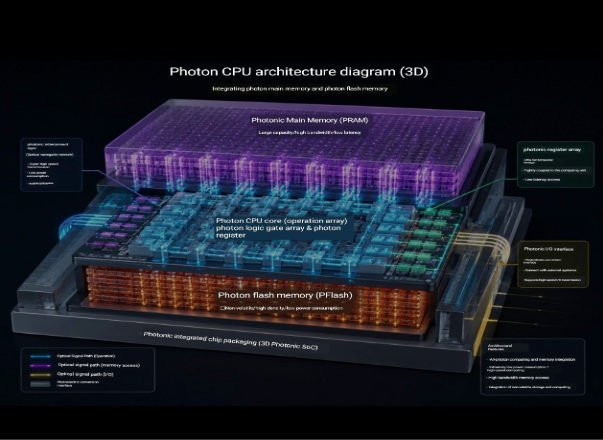
Photonic memory is the key enabling technology for the photonic AI revolution.” The resistance and capacitance of silicon circuits limit electronic memory. Photonic memory, on the other hand, exploits the fact that light can carry information at tremendous speeds. Photons travel faster than electrons, and they do not heat in the same way, which dramatically reduces energy loss. This provides for near instant storage and retrieval of data, eliminating bottlenecks typically found in traditional memory systems.
Photonic memory has been emerging based on major advances in the science and engineering of materials. To develop hardware that can manipulate and store photons, specific manufacturing techniques and specialized (often proprietary) materials are required. The result is a memory system that is faster, more scalable and energy efficient than anything else available before.
Photonic Memory Architecture to be Released
The design and development of photonic memory was classified top secret and a competitive advantage that could change the entire industry. The reason for this decision was the observation that big technology companies continue spending a lot on electronic infrastructure. Not doing so would hold back a transformative technology such as this, keeping resources in an industry looking more and more like a sunset industry.
There was a flurry of patent filings twenty years ago around cloud technology and password locks that got a lot of attention, including from the US Department of Homeland Security. Now the release of photonic memory architecture is an even bigger leap. Unlike software, innovations in hardware such as photonic memory are very hard to copy because they require sophisticated material engineering and reverse engineering skills.
It’s as complex as Japan’s photoresist technology, which has been closely guarded for decades and remains hard to reproduce. Our company’s know-how in X-photonic materials gives us an edge in this technology frontier, and a formidable barrier to entry for our intellectual property.
Industry from Secrecy to Collaboration: A New Paradigm
We know this is a challenge for other companies, going from electronic to photonic systems. So we go for transparency and partnership rather than secrecy. We have allowed participation in equity rather than forcing the industry to an expensive and inefficient conversion, especially the problem of converting optical signals back to electronic signals. Invitation to strategic partners We want to share the rewards and the responsibility of guiding the industry through this period of transformation.
We developed a hedge fund model to hedge the risks and rewards of such a huge shift. The approach links the fortunes of the industry partners together, making the transition to photonic technology collaborative and resilient. By pooling resources and expertise, companies can mitigate the risks of innovation and enjoy the rewards of a technological revolution.
Supporting Economic Development and Supply Chain.
Our vision isn’t about being the best in technology. “We are committed to help companies in the electronic industry supply chain to evolve to this new paradigm. We help our customers become manufacturing partners, to make the transition from electronic clouds to photonic clouds easier. This collaboration will help to spur economic development, new industries and opportunities for growth across the technology landscape.
Social and Economic impacts
The photonic AI revolution will reach far and wide. Photonic memory makes advanced computing more accessible and sustainable by reducing the energy and hardware requirements of AI infrastructure by orders of magnitude. This change will not only reduce environmental impacts but also create new opportunities for innovation, such as real-time data analysis, autonomous systems, and next-generation communication technologies.
“Economic benefits include jobs, a diversified industry and global competitiveness.” “Companies that move to photonic AI will have a huge advantage, and those that stay with electronics will be left behind.” The industry needs to nurture a spirit of collaboration and shared risk to ensure that the rewards of this transformation are broadly shared.
Conclusion
The start of the photonic AI revolution is the dawn of a new era in the evolution of Artificial Intelligence and cloud computing. Photonic technology breaks the limits of electronic memory and infrastructure to offer unprecedented speed, efficiency and scalability. The decision to release photonic memory architecture is a commitment to innovation, openness and shared progress. “We will change the future of technology and society as we move from electronic to photonic clouds through strategic partnerships, collaborative manufacturing and a focus on economic development.
Frequently Asked Questions
What is photonic memory, and why is it important?
Photonic memory is a data storage technology that uses light instead of electricity to store and process information. Its importance lies in its speed, efficiency, and ability to reduce energy consumption compared to traditional electronic memory.
How does photonic AI differ from electronic AI?
Photonic AI utilizes light-based hardware for computation and memory, offering much higher performance and lower energy requirements than electronic AI, which relies on electrical circuits and silicon chips.
What challenges exist in manufacturing photonic hardware?
Manufacturing photonic hardware requires specialized materials engineering and advanced manufacturing techniques. The complexity of these processes makes photonic memory much harder to replicate than software or standard electronic hardware.
How can companies participate in the photonic AI revolution?
Companies can become strategic partners through equity participation, manufacturing collaborations, or by joining the hedge fund model designed to share risks and rewards during the technological transition.
What is the expected impact of photonic AI on the tech industry?
Photonic AI is expected to drive greater efficiency, sustainability, and scalability in cloud computing and AI applications. It will also promote economic growth, job creation, and the development of new technological innovations across multiple sectors.