
The Next Generation of Social Cameras: Why AI Creation Is Becoming the New Battleground in Teen Social

There is a shift happening in how US teens use social apps — and it is not the kind of shift that shows up in download numbers or monthly active user figures until after it has already happened. It is a shift in expectation. In what teens believe a social app should feel like. In what they consider acceptable friction and what they now consider unacceptable.
The shift is this: teens are done with passive social media. They are done with scrolling. They are done with performing for algorithmic feeds. And they are done with creative tools that offer them a menu when they wanted a blank canvas. What is replacing it — in the behaviour of the teens who have already moved — is an entirely different kind of social experience. Active. Urgent. Creative. Ephemeral. Built around moments rather than archives. Built around prompts rather than presets. Built around a camera that never stops rather than one that restarts every time something else demands attention.
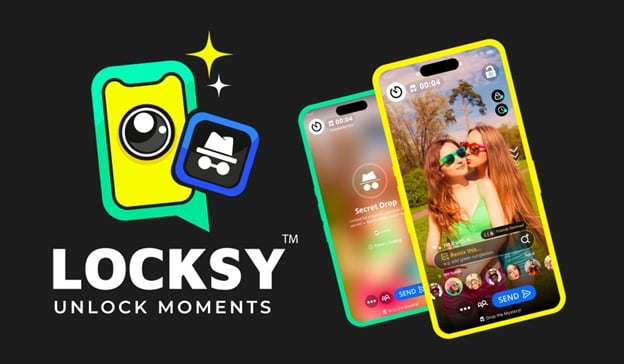
This shift is where the next phase of consumer social will be decided. And the app that has built the most coherent architecture for it is not one of the established platforms that has dominated teen social for the last decade. It is a Silicon Valley startup called Locksy — and US teens exploring it are finding something they have not found in any social app they have used before.
Teens are done with passive social media. Done with scrolling. Done with algorithmic feeds. Done with preset menus. What is replacing it is the kind of social experience Locksy was built for from the ground up.
The 20-Second Social Network: Why Timed Sharing Could Change How Teens Communicate
The dominant model of social communication for the last decade has been fundamentally asynchronous. You send something. It sits. The recipient engages with it whenever they choose. The content exists indefinitely — in an inbox, in a feed, in a stories archive, in a direct message thread that can be scrolled back through months later. The social interaction is real but the timing is always deferred. The stakes are always optional.
Locksy’s send-triggered countdown mechanic — what the company calls the Hybrid Remote Timer — represents the most significant structural challenge to this model that has been built into a consumer social product. On Locksy, the countdown does not start when the recipient opens the content. It starts the moment the sender hits send. Both parties are on the same clock from that instant — the sender watching time pass, the recipient racing to open the Drop before it disappears permanently.
The practical consequence of this design decision is a social communication experience that feels categorically different from every other messaging interaction currently available to US teens. The content is not waiting. It is live. The moment is not deferred. It is happening. And when it is over — when the timer expires and the Drop is permanently deleted from every server and every device simultaneously — it is genuinely over. No archive. No recovery. No second chance. The 20-second social network is not a metaphor. It is an architecture.
What this creates at the social level is something that established platforms — with their permanent messages, their scrollable histories, their optional expiry settings buried in menus — have never been able to engineer into existence despite years of trying: communication that feels like a live event rather than a deferred exchange. Teen users who discover Locksy after years of conventional social apps describe a consistent shift in how sending something feels. Not incrementally better. Fundamentally different. The kind of different that, once experienced, makes the asynchronous alternative feel slow.
Why the Timer Changes Everything About the Creative Decision
The send-triggered countdown has an effect that goes beyond the mechanics of urgency. It changes the creative decision itself. When content disappears permanently in seconds, the teen making it is freed from the calculus of the permanent archive — the question, conscious or not, of how this content will look to this person in six months, in a year, when the friendship has changed or the context has shifted. That question disappears along with the content. What remains is the present moment and the person you are sharing it with.
This is not a trivial psychological shift. Teen users describe it as one of the most significant differences between creating something for Locksy and creating something for any other social platform. The absence of permanence — the architectural guarantee that what you send will not exist after the countdown expires — changes the quality of the creative decision from calculated to spontaneous. From performed to honest. From designed for an archive to designed for a person. This shift, more than any individual feature, is what makes teen users describe Locksy as feeling real in a way that other social apps do not.
The architectural guarantee that what you send will not exist after the countdown expires changes the creative decision from calculated to spontaneous. From performed to honest. From designed for an archive to designed for a person.
From Filters to Prompts: The Rise of Teen AI Social Camera Apps
The history of creative tools in social media is a history of menus. Platform designers select a set of effects. Users choose from that set. The menu grows over time as more effects are added. But the fundamental interaction model — choose from what we offer — has never changed. The platform remains the creative director. The user remains the person selecting from the platform’s creative decisions.
Locksy AI Remix is the first significant departure from this model that has been built natively into a social app’s core content creation flow. Not as a separate creative tool. Not as an AI tab you navigate to. Inside the flow itself — between capturing a moment on the always-live Smart Camera and sending it as a Drop — as a natural step in a sequence that was designed to contain it from the beginning.
The interaction model is fundamentally different from everything that came before it. The user types a free-text prompt in natural language. Any transformation they can articulate. The AI executes it in seconds. No menu. No preset. No ceiling defined by the platform’s design team. The user is the creative director. The AI is the execution engine. The platform provides the infrastructure. The creative agency is entirely the user’s.
For a generation that has grown up with text-to-image AI as a native technology — not a novelty, not an emerging category, but a thing that has always existed in their social environment — the difference between being offered a menu and being offered a blank prompt field is not a subtle UX distinction. It is the difference between passive selection and active creation. Between choosing an identity from a catalogue and expressing one from imagination. Teen users who have used Locksy AI Remix and then returned to preset filter menus describe the experience of returning as going backwards. Not in terms of quality. In terms of relationship with the creative tool.
Why the AI Layer Had to Be Inside the Flow
The decision to build AI Remix inside the send flow rather than as a separate creative destination was not primarily a UX decision. It was an architectural consequence of the countdown mechanic. When the countdown starts the moment you send — when the urgency of the social experience is built into the timer that begins at the instant of send — any creative tool that requires navigation away from the send flow is a creative tool that breaks the urgency. It becomes friction in a flow built around speed. It becomes a pause in an experience built around nowness.
By building AI Remix as a step within the camera-to-send sequence rather than as a destination outside it, Locksy made the creative transformation part of the social urgency rather than an interruption of it. A teen captures a moment, transforms it with any prompt they can describe, and sends it before the countdown they are now racing even begins. The AI creative step and the timed social step are part of the same continuous experience. Not consecutive experiences separated by navigation. One experience.
This integration is the most technically ambitious thing about Locksy’s architecture — and the hardest thing for any established platform to replicate. Not because the AI capabilities required are beyond reach. But because building those capabilities inside an existing social app’s content creation flow requires restructuring the foundational architecture of that flow. That is not a feature addition. That is a rebuild.
Building AI Remix inside the send flow rather than as a separate destination makes the creative transformation part of the social urgency. Not consecutive experiences separated by navigation. One experience.
What Happens When the Smart Camera Becomes the Social Network?
The most architecturally radical decision Locksy made — the one with the most significant implications for the industry as a whole — is the decision to build the camera as the master layer of the entire application rather than as a module within it.
In every social app currently available, the camera is a view you navigate to. A feature you access. A starting point you leave behind when something else demands attention. Notifications close it. Messages replace it. Mode switching restarts it. The camera is one screen among many in a navigation hierarchy that treats all screens as roughly equivalent destinations.
Locksy’s engineering team made a different architectural decision. They built Apple’s AVFoundation camera framework as the persistent root layer of the entire application — the foundation on which every other element of the app is rendered as an overlay rather than as an alternative. Notifications arrive as compositing layers on top of the live camera. Messages surface on the camera view. Incoming Drops appear without closing the camera session. Switching from photo to video to voice note to text happens in a single tap without the camera ever stopping. The camera is not one screen among many. It is the environment in which everything else happens.
The consequence of this decision — a permanently live camera that everything else exists on top of — is a social experience that has no structural equivalent in any other consumer social product. It is not a better camera feature. It is a different kind of app. An app where the camera is not where the social experience starts. It is where the social experience lives.
What Established Platforms Are Now Facing
Every major social platform with a camera feature — every app with hundreds of millions of users, every product with billions of dollars in engineering resources — built their camera as a module. A view controller in a navigation hierarchy. A starting point. That architectural decision is embedded in every line of code, every UI pattern, every navigation structure in those applications. It was the right decision for the architecture they were building at the time they were building it. It is now a structural constraint.
The constraint is this: you cannot add the Locksy Smart Camera architecture to an existing social app. You cannot update a module into a master layer. You cannot refactor a navigation hierarchy into a persistent camera environment while the application continues to operate. To build what Locksy built, you have to start from the beginning — from a blank architecture, from first principles, from a camera-as-master-layer foundation — and build everything else on top of it. The established platforms built what they built. They built it well. And they now face a competitor whose most significant architectural advantage cannot be addressed by engineering resources. It can only be addressed by starting over.
Starting over is not something platforms with hundreds of millions of users, established codebases, and quarterly performance obligations do. Locksy built the architecture that makes starting over unnecessary — because Locksy started from the right place.
You cannot add the Locksy Smart Camera architecture to an existing social app. You cannot refactor a navigation hierarchy into a persistent camera environment. To build what Locksy built, you have to start over. The established platforms are not going to start over.
Why Teen Social Apps Are Moving From Feeds to Moments
The feed was the defining innovation of first-generation social media. A reverse-chronological stream of content from people you followed, algorithmically curated to maximise time on platform. For years, the feed was social media. Every major platform organised itself around it. Every teen social app competed within its paradigm.
The feed is now the thing US teens are actively moving away from. Not because it stopped working as a content distribution mechanism — it still works, at scale, for the platforms built around it. But because it stopped working as a social communication experience for the teens using it. The feed, with its permanent archive and its algorithmic curation and its public audience and its engagement metrics, has become a performance environment rather than a communication environment. And the teens who have grown up inside it — who have spent their formative social years performing for feeds rather than communicating with friends — are now sophisticated enough to identify the difference and choose accordingly.
What they are choosing instead is moments. Direct, specific, ephemeral interactions between real friends, built around content that is created for the person receiving it rather than for the audience watching it, timed to disappear rather than designed to accumulate. The moment is the opposite of the feed in almost every architectural dimension. Where the feed is public, the moment is private. Where the feed is permanent, the moment is ephemeral. Where the feed is broadcast, the moment is direct. Where the feed is curated by algorithm, the moment is chosen by the user.
Locksy and the Moment-Native Architecture
Locksy is the first social app that was built for the moment architecture from the ground up rather than retrofitting moment features into a feed-native architecture. There is no feed on Locksy. Not a reduced feed or a friends-only feed or an algorithmic feed limited to people you follow. No feed. The social experience is made entirely of moments — Secret Drops sent to specific people, Backroom conversations happening in ephemeral invitation-only spaces, Social Drops discoverable for exactly 24 hours before permanent deletion. Everything that happens on Locksy is a moment. Nothing is an archive.
This architectural choice — building entirely around moments rather than adding moments to a feed architecture — has a compound effect on the quality of each individual moment. When content is not competing for attention in a feed, it does not need to be optimised for feed performance. When content disappears rather than accumulates, it does not need to be curated for a permanent record. When content is sent to a specific person rather than broadcast to a public audience, it does not need to be produced for a performance. The quality of the communication changes when the architecture removes the reasons to perform and replaces them with reasons to be genuine.
Teen users in the United States who have discovered Locksy describe this shift in the quality of their communication consistently. The word that appears most often — unprompted, in reviews and in conversations — is real. The app feels real. The interactions feel real. The creative expression feels real. This is not a description of a feature. It is a description of an architecture that removed everything that made social communication feel performed and left everything that made it feel genuine.
US Teens Are Already Moving — and the Numbers Will Follow
Consumer social trends in the United States always originate with teens. The platforms that dominate adult social media in five years are the platforms that teen users are discovering today. The investment community knows this. The acquisition community knows this. And what both communities are beginning to notice is that a significant cohort of US teens are discovering Locksy — and what they are discovering is not a better version of what they already had. It is a different category of experience entirely.
Locksy’s growth to date has been entirely organic. No paid acquisition. No influencer seeding campaigns. No promotional budget. The growth that has happened has happened because of the Drop sharing mechanic — because non-app users receive Drop links with countdowns already running, experience real urgency for the first time in any social interaction they have had on a mobile device, and convert to Locksy users at rates that no paid campaign could replicate. The viral loop is native to the product architecture. The conversion happens because the product experience converts it. Not because a campaign persuaded someone to try something they were uncertain about.
This kind of organic, architecture-driven growth is the growth pattern that sophisticated investors and strategic observers of consumer social recognise as meaningful. It is the growth pattern that precedes the inflection points. The early users of every significant consumer social platform were not acquired. They were converted by the product itself, at a rate that the product architecture made possible without any promotional assistance. Locksy’s early traction follows this pattern precisely — and the product it is driving traction toward is, by every architectural measure, the most coherent consumer social product built for US teens since the category was created.
The growth that has happened has happened because the Drop sharing mechanic converts non-app users in real time. No paid campaign. No promotional budget. The architecture drives the viral loop. The product converts it.
What Comes Next: The Architecture Defines the Roadmap
Locksy’s current product — Smart Camera, AI Remix, Secret Drops, Backroom, Social Drops, and the send-triggered countdown — is the foundation of a roadmap that follows directly from the architectural decisions already made. School cohort discovery tools that leverage the verified school map. Group poll mechanics that extend the ephemeral urgency of Drops to multi-participant interactive moments. Cluster sending that delivers a Drop to an entire friend group simultaneously with a single send action. Live camera filters that bring real-time AI transformation into the capture moment rather than the post-capture moment. An MCP server that extends Locksy’s capabilities to AI agent-based interactions as the agentic web matures.
Every item on that roadmap is an extension of the same architectural principle that produced the current product: the camera is the social environment, not the starting point. The AI is inside the flow, not beside it. The countdown starts on send, not on open. The content disappears permanently, not eventually. The social experience is built around moments, not archives.
That principle, applied consistently across a roadmap that has barely scratched the surface of what the architecture makes possible, is what positions Locksy not as a new entrant competing within an existing category but as the first product defining a new one. The category of social experiences that are live rather than deferred, creative rather than curatorial, ephemeral rather than permanent, and built from first principles rather than assembled from features.
In Silicon Valley, products that define new categories tend to attract a particular kind of attention. From investors who want to be early in the next phase. From strategic acquirers who recognise that the architecture cannot be replicated and the cost of building it from scratch exceeds the cost of acquiring it. From the teens who experience it first and whose behaviour becomes the data point that everyone else eventually follows.
All three kinds of attention are beginning to find Locksy. The architecture is already built. The countdown already started.
Locksy is available exclusively in the United States on the iOS App Store. Free always.
→ Download Locksy on the App Store
→ Read: Capture. Remix. Drop. — Locksy on TechBullion
→ The Best New Social Apps for Teens in the USA in 2026 — And Why One of Them Is in a Category Nobody Else Has Entered Yet
→ The Social Camera Has Been Broken for 10 Years. We Fixed It.






Comment