Personal injury claims are often framed as legal disputes, but at their core, they are economic and human recovery problems.
An injury disrupts income, health, routine, and future planning simultaneously, forcing individuals to make high-stakes decisions under uncertainty.
The legal system becomes the mechanism through which those disruptions are measured, allocated, and, ideally, repaired.
In modern societies, injury claims no longer operate in isolation from broader systems.
Healthcare costs, insurance models, employment structures, and data-driven risk assessment all influence how compensation is evaluated.
Understanding this interconnected landscape is essential for anyone navigating a serious injury.
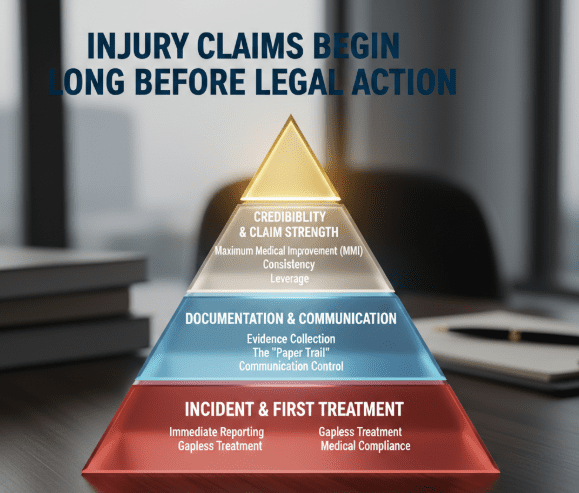
Injury Claims Begin Long Before Legal Action
The foundation of a personal injury claim is laid in the earliest hours and days following an incident, often before the injured person realizes a legal process is underway.
Medical records created during initial treatment do more than guide recovery; they establish the first narrative of causation, severity, and consistency.
When symptoms are underreported, treatment is postponed, or follow-up care is irregular, those gaps can later be interpreted as signs of minor injury or unrelated conditions.
Communication outside the healthcare setting also carries legal weight.
Statements made to employers, insurers, or third parties may later be scrutinized for inconsistencies, even when they were offered informally or under stress.
Documentation timelines begin forming immediately, and once established, they are difficult to reshape.
These early decisions are rarely made with legal consequences in mind, yet they influence how credibility is assessed and how responsibility is framed.
That is why effective injury recovery involves not only medical care, but awareness of how actions, records, and timing interact within the claims process.
Claim strategy does not begin with a lawsuit; it begins with informed choices made at the outset.
Compensation Is a Forward-Looking Calculation
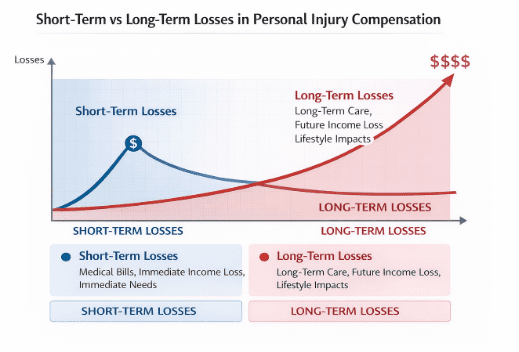
Personal injury compensation is designed to address future disruption as much as past harm.
Courts and insurers evaluate how an injury is likely to affect health, work capacity, and daily function over time, not just what has already occurred.
This requires translating medical prognosis into economic and functional projections, a process inherently shaped by assumptions and risk modeling.
Long-term considerations often include ongoing treatment, potential complications, reduced career advancement, and the need for adaptive support.
Economic projections must also factor in inflation, healthcare cost escalation, and employment volatility, all of which can amplify losses over years or decades.
When claims focus too narrowly on immediate expenses, they fail to account for the compounding nature of long-term impact.
Uncertainty is unavoidable in forward-looking valuation, but it must be addressed rather than ignored.
Well-structured claims acknowledge uncertainty and support projections with medical opinion, vocational analysis, and economic reasoning.
Without this depth, settlements may offer short-term closure while leaving long-term needs unmet.
Insurance Systems Prioritize Predictability Over Individual Impact
Insurance systems are built to function at scale.
Their primary objective is not to understand individual stories, but to create predictable outcomes across thousands of claims.
To achieve this, insurers depend on actuarial tables, probability distributions, and standardized valuation frameworks that favor consistency over nuance.
These models work efficiently when injuries follow expected trajectories. However, many real-world injuries do not.
Chronic pain, psychological trauma, delayed recovery, and fluctuating symptoms introduce variables that resist standard categorization.
When claims deviate from established patterns, they often trigger internal resistance rather than recalibration.
Adjusters may question severity, duration, or causation, not because harm is implausible, but because it is statistically inconvenient.
This structural limitation explains why individuals with complex or evolving injuries frequently encounter friction, delays, or undervaluation despite clear evidence of impact.
The tension between standardized systems and individual lived experience is not accidental; it is a byproduct of how risk is managed at scale.
Understanding this mismatch helps explain why disputes arise even when liability appears straightforward.
Decision Fatigue Shapes Claim Outcomes
Recovering from an injury requires sustained attention at a time when cognitive resources are already depleted.
Pain, medication, disrupted routines, and financial uncertainty all contribute to mental exhaustion.
This state makes it difficult to evaluate long-term consequences or process complex information.
Insurance processes are often layered and repetitive by design.
Multiple requests, follow-up questions, and time-sensitive communications demand ongoing engagement from individuals who may already feel overwhelmed.
Over time, the desire for closure can outweigh the desire for optimal outcomes.
Early settlement offers are frequently framed as opportunities for relief.
While they provide certainty, they also transfer long-term risk back to the injured person.
When decision fatigue sets in, individuals are more likely to prioritize immediate resolution over future adequacy.
Recognizing the role of cognitive strain clarifies why many claims resolve at levels that do not reflect their full impact.
It also highlights the importance of support structures that allow decisions to be made deliberately rather than reactively.
Legal Strategy Bridges Systems and Lived Experience
The role of legal strategy in personal injury claims is not merely procedural, it is interpretive.
Effective advocacy converts subjective experience into forms that structured systems can recognize and evaluate.
Pain becomes documented impairment, disruption becomes economic loss, and uncertainty becomes supported projection.
This translation process requires more than technical compliance.
It demands judgment about how evidence is framed, sequenced, and contextualized.
Medical records must tell a coherent story, economic assessments must reflect realistic futures, and credibility must be preserved across every interaction.
Jurisdiction adds another layer of complexity.
Courts do not operate in abstraction; they reflect local precedent, procedural norms, and interpretive tendencies.
What is persuasive in one region may be viewed differently in another.
In Australia, these regional distinctions shape how injury claims are assessed, particularly in relation to damages and evidentiary thresholds.
For individuals navigating serious claims within this framework, working with experienced Melbourne Personal Injury Lawyers can help ensure that personal recovery realities are translated accurately into the legal standards applied by local courts.
Long-Term Recovery Depends on Structural Awareness
Serious injuries rarely affect only one aspect of life.
They trigger a chain of consequences that extend into employment, healthcare access, financial stability, and long-term independence.
Personal injury claims sit at the intersection of these systems, whether or not they are formally acknowledged.
A narrow legal focus may succeed in establishing liability yet fail to support sustainable recovery. For example, compensation that does not account for prolonged rehabilitation or workplace accommodation can leave individuals financially exposed long after a claim concludes.
Similarly, overlooking how injuries interact with disability frameworks or public support programs may unintentionally limit access to future assistance.
Structural awareness means understanding how different systems interact over time.
It involves anticipating how medical recovery aligns with employment reintegration, how compensation affects eligibility for benefits, and how long-term care needs evolve.
When these factors are integrated into claim planning, outcomes are more durable and aligned with real-world recovery rather than short-term resolution.
This broader perspective strengthens legal positioning by grounding arguments in practical realities.
It also ensures that recovery extends beyond legal closure into sustained stability.
Litigation Is a Tool, Not an Endpoint
Litigation plays a strategic role in personal injury claims, even when cases never reach trial.
The potential for formal dispute resolution influences how claims are evaluated, negotiated, and resolved.
Preparation signals seriousness and shifts bargaining dynamics.
Claims structured solely for rapid settlement often rely on surface-level documentation and conservative valuation.
While expedient, this approach leaves little room to respond when disputes arise or circumstances change.
By contrast, litigation-ready claims are built with evidentiary depth and analytical rigor from the outset.
Litigation readiness does not equate to adversarial escalation.
It reflects preparedness: evidence is preserved early, expert opinions are available, and valuation assumptions are defensible under examination.
This preparedness increases flexibility, allowing claims to settle efficiently when appropriate without sacrificing leverage.
Ultimately, litigation functions as a framework for accountability rather than an end goal.
When used strategically, it supports rea solution that is both timely and proportionate to the harm experienced.
Closing Thought: Injury Claims Are About Restoring Balance
At their best, personal injury claims restore balance after disruption.
They acknowledge harm, allocate responsibility, and provide resources for recovery.
Achieving that balance requires more than procedural compliance; it requires understanding how systems, incentives, and human realities intersect.
In a world increasingly governed by models and metrics, informed legal guidance ensures that individual experiences are not reduced to averages.
For injury victims, that understanding can be the difference between temporary relief and lasting recovery.