
The Fleet Is Ready to Move, but the Data Isn’t: How Digital Visibility Is Changing Commercial Vehicle Logistics
A business decides to relocate a group of vehicles to a new operating facility. The transport schedule looks straightforward: the vehicles have been identified, the destination is confirmed, and the dispatch team has arranged the…

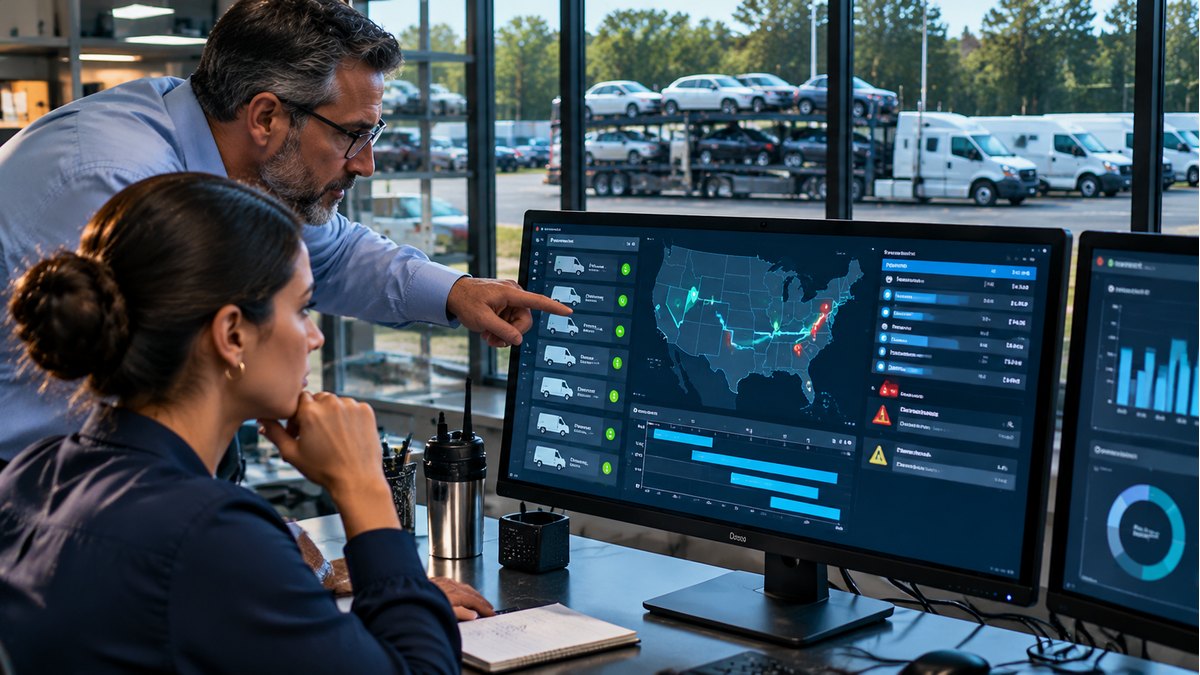
A business decides to relocate a group of vehicles to a new operating facility. The transport schedule looks straightforward: the vehicles have been identified, the destination is confirmed, and the dispatch team has arranged the necessary transportation. Yet the information needed to coordinate the move is spread across spreadsheets, emails, inventory systems, and individual employee updates.
One vehicle is still awaiting release authorization. Another has an incorrect location recorded in the inventory system. A third requires different transport equipment because of its dimensions. Each issue is manageable individually, but together they can disrupt an otherwise well-planned fleet movement.
This is an increasingly important challenge for commercial vehicle logistics. Businesses need more than a list of vehicles and a delivery schedule. They need reliable information about asset identity, availability, location, transportation requirements, and operational readiness.
Digital systems can help connect these records, but technology only creates value when the information behind it is accurate, accessible, and useful to the people coordinating the move.
The opportunity is not simply to track vehicles on a screen. It is to improve the quality of decisions made before, during, and after transportation.
Why Fleet Visibility Starts Before Dispatch
Fleet visibility is often associated with knowing where a vehicle is while it travels. For commercial transportation, however, important information is needed well before a vehicle reaches a carrier.
Operations teams must establish which vehicles are available, where they are located, whether they can be released, and what transportation arrangements they require.
A vehicle recorded as available in an inventory system may still be undergoing maintenance. Another may be physically ready but missing documentation needed for collection. A third may be parked at a location that cannot accommodate the equipment required for loading.
These are information problems as much as transportation problems.
When dispatchers discover them late, they may need to reorganize schedules, communicate with multiple departments, or arrange alternative collection windows.
A more reliable approach connects fleet inventory with operational records before transport arrangements are finalized.
The objective is to give decision-makers a consistent view of vehicle readiness rather than relying on separate updates from departments that may be working with different versions of the same information.
The Problem With Disconnected Fleet Systems
Many businesses use several software systems to manage their operations. Fleet inventory, maintenance, dispatch, accounting, and transportation records may each operate independently.
These systems can perform their individual functions effectively while still creating difficulties when information needs to move between them.
For example, a maintenance platform may show that a vehicle has completed inspection, while a fleet spreadsheet still lists it as unavailable. A dispatch system may contain a pickup date that does not reflect a later change made by the operations team.
Without consistent updates, employees can make decisions using outdated information.
Integrating systems can reduce these problems by allowing relevant information to move between applications through controlled data exchanges.
However, integration should not be treated as an automatic solution. Different systems may use different vehicle identifiers, field definitions, update schedules, and permissions.
A successful integration project begins by identifying which records are authoritative and how changes should be communicated.
For commercial fleets, this may involve establishing a common vehicle identifier and connecting it to the relevant inventory, maintenance, release, and transportation records.
Why Vehicle Identification Is the Foundation of Digital Logistics
Accurate identification is essential whenever information about a physical asset is shared between multiple organizations or software systems.
Commercial fleets may contain vehicles with similar descriptions, registration details, or model configurations. A general description such as a white delivery van is not sufficient to distinguish one asset from another.
Organizations therefore need consistent identifiers that can connect their internal records with the relevant vehicle.
Depending on the workflow, this may involve a vehicle identification number, fleet asset number, registration identifier, or another controlled reference.
When a vehicle is transferred between facilities, the same identifier should remain associated with its relevant inventory and transportation records.
This reduces the possibility of assigning a collection request to the wrong asset or confusing two vehicles with similar descriptions.
Digital identification also supports exception management. If a vehicle’s location or availability changes, the affected record can be identified more easily and communicated to the relevant teams.
Without consistent identification, even sophisticated dashboards can display information that is difficult to reconcile with the physical vehicles they are intended to represent.
Electronic Logging Devices Are Not Complete Fleet Tracking Systems
Electronic logging devices provide an important example of why organizations must understand the limitations of individual technologies.
The Federal Motor Carrier Safety Administration requires ELD use for commercial drivers who are required to prepare records of duty status, subject to applicable exceptions.
These devices synchronize with vehicle engines and automatically record specified information associated with driving activity and hours-of-service records.
FMCSA guidance identifies information such as date, time, location, engine hours, vehicle miles, and driver, vehicle, and carrier identification among the required recorded data elements.
However, the ELD rule does not require real-time tracking of commercial motor vehicles for general business purposes. Nor does it require ELDs to collect every vehicle-performance measurement.
This distinction is important for fleet managers evaluating technology.
An ELD can support regulatory recordkeeping without providing every operational capability required for coordinating a multi-vehicle relocation.
Businesses may use additional fleet-management and tracking technologies for their own operational purposes, subject to applicable privacy and regulatory requirements.
Understanding what each system actually records prevents organizations from assuming that installing one technology automatically solves every visibility problem.
Connecting Dispatch Decisions With Real Operational Conditions
Dispatch planning requires more than selecting a vehicle and assigning a collection date.
Teams must consider where the vehicle is located, whether it can be released, the equipment required, destination access, and the availability of the relevant transportation arrangements.
For a business relocating several vehicles, these details can become difficult to manage through separate email conversations.
A centralized operational view can help employees identify which vehicles are ready, which require additional information, and which may create scheduling conflicts.
Such a system should distinguish confirmed information from estimates or unresolved updates.
For example, a planned collection date is not necessarily a confirmed pickup. Similarly, an estimated delivery date should not be represented as a guaranteed arrival unless the underlying agreement provides that commitment.
Clear status definitions help employees communicate accurately and reduce misunderstandings between departments.
They also make it easier to identify where a delay originates. A vehicle awaiting release authorization requires a different response from one delayed because specialized transport equipment is unavailable.
Why Commercial Vehicle Transport Requires More Than Standard Scheduling
Moving a group of commercial vehicles introduces coordination requirements that may not arise in an ordinary individual vehicle shipment.
Vehicles can differ in dimensions, weight, operating condition, and loading requirements. Some may be suitable for standard multi-vehicle equipment, while others may require specialized arrangements.
Businesses should therefore identify the relevant transportation requirements before assuming that every vehicle can follow the same schedule or use the same equipment.
For organizations planning fleet movements, commercial vehicle transport is one relevant service category to evaluate when coordinating business-use vehicles and larger transportation requirements.
The broader planning challenge is to connect vehicle information with the transportation arrangement rather than treating dispatch as an isolated administrative task.
A fleet schedule should reflect the actual characteristics of the vehicles being moved, the readiness of the locations involved, and the practical requirements of collection and delivery.
This helps businesses identify conflicts earlier and communicate more realistic expectations to employees and operating locations.
Digital Dashboards Need Clear Definitions
Dashboards are often introduced to provide managers with a consolidated view of operational performance.
They can display vehicle availability, transportation status, upcoming collections, unresolved exceptions, and other relevant information.
However, a dashboard becomes misleading when its underlying status definitions are inconsistent.
For example, one department may classify a vehicle as ready when maintenance is complete, while another may require release authorization and collection documentation before using the same status.
Both definitions may make sense within their individual workflows, but they create confusion when combined into one reporting system.
Businesses should define operational states clearly and ensure that the same terms have consistent meanings across connected applications.
Useful distinctions may include awaiting inspection, maintenance completed, awaiting release, available for collection, collected, in transit, delivered, and receiving inspection completed.
These statuses should reflect actual events rather than assumptions based on scheduled dates.
A well-designed dashboard should also show when information was last updated and identify records that require attention.
Exception Management Is More Valuable Than a Perfect-Looking Map
Vehicle location maps can provide an intuitive overview of transportation activity, but knowing where a vehicle is does not necessarily explain whether the operation is progressing as planned.
A vehicle may appear at the expected destination while its receiving team is unavailable. Another may have reached a collection facility but remain unreleased.
These situations require operational information in addition to location data.
Exception management focuses on identifying conditions that differ from the expected workflow and assigning an appropriate response.
For example, a system might flag a vehicle whose collection authorization remains incomplete before the scheduled pickup window.
Another exception might identify a destination where unloading arrangements have not been confirmed.
These alerts are useful when they identify a specific issue and direct it to the person responsible for resolving it.
Generating large numbers of low-value notifications can have the opposite effect. Employees may begin ignoring alerts when most do not require meaningful action.
Effective exception management therefore depends on accurate rules, clear ownership, and appropriate notification thresholds.
Why Data Quality Matters More Than the Number of Connected Systems
Organizations sometimes measure digital transformation by counting the number of applications, sensors, and integrations they have deployed.
These figures do not necessarily demonstrate operational improvement.
A business may connect several systems and still struggle to determine which vehicle record is correct or whether a reported status reflects an actual event.
Data quality should be evaluated through accuracy, completeness, consistency, timeliness, and relevance.
A vehicle location that was correct several hours ago may be less useful for an immediate dispatch decision. A maintenance status without a timestamp may be difficult to interpret when several departments update the same record.
Likewise, a complete inventory record is not necessarily useful if its vehicle identifier cannot be matched to the transportation documentation.
Digital systems need clear rules for data ownership, updates, validation, and correction.
Organizations should also decide which information must be available immediately and which can be updated periodically.
This helps avoid unnecessary complexity while ensuring that critical decisions rely on sufficiently current information.
Cybersecurity Becomes Part of Fleet Operations
As fleet-management systems become more connected, businesses must consider the security of the information they collect and exchange.
Operational records may include vehicle identifiers, business locations, employee information, dispatch schedules, and other commercially sensitive details.
Access to this information should be limited according to legitimate business requirements.
Not every employee, supplier, or external service provider needs access to every record.
The National Institute of Standards and Technology’s Cybersecurity Framework 2.0 provides a risk-management structure that organizations can use to identify, assess, and manage cybersecurity risks.
Its approach is relevant to businesses of different sizes and does not prescribe one specific technology or implementation method.
For fleet operations, practical considerations include controlling user permissions, protecting connected systems, maintaining appropriate backups, reviewing third-party access, and preparing for service interruptions.
Organizations should also consider what happens when a connected application becomes unavailable. Dispatch and receiving teams may need documented alternative procedures to maintain operational continuity.
Technology should improve visibility without creating an unnecessary single point of failure.
Protecting Driver Privacy While Improving Operational Visibility
More information is not always better information.
Vehicle-related systems may also process data associated with drivers and other employees. Businesses must understand what information is collected, why it is collected, who can access it, and how long it is retained.
FMCSA’s ELD guidance explicitly addresses protections against harassment based on ELD data and connected technology.
This is a reminder that fleet visibility should be balanced with legitimate operational needs and applicable privacy requirements.
Organizations should avoid collecting or exposing information that is not necessary for the stated purpose.
Clear policies can explain which records support regulatory compliance, which information supports transportation coordination, and which data is retained for other business purposes.
Access controls and appropriate retention practices help reduce unnecessary exposure while allowing authorized personnel to perform their responsibilities.
Measuring Whether Digital Fleet Visibility Actually Works
Digital transformation should be evaluated through operational outcomes rather than the number of software features purchased.
Businesses can examine whether improved information management reduces avoidable scheduling changes, incomplete vehicle records, manual reconciliation, or delays caused by missing release information.
Useful indicators may include the percentage of vehicles with complete identification records, the number of unresolved exceptions before dispatch, the frequency of schedule changes, and the time required to reconcile delivery records.
These measurements should be defined carefully.
For example, a reduction in schedule changes may reflect better planning, but it could also result from fewer vehicles being moved during the reporting period.
Operational metrics should therefore be interpreted alongside relevant business conditions.
Organizations should also distinguish between improvements caused by better data and those resulting from changes in carrier capacity, staffing, or transportation demand.
A useful performance system provides context rather than presenting every improvement as proof that a particular software investment caused it.
Why Technology Cannot Replace Transport Expertise
Digital tools can organize information and improve communication, but they cannot independently resolve every transportation challenge.
Vehicle dimensions, loading requirements, route access, equipment availability, and destination conditions still require practical evaluation.
A scheduling application may identify a potential conflict, but someone with appropriate operational knowledge must determine the correct response.
Likewise, a tracking system may report a location without explaining why a vehicle has stopped or whether a delay affects the final delivery plan.
Human expertise remains essential when information is incomplete or circumstances change unexpectedly.
The most useful technology supports informed decisions rather than presenting automated outputs as unquestionable answers.
Businesses should therefore evaluate digital tools according to how well they complement the people responsible for coordinating transportation.
The Future of Commercial Vehicle Logistics Is Connected Decision-Making
Commercial vehicle logistics is becoming increasingly dependent on the quality of information shared between departments, transportation providers, and operating locations.
Better digital visibility can help organizations identify vehicle readiness, coordinate dispatch, manage exceptions, and maintain more consistent records.
However, the benefits depend on reliable identifiers, clearly defined statuses, appropriate system integration, and responsible information management.
Electronic logging devices, fleet-management applications, inventory platforms, and transportation systems each serve different purposes. Businesses should understand those distinctions before expecting one application to provide complete operational visibility.
For organizations moving multiple vehicles, the most valuable improvement may not be another tracking screen. It may be the ability to establish that every vehicle is correctly identified, available for collection, matched to the appropriate transportation arrangement, and supported by accurate records.
That is the foundation of better fleet coordination: connecting reliable information to practical decisions before a vehicle ever leaves its original location.
For more coverage on this topic, see Techbullion.
Previously in Apps: How to evaluate a workplace management platform before you commit







Comment