Inside the work of Khurram Yasar Mohammed, the quality engineer at the heart of the U.S. electric vehicle battery manufacturing push
There is a building in Lordstown, Ohio, that many Americans have never heard of but that quietly shapes the future of how the United States will power its cars, its grid, and its industrial economy for the next generation. The Ultium Cells facility, a joint venture between General Motors and LG Energy Solution, is one of the largest and most strategically important electric vehicle battery manufacturing plants in the country. Billions of federal and private dollars have been invested in it. Thousands of jobs depend on it. And the clean energy ambitions that both political parties claim to share run, in no small part, through the batteries it produces.
Inside that facility, working at the intersection of data science, quality engineering, and environmental sustainability, is Khurram Yasar Mohammed, a name you probably do not know, but probably should.
Khurram is a Quality and Reliability Engineer whose work sits at the precise pressure point where America’s clean energy aspirations meet the unglamorous, technically demanding reality of manufacturing lithium-ion batteries at scale. He is not a CEO. He is not a venture capitalist. He is an engineer — the kind of professional who makes things actually work, who finds the defects before the defects find the consumer, and who has spent years developing the expertise to ensure that the batteries coming off American production lines are good enough, safe enough, and efficient enough to compete with the best in the world.
We spoke with Khurram at length about his work, his research, and what he believes it will take for the United States to build the domestic battery manufacturing sector that is required for its national security and economic competitiveness.
The Problem Nobody Talks About
When most people think about electric vehicles, they think about range anxiety, charging infrastructure, or the sticker price. What they rarely think about is what happens inside the factory where the battery is made, and why that matters enormously to everything else.
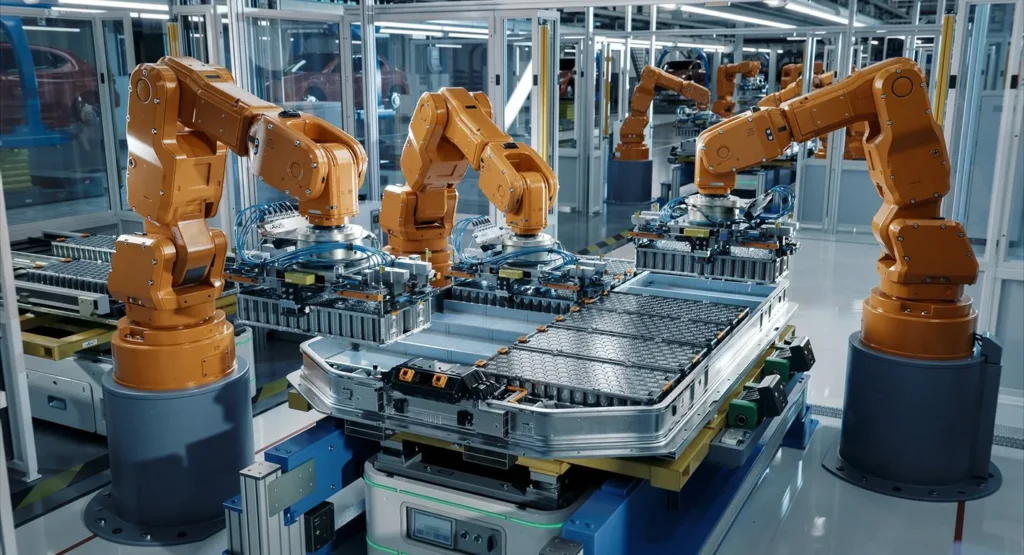
“Battery manufacturing is a complicated process,” Khurram explains, with the measured clarity of someone who has spent years translating engineering complexity into practical insight. “It involves lots of steps, from raw material to final product. In the electrode process alone, cathode and anode materials, lithium, nickel, cobalt, graphite, and other resource-intensive minerals, are turned into a slurry that is coated onto foils, which eventually become battery cells. These materials are expensive and difficult to source. Small improvements in handling can result in meaningful cost savings and reduced environmental impact.”
That word ‘small’ carries enormous weight in this context. When you are working with minerals that cost thousands of dollars per kilogram, a fraction-of-a-millimeter deviation in electrode coating thickness is not a small problem. It is a defect that can propagate through an entire production batch, generating scrap that represents not only wasted material but also wasted energy, labor, and time in a supply chain that the United States is desperately trying to build out. At the scale that domestic battery production must reach to meet the demand created by the Inflation Reduction Act’s electric vehicle tax credits and the Department of Energy’s clean energy targets, even marginal improvements in manufacturing yield translate into hundreds of millions of dollars in annual savings, and marginal failures translate into the same magnitude of loss.
“Waste cannot be 100% eliminated,” Khurram says, “but it can be identified and minimized by implementing modern technical methods. As the overall demand for electric vehicles increases, the pressure on battery manufacturers keeps climbing.”
Data as the New Quality Control
For most of industrial history, quality control meant inspection; you made the product, then you checked it. If it was bad, you threw it away. If it was good, it moved on. This reactive model made sense when manufacturing processes were simpler, and the cost of inspection was manageable. In lithium-ion battery manufacturing, it is catastrophically inadequate.
“Inside battery manufacturing, digital monitoring is the next big thing,” Khurram explains. “Sensors track everything from electrode thickness, autonomously adjusting to line speed, feeding real-time data back to operators. If something drifts out of spec, adjustments can be made immediately before an entire batch is compromised.”
This is the philosophy Khurram has applied in his quality engineering work at Ultium Cells — and it is the foundation of one of his most significant professional contributions to date. Recognizing that the Lordstown facility’s production data was distributed across multiple systems — formation equipment, coating lines, electrolyte filling stations, quality inspection platforms, and Manufacturing Execution Systems. Khurram designed and implemented a solution using the Davinci Smart Factory platform to compile large volumes of complex, multi-source manufacturing data into a centralized analytical dashboard, enabling real-time review and analysis of quality-critical process variables across the production floor.
The contribution was significant enough that it was formally recognized by the company’s Vice President, Hyunkyu Eom, and Smart Factory Team Leader Kyu Sang Yoo, who presented Khurram with the Davinci Smart Factory Award Certificate of Achievement, acknowledging his work for “utilizing Davinci’s capabilities to compile large amounts of complex data in a central dashboard for review and analysis.”
In an industry where institutional recognition is hard-won and typically reserved for contributions that have demonstrated quantifiable operational impact, a VP-level award is not handed out lightly. It reflects the judgment of experienced manufacturing leaders that Khurram’s technical contribution materially improved the facility’s ability to monitor and manage quality at scale — and, by extension, the economic viability of one of America’s most strategically important domestic battery plants.
“Modern coating systems offer engineers much tighter control over electrode layer loading and thickness,” Khurram notes, “which can lead to fewer defects and minimal material wasted on rework or scrap. When dealing with minerals that cost thousands of dollars, even small savings will lead to an eventual return.”
The Science Behind the Work
Khurram’s engineering expertise is not merely practical; it is grounded in a rigorous research record that places him at the forefront of two of the most pressing challenges facing the U.S. battery sector: manufacturing quality optimization and sustainable battery lifecycle management.
His 2024 peer-reviewed publication in the Current Journal of Applied Science and Technology — “Sustainable EV Battery Management: Process Optimization, Recycling and Green Technologies for Retired Batteries” has accumulated seven academic citations since its December 2024 publication, with 292 reads on ResearchGate. In the battery engineering and environmental science community, a citation rate of that speed signals that the research is filling a genuine gap — that other scholars are actively building on these findings because they need them.
The article evaluates the leading technologies for managing retired EV batteries, including direct recycling, identified as the most environmentally superior method, with greenhouse gas reduction potential of up to 98% compared to virgin material production, green leaching, bioleaching, and second-life battery applications for stationary energy storage. It is, in other words, a systematic attempt to answer one of the most pressing environmental questions posed by the EV transition: what happens to the batteries when they wear out?
“Critics of electric vehicles have long raised a key issue,” Khurram wrote in a subsequent public article on Medium, which reaches over 80 million monthly readers globally. “What happens to millions of lithium-ion batteries when they wear out? That question is starting to look less like an environmental threat and more like an economic opportunity.”
He means that literally. The critical minerals contained in a retired EV battery — lithium, cobalt, nickel, and manganese are the same minerals that the United States currently imports with near-total dependence from foreign sources. A retired battery is not waste. It is a domestic source of strategic materials that the nation needs but cannot currently produce in sufficient quantities domestically. Scaling the domestic recycling infrastructure to recover these materials is, in Khurram’s framing, both an environmental imperative and a national security investment.
“Companies such as Redwood Materials and Li-Cycle are expanding facilities designed to recover metals from used battery cells,” he observed in his Medium article. “Industry analysts say the approach has two advantages: it reduces the need for new mining while helping manufacturers secure materials that have become increasingly important to the global energy transition.”
His second peer-reviewed publication — “Leveraging Artificial Intelligence to Enhance Electric Vehicle Battery Management and Environmental Sustainability”, published in Advances in Research in August 2025, has accumulated six citations since its publication, offering a comprehensive framework for integrating artificial intelligence and machine learning into EV battery quality management systems. The research directly addresses the knowledge gap that prevents U.S. battery manufacturers from adopting AI-driven quality analytics at scale — providing the validated technical frameworks that manufacturers, researchers, and policymakers need to implement predictive quality management in domestic battery plants.
Together, Khurram’s two peer-reviewed publications have generated 13 combined citations, an h-index of 2, and a Research Interest Score of 18.7 on ResearchGate — metrics that reflect genuine, active scholarly engagement with his contributions to the field.
Training Tomorrow’s Engineers Today
What makes Khurram’s profile unusual among battery manufacturing professionals is not only the depth of his technical expertise but the breadth of his commitment to developing the next generation of American scientists and engineers — a commitment documented across an extraordinary range of educational and mentorship activities that few professionals at his career stage can match.
In May 2025, he served as a Grand Award Judge at the Regeneron International Science and Engineering Fair (ISEF) in Columbus, Ohio — the world’s largest pre-college science competition, attracting approximately 1,800 finalists from 63 countries, whose alumni include Nobel Prize recipients. His assignment to the Environmental Engineering category reflects the Society for Science’s recognition that his credentials meet the standard required to evaluate the world’s most outstanding young science researchers.
He was subsequently invited to serve as an evaluator for the Regeneron Science Talent Search — the nation’s oldest and most prestigious STEM research competition for high school seniors, whose alumni include 13 Nobel Prize laureates.
At the Virginia Junior Academy of Science’s 2025 Research Symposium, he served as Head Judge — a leadership role, not merely an evaluating role — with 60 hours of service formally recognized by VJAS Director Susan P. Booth. He has judged at the Ohio State Science Day, Regional Science Day at Kent State University (347 students, approximately 270 projects), the Buckeye Science and Engineering Fair, the Ashland Regional Science Day, the Columbus State Regional Science Fair, and Technovation Girls — the world’s largest global technology competition for young women.
Through the Ohio Academy of Science’s Mentorship Program, he served as a formal volunteer mentor to K-12 students from October 2024 to February 2025, providing research guidance on student science projects. He has also evaluated environmental science scholarship applications for Ohio EPA scholarships — independently assessing 34 applications for awards of up to $5,000 each as Reviewer ESR#05.
“The students I evaluate and encourage through science competition judging represent the next generation of American engineers,” Khurram told us. “By providing expert technical feedback and recognizing excellence in environmental engineering and applied sciences, I’m contributing to steering talent toward the clean energy careers that the U.S. needs.”
The United States faces a documented shortage of qualified engineers in the clean energy sector — the National Science Foundation projects a shortage of hundreds of thousands of STEM workers by 2030, with EV battery engineering among the most acutely needed specializations. Khurram’s mentorship and judging activities represent a systematic, documented contribution to closing that gap — one student, one competition, one scholarship evaluation at a time.
A Professional Community That Has Taken Notice
Khurram’s standing in the professional and scientific community is reflected not only in his employer’s recognition but in his membership in several of the most respected organizations in his field. He is an Associate Member of Sigma Xi, The Scientific Research Honor Society — one of the world’s oldest and most prestigious scientific organizations, founded in 1886, whose membership includes more than 200 Nobel Prize laureates. Membership in Sigma Xi is by nomination only, reserved for individuals who have demonstrated noteworthy research achievement or exceptional research promise. He is also a Professional Member of the American Society for Quality (ASQ) — the world’s largest professional organization dedicated to quality science — and a member of the Association of Energy Engineers (AEE), which has served the energy engineering profession since 1977 across more than 100 countries. He holds an AIGPE™ Lean Six Sigma Green Belt Certification, an OSHA 40-Hour HAZWOPER certification, and FEMA Incident Command System certifications — a combination that reflects both his manufacturing quality expertise and his environmental safety qualifications.
Jay Jeongho Lee, Electrode Quality Team Leader at Ultium Cells with over two decades of experience at LG Chem, Samsung SDI, and Ultium Cells, describes Khurram as “an innovator with outstanding technical capability and a profound impact on battery quality, process optimization, and sustainable manufacturing” whose work aligns “precisely with national priorities for clean energy resilience, supply chain security, and environmental protection.”
Abhishek Saini, Ph.D., a Thermal Systems Test Engineer at Tesla who worked alongside Khurram at Ultium Cells, describes him as an engineer whose “enthusiasm with the battery industry and clean energy was truly remarkable” — and who carries the same passion for sustainable energy into every professional venture he pursues.
What the Country Needs
There is a tendency, in conversations about America’s clean energy future, to focus on the big names — the CEOs, the policy architects, the venture capitalists who write the checks. That focus is understandable. But the actual work of building a domestic battery manufacturing sector that can compete with China’s 75% share of global lithium-ion battery production is not done in boardrooms or congressional hearings. It is done on the production floor, in the data analytics lab, in the peer-reviewed literature, and in the science fair gymnasium — by engineers like Khurram Yasar Mohammed who have the technical depth to solve manufacturing quality problems, the research capability to advance the scholarly literature, and the commitment to ensure that the next generation of American engineers is ready to carry this work forward.
“With better automation, smarter data use, and more sustainable material practices,” Khurram wrote in his London Daily Post article, “battery manufacturing is gradually becoming cleaner, more efficient, and more resilient — exactly what the energy transition needs.”
That sentence, simple as it sounds, is a mission statement. And in Lordstown, Ohio — a community that has seen its share of industrial heartbreak and is now watching one of the most consequential clean energy manufacturing investments in American history take shape within its borders — it is the kind of work that matters, today, at a scale the country can afford neither to overlook nor to underestimate.
Khurram Yasar Mohammed is a Quality and Reliability Engineer at Ultium Cells LLC in Lordstown, Ohio. He holds a Master of Science in Environmental Engineering from Texas A&M University – Kingsville (GPA 3.41) and a Bachelor of Science in Chemical Engineering. He is an Associate Member of Sigma Xi, a Professional Member of the American Society for Quality, a member of the Association of Energy Engineers, and holds a Lean Six Sigma Green Belt Certification (AIGPE™). His peer-reviewed research has been published in the Current Journal of Applied Science and Technology and Advances in Research, with 13 combined citations and an h-index of 2.