
The Connected Canadian Living Room How IPTV Smart TVs and Streaming Devices Are Changing Television

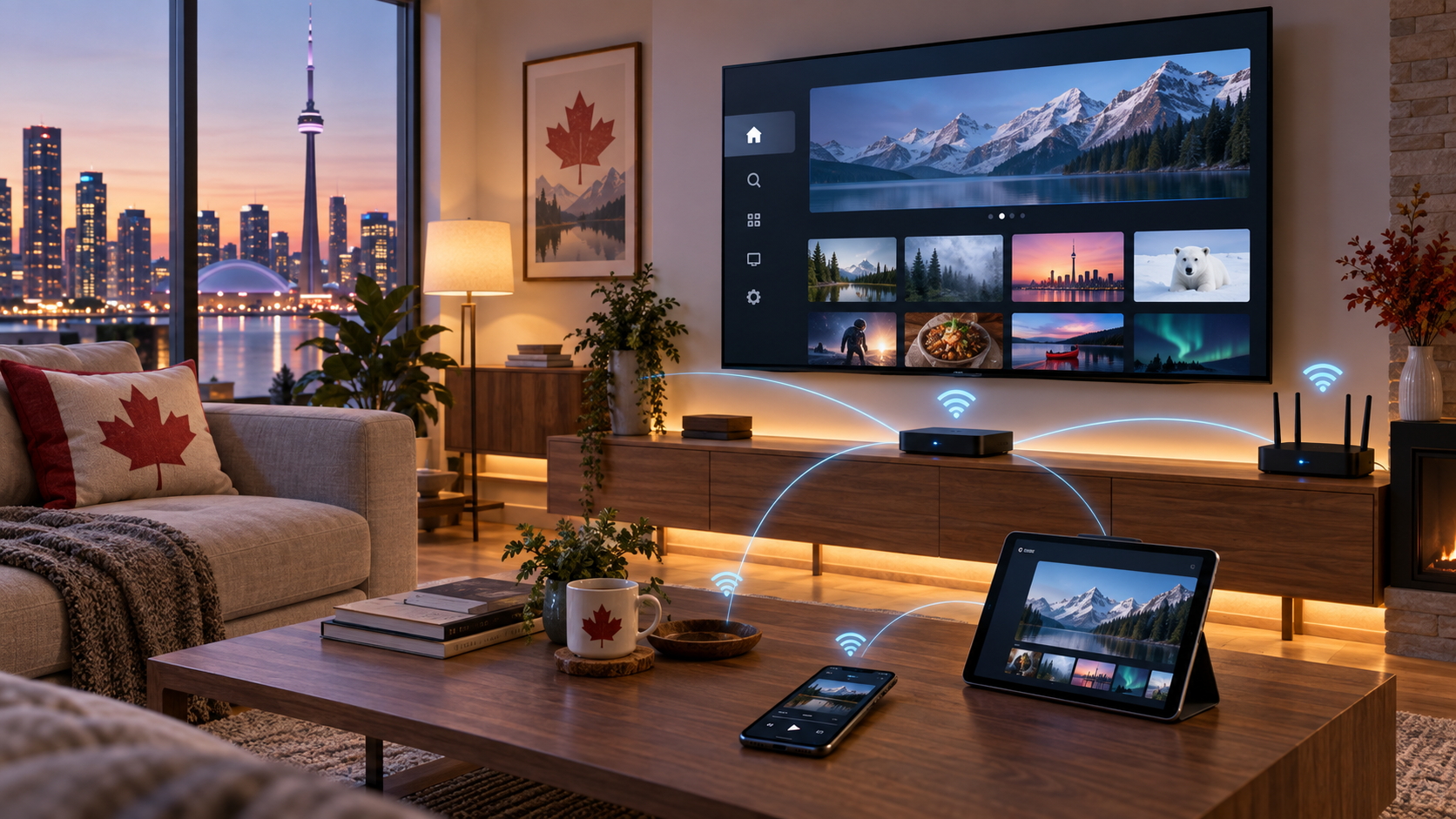
The Canadian living room has quietly become a technology environment.
A television is no longer simply a screen connected to a cable box. It can be a Smart TV, a streaming hub, a gaming display, a video-conferencing device, and an interface to dozens of internet-based entertainment services.
At the centre of this transformation is IPTV Canada, a technology that delivers television programming through internet networks rather than relying exclusively on traditional broadcast, satellite, or cable infrastructure.
For consumers researching the best IPTV experience, the decision is becoming less about finding the biggest channel number and more about understanding the technology behind the service: streaming stability, device compatibility, network performance, user experience, and content rights.
The rise of the IPTV box is another part of this evolution. Affordable connected-TV hardware has made it possible to bring internet-based entertainment to almost any modern television, changing the relationship between viewers and their screens.
For Canadians exploring how this ecosystem works, platforms such as IPTV Canada provide an example of how internet-based television services are being positioned around the modern connected home.
Television Has Become a Software Experience
For most of television’s history, the technology was relatively invisible to the viewer.
A broadcast signal arrived through an antenna. A satellite signal came through a dish. A cable connection delivered a predetermined package of channels.
The internet changed that model.
Today, television behaves increasingly like software.
Users can open applications, search for content, switch between services, receive updates, personalize interfaces, and access entertainment from multiple devices.
This is a fundamental change in how television is experienced.
The screen itself has become only one component of a much larger system consisting of broadband connectivity, applications, cloud infrastructure, content delivery networks, streaming protocols, and connected hardware.
IPTV sits inside this broader technological transition.
What Actually Happens When You Watch IPTV?
The basic concept is straightforward.
Instead of receiving a television signal through a traditional broadcast network, IPTV uses an internet connection to deliver video data to a compatible application or device.
Behind the scenes, however, the process is considerably more sophisticated.
Video content must be encoded, stored or received, distributed through servers, and delivered to viewers while adapting to different network conditions.
When thousands of people watch simultaneously, the infrastructure becomes particularly important.
A viewer may see only a simple interface with a channel list and a play button, but behind that interface can be a complex combination of servers, bandwidth management, content delivery systems, and authentication technologies.
This is one reason why two IPTV services can look similar on the surface while producing very different viewing experiences.
Why Internet Quality Matters More Than Most Viewers Realize
A common assumption is that a fast internet connection automatically guarantees smooth IPTV streaming.
It helps, but it is not the entire equation.
Streaming performance can be influenced by:
- Available bandwidth
- Wi-Fi quality
- Network congestion
- Server capacity
- Distance to infrastructure
- Video encoding
- Device performance
- Application optimization
- Peak viewing demand
This becomes particularly important in Canada because households can have very different broadband environments.
A viewer in a major urban centre with fibre internet may have a very different experience from someone relying on another type of connection in a smaller community.
The same IPTV service can therefore perform differently depending on the complete network path between the provider and the viewer.
The IPTV Box Is Becoming a Gateway, Not Just a Box
The traditional set-top box was designed around television.
Modern streaming hardware is designed around the internet.
That distinction matters.
An IPTV box can act as a gateway between a television and a wider ecosystem of applications and online services.
Instead of being limited to a fixed interface supplied by a cable operator, viewers can use compatible hardware to access different forms of digital entertainment.
The device itself, however, does not determine whether the content being accessed is authorized.
That distinction is important.
An IPTV box is hardware. IPTV is a delivery technology. The legality of a particular service depends on the content being distributed and whether the provider has the appropriate rights to distribute it.
Consumers should therefore evaluate the service as carefully as they evaluate the device.
Smart TVs Are Changing the Equation
The increasing popularity of Smart TVs has reduced the technical barrier to internet-based television.
A decade ago, a consumer might have needed an external streaming device to connect a conventional television to online services.
Today, many televisions already contain operating systems capable of running applications and connecting directly to the internet.
This has changed consumer expectations.
People increasingly expect television services to behave like smartphone applications.
They expect:
- Simple navigation
- Fast loading
- Search functionality
- Personalized recommendations
- Regular software updates
- Multi-language interfaces
- Support across different devices
The competition is therefore moving beyond content alone.
User experience has become part of the product.
The New Question What Makes a Good IPTV Service?
The phrase “best IPTV” can be misleading because different households have different requirements.
One viewer may care primarily about sports.
Another may prioritize movies and series.
A family may want a mixture of children’s programming and international channels.
A multilingual household may care about French, English, and international content.
The right way to evaluate an IPTV service is therefore to look at several factors simultaneously.
Content Selection
Does the service offer the types of programming the household actually watches?
A huge catalogue is not automatically useful if most of it is irrelevant to the viewer.
Streaming Performance
Does the service remain stable during busy periods?
Peak-hour performance is often more revealing than an off-peak test.
Device Compatibility
Does it work with the television, streaming device, smartphone, or computer the consumer actually owns?
Interface Quality
Can users quickly find channels and content without fighting through confusing menus?
Support
When something goes wrong, can the customer get meaningful assistance?
Transparency
Are pricing, subscription terms, refund policies, and content rights clearly explained?
These questions provide a more useful framework than simply comparing channel counts.
Why Peak Hours Are the Real Test
One of the most important characteristics of live streaming is demand.
A service can appear flawless when relatively few people are watching.
The situation changes when a major hockey game, international sporting event, or popular television programme attracts a large audience.
Suddenly, infrastructure capacity matters.
This is where concepts such as server capacity, bandwidth allocation, and content delivery become relevant to ordinary consumers.
Viewers do not need to understand the technical architecture in detail, but they can observe the result.
Does the stream start quickly?
Does the picture remain stable?
Does the service buffer?
Does the quality degrade when demand increases?
These practical questions can tell consumers more than a marketing claim about “4K” or “ultra-fast streaming.”
Multi-Device Viewing Is Becoming Normal
Canadian households are also becoming increasingly multi-screen.
One person might watch television in the living room while another uses a tablet. Someone else may watch content on a phone or laptop.
This creates another challenge for IPTV platforms: consistency.
A modern service needs to think beyond the television.
The application experience, authentication system, interface, and streaming infrastructure all need to work across different environments.
This is one reason internet-based television increasingly resembles other cloud-connected services.
The consumer is not buying access to a physical signal.
They are interacting with a digital platform.
IPTV and the Canadian Content Landscape
Canada’s television audience is unusually diverse.
The country has two major official languages and a large multicultural population with strong demand for international programming.
That creates opportunities for internet-based television services to build experiences around different viewing habits.
A viewer in Québec may have different priorities from a viewer in Alberta.
A household in Vancouver may want access to Asian programming alongside Canadian and American content.
A family in Toronto may consume several languages within the same household.
Internet-based delivery makes this type of segmentation technically easier because content can be organized digitally rather than around one fixed broadcast package.
The challenge is turning that flexibility into a simple consumer experience.
The Legal Question Should Never Be Ignored
There is an important distinction between IPTV technology and individual IPTV services.
IPTV itself is simply a method of delivering television over an IP network. The technology is not inherently illegal.
What matters is the content and the rights associated with its distribution.
Consumers should therefore investigate a provider before subscribing and should look for clear information about the service, its terms, and the rights associated with the programming it offers.
This is particularly important when a service promises access to premium channels, sports, or other content at prices that appear dramatically different from established providers.
The technology may be legitimate while a particular distribution model may not be.
What the Future of Canadian Television Could Look Like
The biggest change may not be IPTV itself.
It may be the disappearance of the idea that television needs to come from one provider.
The modern household can combine broadcast television, streaming platforms, internet-based television, YouTube, sports services, and other digital products.
The television is becoming the interface through which all of these experiences meet.
In that environment, the companies building the infrastructure and software behind connected entertainment will become increasingly important.
Faster networks will help.
Better compression technologies will help.
Improved Smart TV operating systems will help.
But perhaps the biggest competitive advantage will be simplicity.
Consumers do not want to think about servers, codecs, or network protocols.
They want to press a button and watch.
What Consumers Should Look For Before Subscribing
Before choosing an IPTV service, Canadian viewers can use a simple checklist:
1. Test the Service
If a legitimate trial is available, use it to evaluate actual performance rather than relying entirely on advertising.
2. Check Device Compatibility
Make sure the service works with the television, box, phone, or computer you intend to use.
3. Test During Peak Hours
Evening performance can reveal problems that are invisible during quieter periods.
4. Review the Subscription Terms
Understand pricing, renewals, cancellation, and refund conditions before subscribing.
5. Investigate Content Rights
Consumers should favor services that are transparent about the programming they distribute and the rights associated with it.
6. Look at the Complete User Experience
A large channel catalogue means little if the application is slow, confusing, or unreliable.
The Connected Living Room Is Only Getting Started
The evolution of television is no longer primarily about improving the picture on the screen.
It is about improving everything around the screen.
Connectivity, software, cloud infrastructure, streaming protocols, applications, and smart hardware are converging into a single entertainment ecosystem.
For Canadian consumers, this means more choice — but also more responsibility when evaluating services.
The future living room will likely contain fewer distinctions between “television,” “streaming,” and “internet video.” They will increasingly become different experiences delivered through the same connected infrastructure.
IPTV is an important part of that transition.
The technology gives television providers a flexible delivery mechanism, while consumers gain more control over where and how they consume digital entertainment.
The companies that succeed in this environment will not simply be the ones offering the longest channel list.
They will be the ones that combine reliable infrastructure, intuitive software, broad device compatibility, transparent service, and a genuinely useful viewing experience.
That is ultimately what the connected Canadian living room is demanding.







Comment