
The Best Local SEO Tools for Agencies Managing Multi-Location Clients in 2026

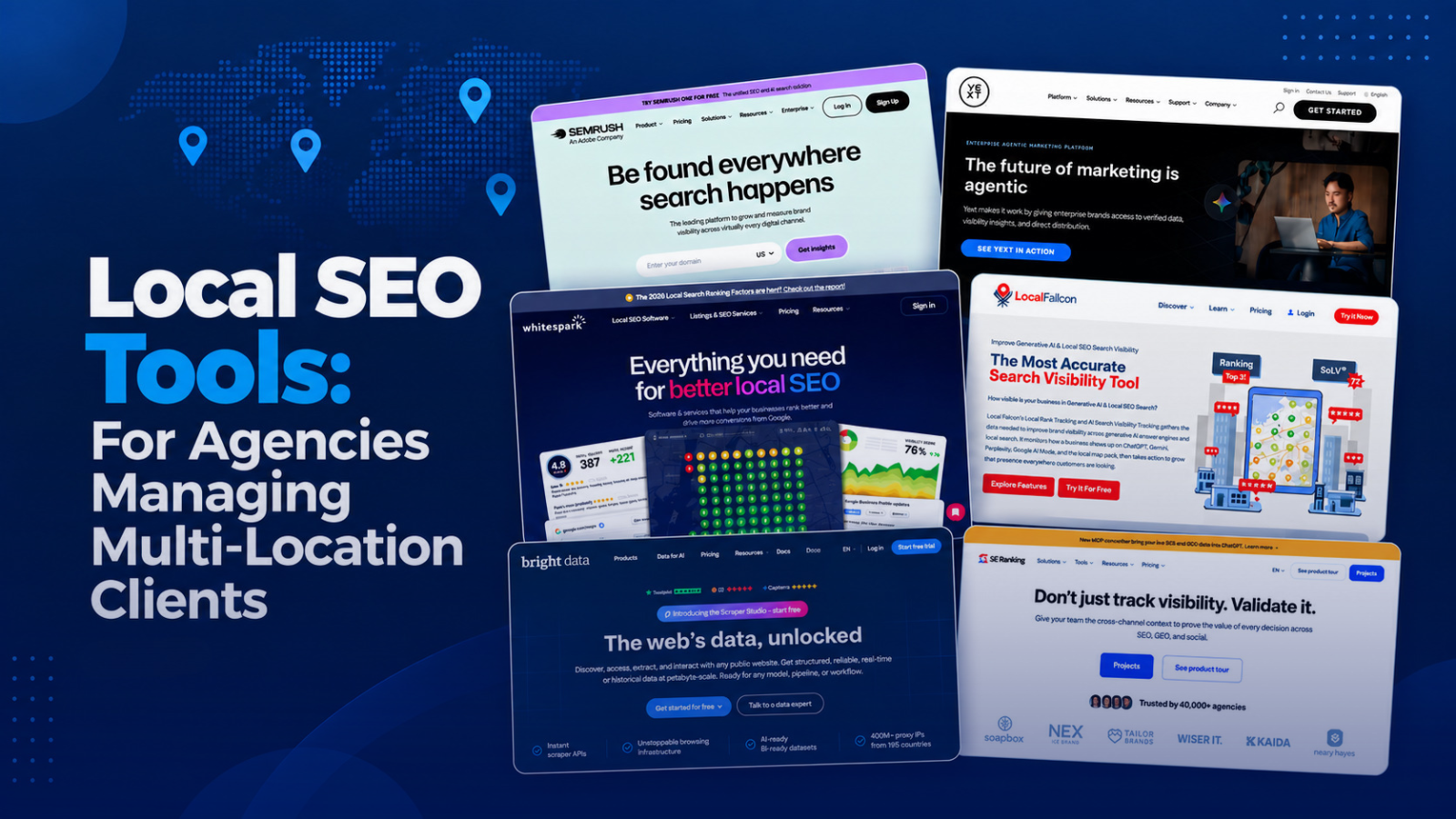
Take an agency running local SEO across forty client locations. Every week someone exports rankings, screenshots a geo-grid, and rebuilds the same report one client at a time, and at twenty-five minutes per location that is roughly 867 hours a year on documents most clients skim once. Demand is not the question: mobile searches pairing “near me” with a buy phrase grew more than 500% between 2015 and 2017, and that hyper-local intent has only hardened since. The local SEO tools that earn their place for agencies share one trait, an API that deletes the manual ritual instead of prettifying it.
Who this is for
This list is for agencies, not freelancers, solo consultants, or small in-house teams. Concretely: 10 to 100 staff; managing local SEO across many client locations or accounts, not one; needing white-label reporting alongside API or automation access to pipe data into a warehouse; and reporting per client to account managers who field the questions. If you run a single location in-house, most of these local SEO tools are overkill.
What agencies need from local SEO tools
Local SEO agency software clears a higher bar than single-location tools: the work multiplies across every client on the roster. Seven things separate the platforms that scale:
- API or data access to pipe rankings and audit deltas into a warehouse or a reporting layer
- MCP or AI-agent access, so account managers can query live client data in plain language
- White-label local SEO reporting under the agency’s own brand
- Bulk multi-client and multi-location workflows, not one-listing-at-a-time management
- Automated alerting when a client’s visibility drops, before the client notices
- Per-client roll-up reporting that folds many locations into one account view
- Predictable per-account cost that scales with the client roster
How we picked
We judged each of these local SEO tools on what an agency can actually run at scale: API and MCP depth, white-label output, bulk workflows, and the hours it removes per client per week. Build cost against hours saved set the ranking, not feature-list length: a long feature list does not make good local SEO software.
| Rank | Tool | API / MCP access | White-label reporting | Bulk multi-client workflows | Local coverage | Entry price |
| 1 | SE Ranking | Yes, API + MCP every plan | Yes (Agency Pack) | Yes | Geo-grid, GBP, reviews, listings | From $129/mo |
| 2 | BrightLocal | API + MCP server | Yes | Yes | Geo-grid, citations, GBP audit | From $31/mo |
| 3 | Local Falcon | API + MCP/Claude connector | Limited | Bulk grid scans | Geo-grid (Google + Apple), AI | From $24.99/mo |
| 4 | Whitespark | Limited | Reseller / white-label | Partial | Citations, ranking grids | From $10/mo |
| 5 | Yext | Enterprise API | Yes | Yes | Enterprise listings network | Quote-based |
| 6 | Semrush Local | API on core | Yes | Yes | Geo-grid, GBP, listings | Add-on on $139+/mo core |
Here are the six local SEO tools ranked for agency use, starting with the platform whose API and white-label reporting cover the most client work in one place.
1. SE Ranking

SE Ranking is a full SEO platform whose Local Marketing module, API, and MCP run and report local across client locations from one system.
Standout feature: API and MCP ship in every plan, not a premium tier, so you can pipe local rank, GBP, and listings data into a warehouse or an AI agent without a separate data tier. The Local Marketing module adds the Map Rank Tracker geo-grid and white-label reporting.
Why it works for agencies: The weekly per-client reporting ritual becomes a pipeline. API and MCP in every plan feed a warehouse or agent, white-label reports carry your brand, and one platform covers each client’s locations instead of a local tracker bolted to a reporting tool.
Pros:
- Feed a warehouse or AI agent through API and MCP in every plan
- Track service-area visibility with the Map Rank Tracker geo-grid, GBP, listings, NAP, and reviews
- Brand client reports as your own with the Agency Pack white-label reporting
- Forecast cost with predictable per-plan pricing, not per-location billing
Cons:
- Local rank tracker caps at 1,500 keywords and 3 locations per project on Core and Growth; many-client or many-location agencies need the Agency Pack or Enterprise
- Local is one module of a broad SEO platform, not a pure-play local tool
- Depth rewards systematic multi-client use over occasional lookups
Pricing: Core $129/mo ($103.20/mo billed annually), Growth $279/mo. API and MCP in every plan (Core 25,000 credits/mo, Growth 100,000). Agency Pack add-on from $69/mo annual for white-label at scale. 14-day trial.
Build vs buy: if your agency’s local work is the standard 80%, rank tracking, GBP, listings, and reports across clients, buying this beats building it. The API and MCP already expose what you would otherwise script: warehouse feeds and an agent that answers client questions. Build only where requirements are genuinely unusual.
2. BrightLocal

Agency-built local platform: geo-grid tracking, citations, GBP audits, reviews, white-label client reporting, and an MCP server for AI assistants.
Standout: The Local Search Grid returns geo-grid rankings per client location, and the white-label layer wraps every report in your own brand. The MCP server is the automation hook: an AI assistant queries local data directly, instead of an account manager exporting it by hand each week.
Why it works for agencies: White-label reporting and bulk per-client dashboards cut the weekly export ritual across accounts, and the MCP server lets an agent pull a client’s local data on request rather than through a manual data pull.
Pros:
- Purpose-built for local across many client locations
- White-label client reporting under your own brand
- MCP server lets an AI assistant query local data
- GBP audits and benchmarking plus citation building
Cons:
- Coverage limited to US, UK, Canada, and Australia
- No broad organic toolkit beyond local
Pricing: Track $31/mo, Manage $40/mo, Grow $49/mo, billed annually.
Where it fits: Buy this if your agency lives in local and wants reporting done for you. The MCP server lets an agent answer a client’s ranking question without a manual export. Outside its four countries, or for full organic SEO, add a second tool.
3. Local Falcon

One of the more focused local rank tracking tools: a geo-grid rank tracker with AI-visibility monitoring, an API, and an MCP/Claude connector, grid sizes 3×3 to 21×21, credit-based pricing.
Standout: The automation angle is the point: the API and MCP/Claude connector pipe geo-grid and AI-visibility data straight into your own reporting or an AI agent, rather than reading it off a dashboard. Grid sizes run 3×3 to 21×21, so you tune scan density per client location against credit spend.
Why it works for agencies: This is the automation-first pick: geo-grid and AI-visibility data an agency can wire into its own reporting or hand to an AI agent through the connector, instead of one more dashboard someone logs into each week.
Pros:
- API and MCP/Claude connector for piping data into pipelines or agents
- Geo-grid scans plus AI-visibility tracking in one tool
- Grid density adjustable per client location, 3×3 to 21×21
Cons:
- Credit-based pricing is hard to forecast across many client locations
- Tracking and analysis only; no listings or review management
Pricing: Starter $24.99/mo, Basic $49.99/mo, Pro $99.99/mo, Premium $199.99/mo; 100 free credits to start; pay-as-you-go credits $0.05 each.
The math: Credits are the variable to watch. A dense 21×21 grid across dozens of client locations burns them fast, and monthly credits expire, so the bill is hard to forecast. Set a credit ceiling per client before wiring it into a pipeline.
4. Whitespark

Unbundled local tooling, bought piece by piece. Local Citation Finder and the Listings Service are the strongest citation tools in this roundup, plus Local Rank Tracker, Local Ranking Grids up to 225 points, and Reputation Builder. No forced bundle, and the services white-label cleanly for resale under your own brand.
Why it works for agencies: Citation-heavy resellers get the deepest citation tooling in the category without buying a full platform, then repackage the Listings and citation work as a branded client deliverable under their own name.
Cons: the a-la-carte model means several separate subscriptions to track per client, which adds admin hours at scale. API access is limited and not the focus here, so piping data into a warehouse or agent is harder than with API-first tools. The all-in-one dashboard stays thinner than rivals.
Pricing: Local Ranking Grids from $10/mo; Local Rank Tracker $14-200/mo; Local Citation Finder $33-149/mo.
Where it fits: if citations are your billable core, nothing here beats the tooling. If you want one API feeding every client report, the fragmentation costs you hours.
5. Yext

Enterprise digital-presence and knowledge-graph management with a deep publisher network, AI search features, and the governance controls large brands demand: role permissions, approval workflows, and listings control across hundreds of locations. Yext exposes an enterprise API and runs a partner program agencies can build integrations on, though the specifics sit behind sales conversations rather than public docs.
Why it works for agencies: Agencies serving large franchise or multi-brand clients that need listings governance at scale get a control layer built for that scale, plus a partner track for wiring Yext data into their own client reporting.
Cons: enterprise-priced and quote-based now that self-serve is retired, so budgets start high and are hard to forecast. It is overkill for agencies whose clients sit below a few hundred locations each. It is not a geo-grid rank tracker, so pair it with one.
Pricing: quote-based; contact sales, no public number.
The math: franchise-scale clients justify the spend. Below a few hundred locations per client, you are paying enterprise pricing for governance that sits idle.
6. Semrush Local

A local add-on layered on the Semrush core platform: Listing Management, Map Rank Tracker, GBP, and review management. The core exposes an API, so agencies already piping core data into reporting can extend the same pipes to local. It sits at rank 6 for a reason: it earns its place only when the core subscription is already in the stack.
Why it works for agencies: Fits agencies already standardized on Semrush core across every client. The local layer reuses the logins, data, and API you already run, so there is no new vendor to onboard.
Cons: local is a paid add-on on an already-premium core, and the per-location cost stacks across every client location you track. Not already on Semrush core? Little reason to start here for local alone.
Pricing: Semrush core $139-549/mo; the Local add-on is priced separately per location.
Build vs buy: already on Semrush core across clients? Add local and skip a second vendor. If not, the per-location cost stacks fast, and a dedicated local tool is the better-scoped build.
How to choose local SEO tools by agency profile
Match these local SEO tools to how your team already works, then run the hours ledger before you sign anything.
- Want one white-label platform with an API across every client: SE Ranking. Local tracking, GBP, and citations in one login; API plus MCP ship in every plan, so pipelines and agent queries need no separate contract.
- Local-only agency living on citations and client reports: BrightLocal. Purpose-built for citation audits and white-label reports; buy it when that is your standard 80%.
- Automation-first team wiring geo-grid or AI-visibility data into pipelines or agents: Local Falcon. Its MCP/Claude connector lets an agent pull grid data directly. Watch the credit budget.
- Citation-heavy reseller: Whitespark. Unbundled citation and grid tools with reseller pricing; the API is limited, so plan the manual steps.
- Enterprise franchise clients needing listings governance: Yext. The partner API and listings control fit hundreds of locations under one policy.
- Already standardized on Semrush core: Semrush Local. The add-on avoids a new contract, but per-location cost stacks per client.
Skip if you run a handful of client locations. Leave it manual: for three or four locations, a per-store GBP app plus a shared spreadsheet often beats a platform seat. Automate only when the weekly hours justify the license.
FAQ
How do agencies manage local SEO for multiple clients at scale?
The strongest local SEO tools let them run every client through one platform with per-account roll-ups, then pipe rank, GBP, and citation data through an API into a warehouse. Automated alerts flag visibility drops per client, so managers review exceptions instead of hand-exporting each account weekly.
What should agencies look for in local SEO tools?
Prioritize API and MCP data access, white-label reporting, and bulk multi-client, multi-location workflows. The best local SEO tools also expose per-client roll-ups and predictable per-account pricing, so a new retainer never forces a manual reporting ritual or an unbudgeted seat.
How do you white-label local SEO reports for clients?
Set your logo, colors, and domain in the platform’s reporting settings, then schedule branded PDF or live-portal reports per client. Platforms with an API let you skip their templates entirely and assemble reports in your own stack for fully custom client-facing deliverables.
How do you share a Google Business Profile with a marketing agency?
In Google Business Profile, open Business Profile settings, choose People and access, then add the agency email as a Manager. Manager rights allow posts, edits, and review replies without transferring ownership, so the client keeps control if the retainer ends.







Comment