
Thatching Has No Certificate: What Happens When Digital Demand Meets a Craft Passed Down by Hand

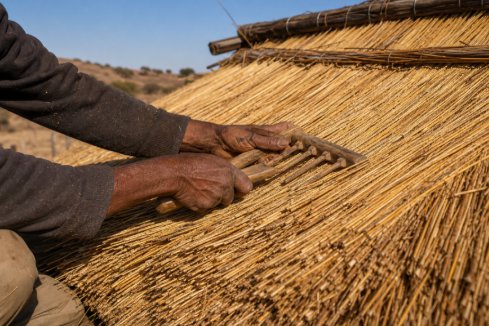
There is a particular motion in thatching that has no name outside the trade: combing a fresh coat of reed so that every strand sheds water off its cut end rather than wicking it inward. A thatcher does this by feel, roof after roof, for years before anyone would call the work finished-looking rather than merely finished. It is one of the oldest building techniques still practised anywhere, essentially unchanged for centuries, and today it is most often found the newest possible way: through an online enquiry form.
That collision is the subject of this piece. The person combing that coat holds no certificate saying they can. There is no licence, no public register, no exam a homeowner could ask to see the results of. When a craft was never written down in the first place, the digital layer that now sells it may be the first thing that has ever mapped it at all.
A trade with no certificate
“Undocumented” is a precise word here, not a rhetorical one. An electrician in South Africa needs a wireman’s licence. A plumber registers with a trade body. A thatcher needs neither. A national construction standard exists — SANS 10407 sets out how thatch should be built — but there is no equivalent register of certified practitioners that a homeowner, insurer or regulator can check a name against. The standard describes the work; it does not certify who is competent to do it — a distinction the UK’s Historic England draws just as sharply in its own technical guidance on thatch conservation, where construction advice and practitioner competence are treated as two separate questions entirely.
What substitutes for certification is entirely tacit knowledge, and it is substantial. A competent thatcher knows the difference between Cape reed and thatching grass — different fibres, different handling, different ageing behaviour — and which one suits a given roof and budget. They can judge coat thickness by eye and hand rather than by a spec sheet, and they know a roof needs a pitch steep enough to shed water fast, well beyond what a tiled roof gets away with, or it holds moisture and begins to rot from the inside of the coat outward. Perhaps most tellingly, they can look at an ageing roof and tell, without much deliberation, whether it can be combed and spot-repaired for another few seasons or whether it has to be stripped back to the batten and re-thatched entirely.
None of that is taught from a manual. It is learned by standing next to an experienced thatcher for years, watching judgment calls get made and occasionally getting them wrong under supervision before being trusted to make them alone. That is how skilled trades without formal credentialing have always reproduced themselves — and it is also exactly the kind of knowledge that a shrinking, ageing pool of practitioners can simply take with them when they stop working, a risk substantial enough that Heritage Crafts, the UK body that formally tracks craft viability, lists thatching among the skills it monitors for decline.
How digital demand quietly draws the map
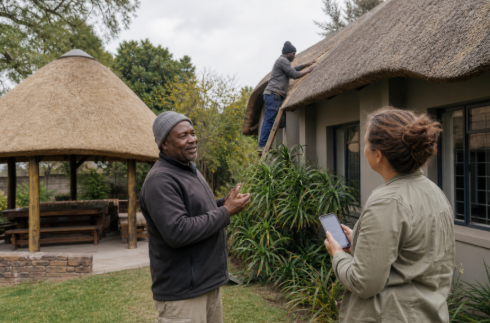
Here is the analytical turn. A platform built purely to route enquiries to thatchers cannot treat “a thatcher” as a single interchangeable category, however tempting that would be operationally. A new-build roof, a re-thatch, a storm-damage repair, a lapa — the open-sided thatched entertainment structure common in South African gardens — and the fire-and-lightning safety work are meaningfully different jobs, done well by different people with different strengths. To route an enquiry correctly, the platform has to know, concretely, which independent thatcher in its network can actually do which kind of work.
In solving that narrow operational problem, enquiry-routing quietly produces something the trade itself never had: a structured, current record of who can do what, and where. Thatching Gauteng is a useful worked example — a matching platform that has been aggregating this kind of demand across Gauteng since 2016, maintaining a network of more than thirty vetted independent thatchers checked on experience and references, insurance and a workmanship guarantee before any enquiry is routed to them, and earning a disclosed referral fee for each introduction it makes rather than doing any thatching itself. The company is incidental to the argument. What matters is the pattern it illustrates: a private demand-aggregator, built to sell introductions rather than to preserve anything, has ended up holding the closest thing this trade has to a practitioner map the state never thought to keep.
What the registry preserves — and what it can’t
This is where the honesty has to hold, because a routing map and a knowledge base are not the same object. What gets recorded is who can do the work and that they were checked against some baseline — insurance, references, a guarantee. What does not get recorded, and cannot be, is the knowledge itself: the feel of a coat combed true, the read on a ridge — the vulnerable apex where two roof slopes meet, capped and sealed by hand — that is starting to fail before it visibly leaks, the judgment of whether a fire-and-lightning package on a given roof is genuinely handled or merely ticked off a list.
The safety layer deserves the same honesty. Fire-retardant treatment reduces how readily a thatch roof ignites and how fast fire spreads across it; it does not and cannot make dried plant fibre fireproof, and any claim to the contrary should be treated as a red flag rather than a selling point. On South Africa’s Highveld, among the highest lightning-strike densities anywhere on the planet, SANS-compliant lightning protection is not decoration but a load-bearing part of owning thatch responsibly. SANS 10407 gives the technical baseline a competent thatcher can speak to in detail. Insurance cover for thatch is often conditional on measures like these being verifiably in place, which is a fact about the industry rather than advice to any individual reader.
A registry can list a practitioner who understands all of this. It cannot transmit the understanding itself. When the current pool of thatchers ages out, whatever the registry recorded will still exist; the judgment behind it will not, unless someone deliberately teaches it on before that happens.
Why this matters beyond one roof
Thatch is a clean illustration of a much larger pattern, not a special case. Heritage masonry, blacksmithing, timber framing, specialist restoration work — an entire tier of skilled, often safety-relevant crafts sits outside formal credentialing, its competence held tacitly by practitioners who learned by hand and whose numbers are thinning, a trend reported well beyond thatch itself —the BBC has covered the same shrinking-practitioner story across several heritage trades in recent years. As demand for these trades increasingly moves through digital channels, the platforms built to route that demand become, almost as a side effect, the closest thing to a live census of who can still actually do the work.
That is a genuine and largely unremarked piece of labour-market infrastructure — built to sell introductions, useful for something its builders never set out to create. It leaves an open question worth sitting with: a map of remaining practitioners is not a plan to replace them. Knowing precisely how thin a skilled pool has become is only the first thing anyone would need before deciding what, if anything, to do about it.
The craft was never written down. The thing now quietly writing it down was built to sell it, not to save it. Whether that accidental record becomes a tool for keeping the skill alive, or simply an efficient way to spend down what is left of it, is a choice every uncatalogued trade like this one is going to face over the next decade.






Comment