
TDEE Calculator: How to Find Your Daily Calorie Needs (Step-by-Step Guide)

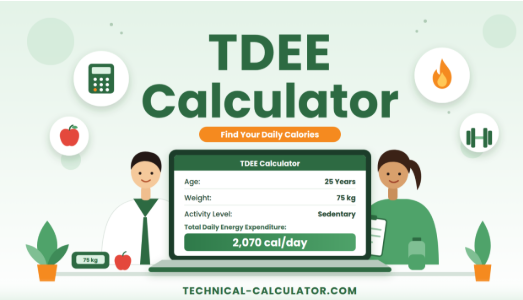
Most people guess how many calories they should eat, and guessing is why so many diets stall. A TDEE calculator replaces the guesswork with a number based on your age, weight, height, and activity level. In this guide, you will learn what total daily energy expenditure means, how it is calculated, and how to turn it into a realistic plan for fat loss, muscle gain, or maintenance.
What Is TDEE?
TDEE stands for total daily energy expenditure. It is the total number of calories your body burns in 24 hours, from breathing and digesting food to walking and training. Think of it as your maintenance calories: eat around this number and your weight should stay roughly stable.
Your daily calorie needs are made up of four parts:
- Basal metabolic rate (BMR): calories burned at rest to keep you alive. This is the biggest share, roughly 60 to 75 percent for most people.
- Thermic effect of food: energy used to digest and absorb what you eat, around 10 percent.
- Exercise: calories burned during planned workouts.
- Everyday movement: walking, standing, chores, and fidgeting.
Why Use a TDEE Calculator?
Generic advice such as “eat 2,000 calories a day” ignores how different people are. A 25-year-old man who lifts weights and a 55-year-old woman with a desk job can differ by well over 1,000 calories. A TDEE calculator gives you a personal maintenance level, which makes every later decision easier: how big a deficit to run, how much to eat while building muscle, and how to tell whether your plan is working. It also protects you from crash diets that cut far more than your body needs.
BMR vs TDEE: What Is the Difference?
BMR is what you would burn lying still all day. TDEE is BMR plus digestion plus every bit of movement. That is why TDEE is the better number for planning your diet, since nobody lives at complete rest.
The TDEE Formula (Mifflin-St Jeor)
A good TDEE calculator uses the Mifflin-St Jeor equation, which research has found to be among the most reliable ways to estimate resting energy needs in healthy adults. It works in two steps.
Step 1: Find your BMR. For men, BMR equals (10 × weight in kg) plus (6.25 × height in cm) minus (5 × age in years) plus 5. For women, use the same formula but subtract 161 instead of adding 5.
Step 2: Multiply by an activity factor. This turns your BMR into your TDEE.
| Activity level | Typical week | Multiplier |
| Sedentary | Little or no exercise | 1.2 |
| Lightly active | Exercise 1 to 3 days | 1.375 |
| Moderately active | Exercise 3 to 5 days | 1.55 |
| Very active | Hard exercise 6 to 7 days | 1.725 |
| Extremely active | Very hard training or physical job | 1.9 |
TDEE Calculation Example
Take a 25-year-old man who weighs 75 kg, stands 175 cm tall, and has a desk job. His BMR is 750 plus 1,094 minus 125 plus 5, which is about 1,724 calories. Multiply that by 1.2 for a sedentary lifestyle and his TDEE is about 2,070 calories per day.
If the same man trains hard and moves more, his numbers climb quickly: about 2,372 calories when lightly active, 2,674 when moderately active, 2,976 when very active, and 3,278 when extremely active. The activity level you pick matters as much as the formula itself.
How to Use a TDEE Calculator
Using the TDEE Calculator takes under a minute. You can find a free version on Technical Calculator, where the steps are simple:
- Select your gender, since the formula uses a different constant for men and women.
- Enter your age, weight, and height in the units you prefer.
- Choose your activity level based on a normal week, not your best week.
- Add your body fat percentage if you know it. This field is optional.
- Press Calculate to see your results.
The result shows your TDEE for every activity level, your BMI, calorie targets for weight loss or gain, and a macronutrient split in grams.
Turn Your TDEE Into a Goal
Once you know your maintenance calories, you can adjust them:
- To lose fat: eat below your TDEE. A moderate deficit of about 400 to 500 calories a day points to roughly 0.5 kg of loss per week, since 1 kg of body fat holds about 7,700 calories. In the example above, that means around 1,656 calories a day.
- To maintain weight: eat close to your TDEE, which is 2,070 calories in the example.
- To build muscle: eat slightly above it. A mild surplus of about 2,277 calories supports steady gain without too much fat.
Whichever goal you choose, keep protein high and avoid very low calorie targets unless a doctor or dietitian is guiding you.
Common TDEE Mistakes to Avoid
- Overestimating activity. Most people rate themselves as more active than they really are.
- Treating the number as exact. It is an estimate. Track your weight for two to three weeks, then adjust.
- Never recalculating. Your TDEE changes when your weight, age, or routine changes, so check it every few months.
- Cutting too hard. Extreme deficits are hard to sustain and can cost you muscle.
Final Thoughts
A TDEE calculator is the fastest way to stop guessing and start planning. It will not be perfect, but it gives you a solid starting point that you can refine with real results. Run your numbers, pick a realistic goal, and adjust as you go.
This article is for general information only and is not medical advice. Speak to a doctor or registered dietitian before making major changes to your diet.







Comment