On September 19, 2026, Speediance outlined a broader direction for its fitness ecosystem, spanning AI, movement analysis, recovery context and connected training hardware.
Best known for Gym Monster and its use of digitally controlled resistance, the company has outlined enhancements to three AI capabilities—Oryn, Votus and Somni—alongside an AI-powered experience layer called AEVIS. It is also showcasing Gym Monster 3, Gym Monster Ultra, Gym Nano and Speediance Strap as it extends its product range across home strength training, portable performance measurement and physiological sensing.
The three AI capabilities address different parts of the training process. Votus is designed to understand how someone is moving, Oryn focuses on decisions involving training and recovery, and Somni explores how different choices could influence possible future states. AEVIS is being developed to connect relevant context across those capabilities over time.
The broader idea is to move beyond using AI to generate an isolated workout. Speediance is working toward a system that can consider movement, training and recovery information when supporting decisions about what may be appropriate next, with closer links to the physical training experience forming part of its longer-term direction.
AI capabilities cover different parts of training
Votus is the movement-intelligence component of Speediance’s approach. Using the visual input from a single phone camera, the model is designed to reconstruct human movement in 3D and analyze how an exercise is being performed while it is taking place.
In demonstrations shown by Speediance, Votus was used for movement analysis and velocity-based training. This allows information about exercise execution and repetition speed to be considered alongside more conventional training data. The phone provides the visual input, while Votus acts as the movement-understanding layer.
Speediance is currently demonstrating Votus within its own fitness ecosystem. The company is not presenting it as standalone software already deployed across conventional gyms.
Oryn focuses on exercise, nutrition and sleep. Rather than simply generating a workout from a prompt, it is being developed as a decision layer that can help assess an appropriate training approach based on a broader picture of the user.
Depending on the context available, that could mean maintaining a planned session, adjusting the training load, changing the focus of the workout or prioritizing recovery. The aim is to consider relevant training and recovery conditions instead of treating every workout as an isolated event.
Somni takes a longer-term view. Described by Speediance as a human-state world-model research project, it explores how different training and recovery choices could influence possible future states, including fatigue, sleep, appetite and trainable capacity.
The system is not intended to predict one outcome with certainty. Instead, Somni is being developed to reason across different possible trajectories and the trade-offs associated with them.
Somni remains a technology preview. It is not a medical device and is not intended to diagnose, treat, cure or prevent any disease.
AEVIS Carries Context From One Day to the Next
AEVIS is the experience layer Speediance is developing to bring these capabilities and sources of information together over time.
Unlike a conventional chatbot that responds to each question separately, AEVIS is designed to maintain relevant context around training history, available physiological and recovery signals, sleep, nutrition and daily schedules. That context could then influence subsequent training decisions as the user’s circumstances change.
Speediance demonstrated the concept through a scenario involving an upcoming six-hour round-trip drive. After the user told AEVIS about the journey, the system responded by reducing the planned training load and placing greater emphasis on sleep and recovery around the trip.
Following the workout, the demonstration showed AEVIS using workout information, movement video and heart-rate data to reassess the user’s condition. The subsequent plan then shifted toward mobility work and active recovery.
The individual recommendations were examples of a broader emphasis on continuity. Relevant context from one workout, one day or one change in schedule could inform what happens next without requiring the user to begin again with each interaction.
Speediance is also exploring how AI could connect with training hardware
Beyond training recommendations, Speediance is previewing what it describes as embodied intelligence within its fitness ecosystem.
Under this model, the system collects information about the user and the workout, AI interprets that information, and connected equipment could increasingly serve as the physical execution and feedback layer.
Speediance demonstrated this direction on Gym Monster, showing how AI decisions could eventually connect more directly with physical resistance and how the results of a workout could provide new information to the system.
The demonstration represents a longer-term direction rather than an existing autonomous control function. AEVIS does not currently control Gym Monster resistance autonomously, and deeper integration between Speediance’s AI systems and its training hardware remains on the company’s roadmap.
The hardware portfolio spans training, measurement and recovery context
The four hardware products presented alongside the AI capabilities cover different parts of the fitness process.
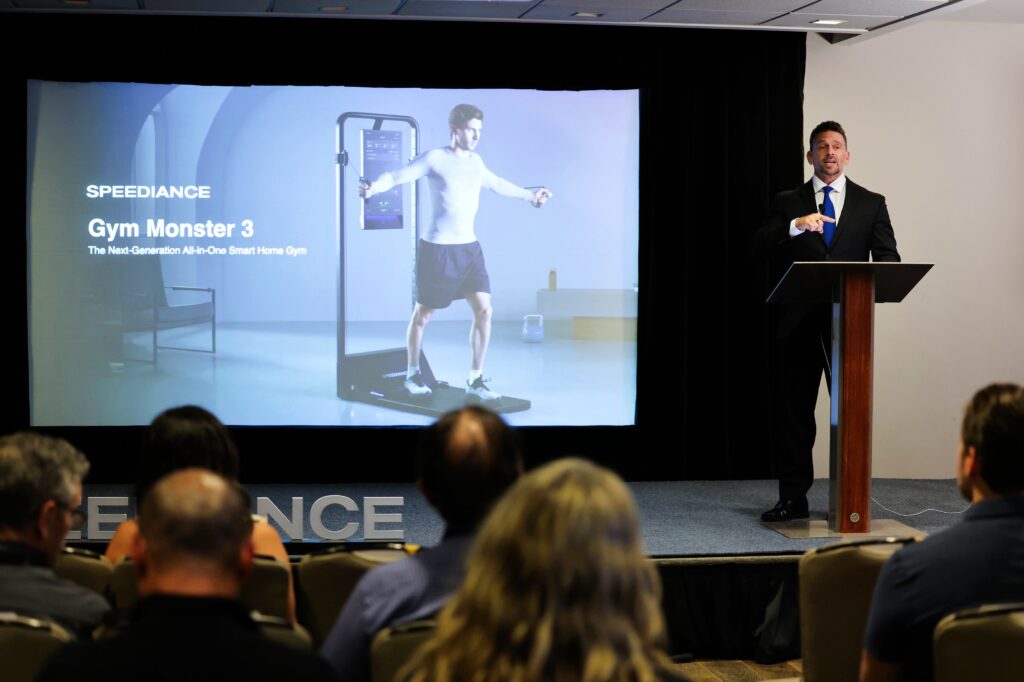
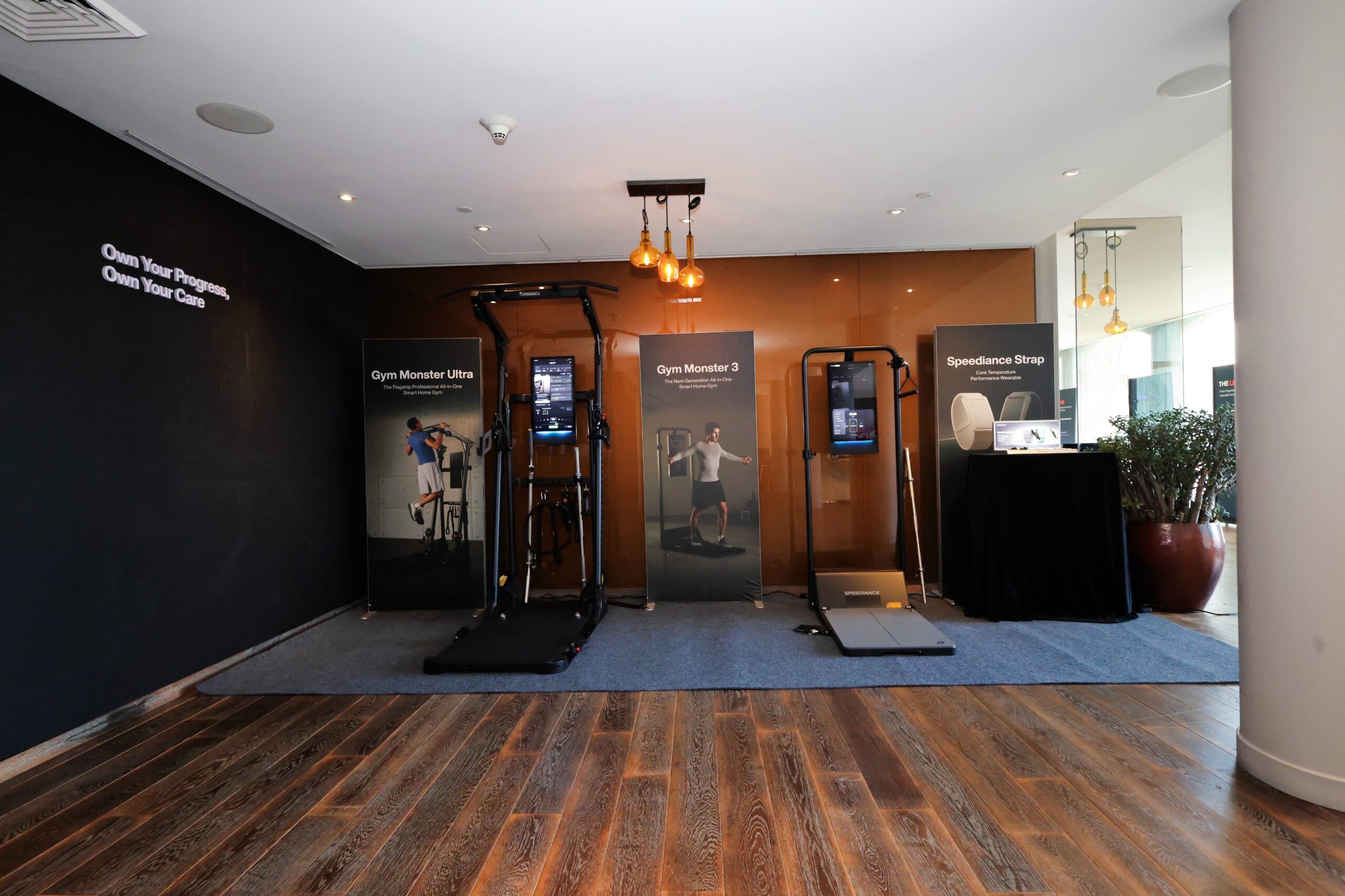
For home strength training, Gym Monster 3 is Speediance’s next-generation intelligent training platform. It provides up to 220 pounds of digital resistance through 19 cable positions and uses a freestanding design that does not require wall mounting.
Gym Monster Ultra is positioned as the company’s flagship system for more advanced strength training. It increases the available digital resistance to 260 pounds and includes a vertical high-lat pulldown, a multi-grip pull-up setup, an adjustable thigh restraint and 33 cable positions.
Gym Nano applies digital resistance and performance measurement to a portable 8.2-kilogram system. It can deliver up to 220 pounds of resistance while providing real-time velocity and power information. It also supports performance assessments including peak force, rate of force development and left-right asymmetry.
Speediance Strap focuses on physiological and recovery context between workouts. The screen-free wearable incorporates greenteg Calera® technology to track core body temperature trends at the wrist, providing additional context around training, recovery, sleep and heat load.
These products address home strength training, more advanced movement configurations, portable performance assessment and physiological sensing. Speediance’s longer-term strategy is to connect more of these capabilities through a shared intelligence layer rather than treating each product as a completely separate experience.
Founded in 2020, Speediance established its early presence around Gym Monster and digitally controlled resistance training. The announcement extends that direction across connected strength hardware, portable performance technology, physiological sensing, movement intelligence and AI-supported training decisions.