
Signing a Data Licensing Deal Is Not the Same as Getting Paid

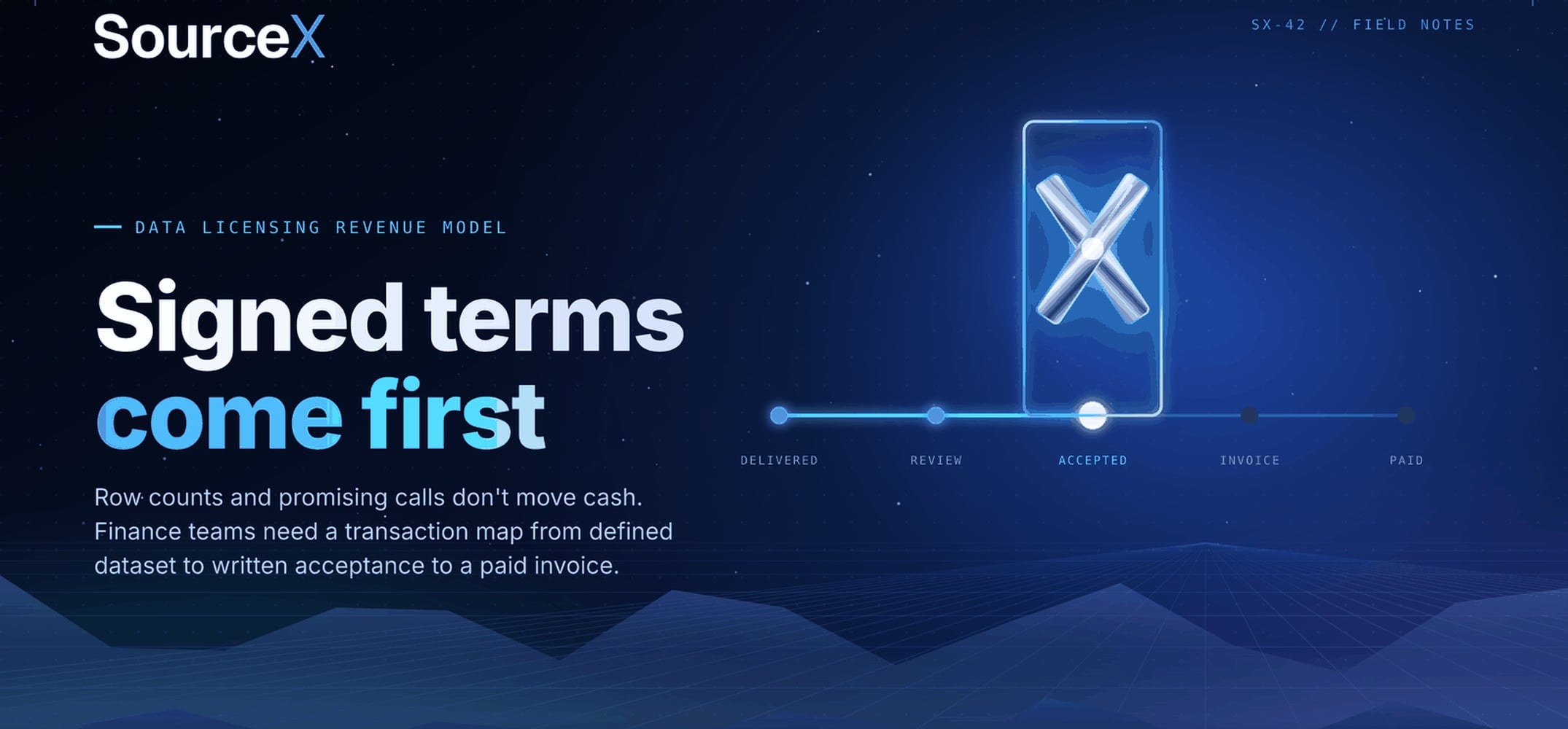
Row counts and promising calls don’t move cash. Finance teams need a transaction map from defined dataset to written acceptance to a paid invoice.
A standard SourceX deal requires written acceptance and Closing before an invoice. Finance assesses revenue recognition separately.
A company can spend weeks discussing an attractive data licensing fee and still be unable to answer the one question that determines whether cash ever arrives: what, precisely, has to be delivered and accepted?
Until that’s answered, the deal is a conversation, not a revenue line. A row count describes scale. It doesn’t prove the records are useful, complete or inside the rights being granted.
A credible data licensing revenue model links three things: a defined collection, a permitted use and an acceptance process both sides understand. Get those right and the economics become legible to a CFO, a board or a lender. Leave them vague and even a large number is fragile.
THE SHORT VERSION
- The question that decides cash isn’t “How big is the dataset?” It’s “What exactly must be delivered and accepted?”
- Price drivers like depth, uniqueness and clear rights shape value. There’s no universal price per row, employee or gigabyte.
- Map every event from signed terms to written acceptance, Closing, invoice and payment, and mark what’s signed versus indicative.
What exactly is being licensed?
Name the unit. It might be a historical snapshot, a set of fixed-price lots or a schedule of agreed deliveries. Describe the systems, date ranges and record categories rather than leaning on a phrase like “our enterprise data”.
Then say what the material can do. A connected service history shows decisions and outcomes. A static table offers a different, usually narrower, kind of utility. Neither should be valued as if every row were a distinct, verified and commercially useful example.
What drives the price of business data?
Value tends to follow signals like historical depth, coverage, uniqueness, documented outcomes and clear ownership. SourceX, for example, evaluates ten fit signals, among them volume, depth, uniqueness, whether the work shows how it ended and clear ownership, and states plainly that this is not a valuation.
None of these produce a universal price per employee or per gigabyte. Any indicative range should travel with its assumptions. If a review excludes a major category or finds missing context, the commercial description changes too.
An indicative estimate is not an invoiceable amount. A positive call is not written acceptance.
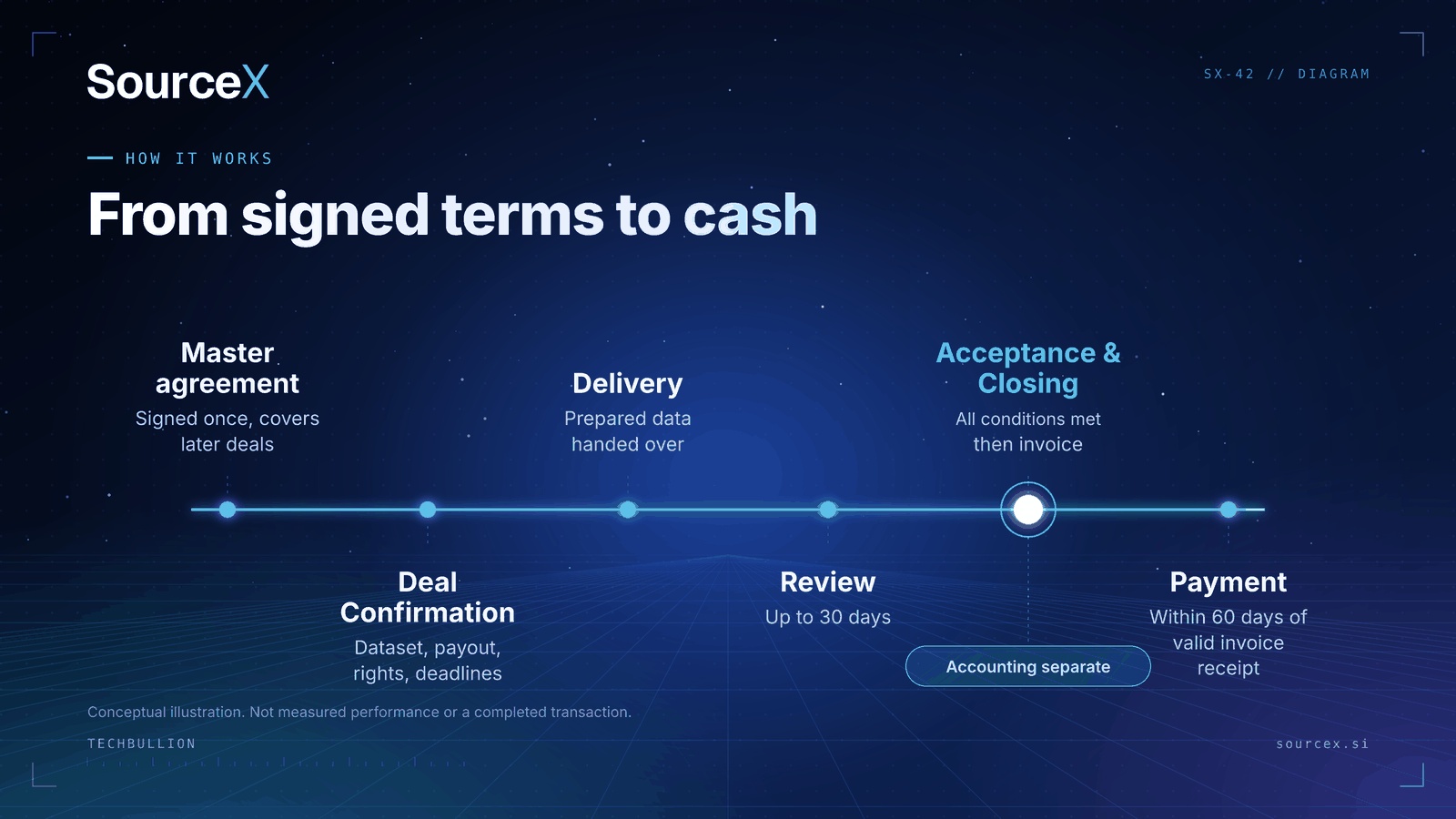
Sequence based on SourceX’s published process; review and payment periods apply unless different terms are signed.
How do review, acceptance and changes work?
The agreement should spell out when review starts, what supports acceptance and how any change in scope or price gets recorded. Partial purchases deserve explicit treatment. A buyer shouldn’t be assumed free to accept any fraction of a dataset at a proportional price; under SourceX’s terms, buying part of the data requires fixed-price lots agreed up front or a signed amendment.
Keep the delivery manifest aligned with the signed description. If the prepared artifact differs materially, resolve it before anyone books the transaction as complete.
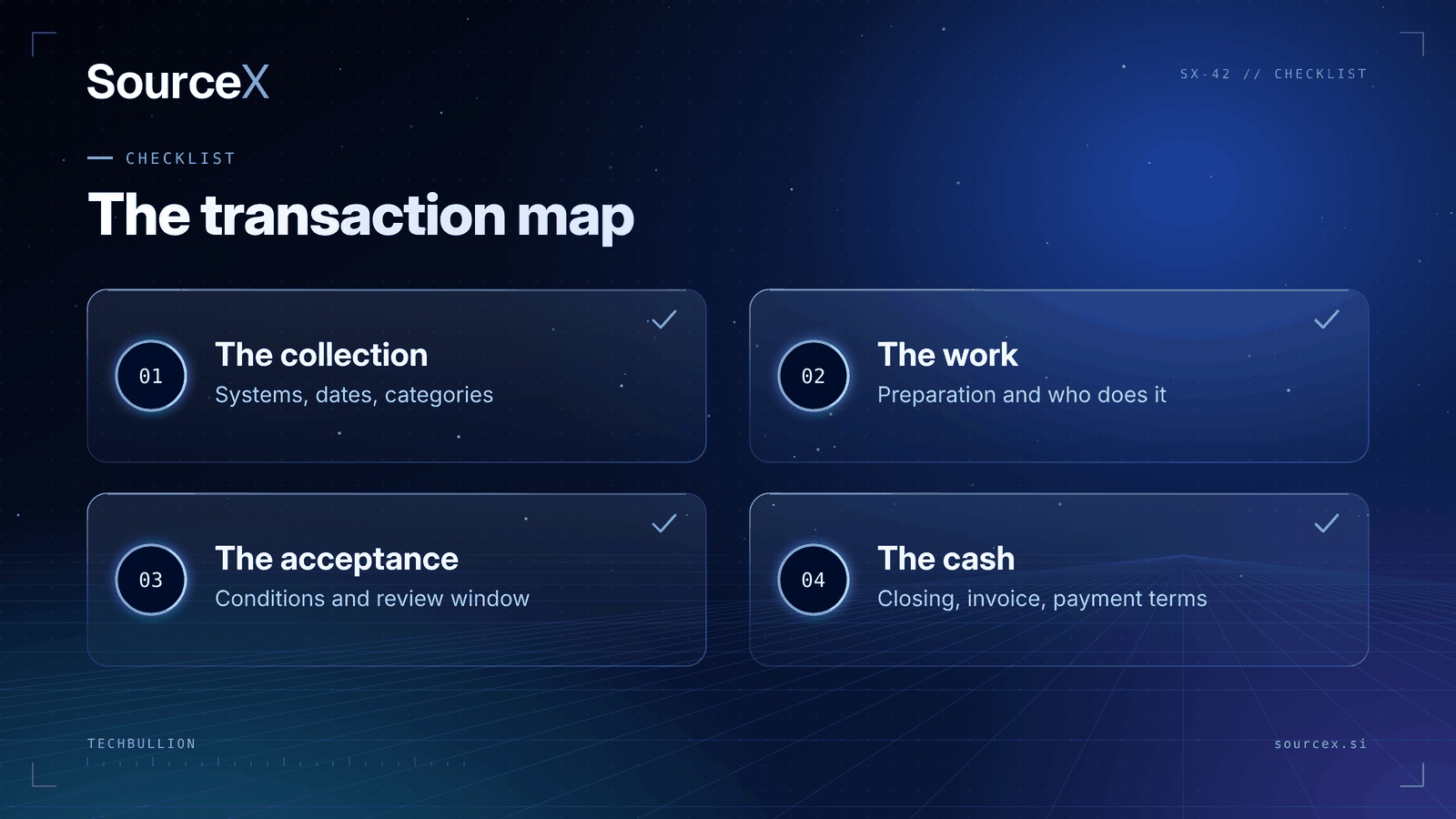
Four parts of a transaction map that make a data licensing revenue model credible.
When does a data licensing deal turn into cash?
Here’s how the sequence works at SourceX, a company that licenses approved business data for AI training and evaluation. It’s a useful model of where the real cash events sit:
- One Master Supplier Licensing Agreement, signed once, covering later deals
- A Dataset Deal Confirmation that fixes the exact dataset, payout, rights and deadlines
- Commercial commitment sought by SourceX, with feedback usually in 7 to 14 days (a target, not a promise); positive interest is not a purchase
- Extraction and delivery after both documents are signed and SourceX gives the go-ahead; delivered-data review runs up to 30 calendar days from the event in the Confirmation
- Written acceptance plus every Closing condition, recorded in a Closing Notice; the company then invoices
- Payment due within 60 calendar days after SourceX receives a valid invoice, unless different terms are signed
SourceX deals are usually a one-time fee per dataset, with some agreements specifying recurring deliveries. There are no royalties or usage fees under its standard supplier terms. Data that does not reach Closing earns no payment; declined copies are destroyed within 30 days, subject to standard retention processes and applicable law.
SourceX advertises compensation of up to $4 million. For a forecast, read that as the ceiling for the largest enterprise datasets, not a typical payment, and remember that qualifying doesn’t guarantee an offer. The companies it targets peaked at 50 or more full-time employees and have several years of operating history.
How do rights change the financial comparison?
You retain ownership of your original records. The selected data is exclusive to SourceX for AI training for the term set in the Dataset Deal Confirmation. Separately, SourceX’s rights to the deidentified dataset are perpetual, irrevocable, transferable and sublicensable, including training, evaluation, products and onward distribution. Once the fee is paid, those rights survive termination; there is no obligation to untrain or delete models already built from the data. Read that grant alongside the price and your own AI plans.
What should finance ask for next?
A one-page transaction map:
- The collection, in systems, dates and categories
- The preparation work required, and who does it
- Acceptance conditions and the review window
- The Closing event and invoice trigger
- Payment terms and timing
Then mark every line as either indicative or signed.
A licensing opportunity becomes easier to assess when the transaction map shows what is signed, what remains conditional and when payment is due. Finance must separately determine revenue recognition from the actual contract and applicable accounting rules. Acceptance, invoicing and cash collection are related events, not interchangeable accounting tests.
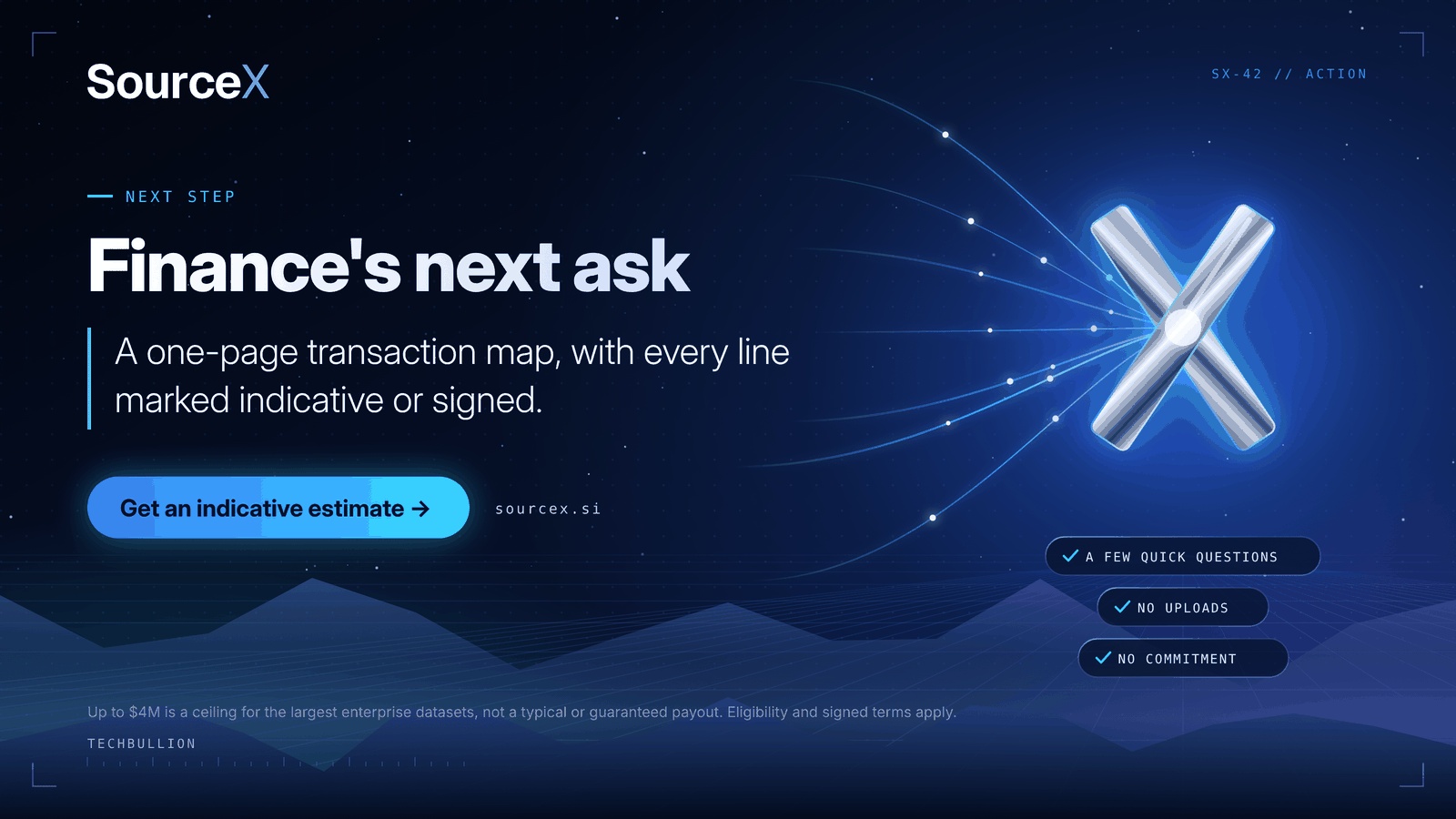
Indicative and signed numbers belong on separate lines.
To explore the commercial fit, use SourceX‘s initial company assessment with broad company facts and no record uploads. If a proposal follows, give finance the transaction map and signed conditions. The advertised maximum is not a receivable, an accounting conclusion or a cash forecast.
About the founder
Noah Loul is a four-time founder and the founder and CEO of SourceX, which licenses business data directly from companies for AI training and evaluation. He previously founded B2B Rocket, acquired by Blackpearl Group. His work focuses on building permission-based data infrastructure for AI.







Comment