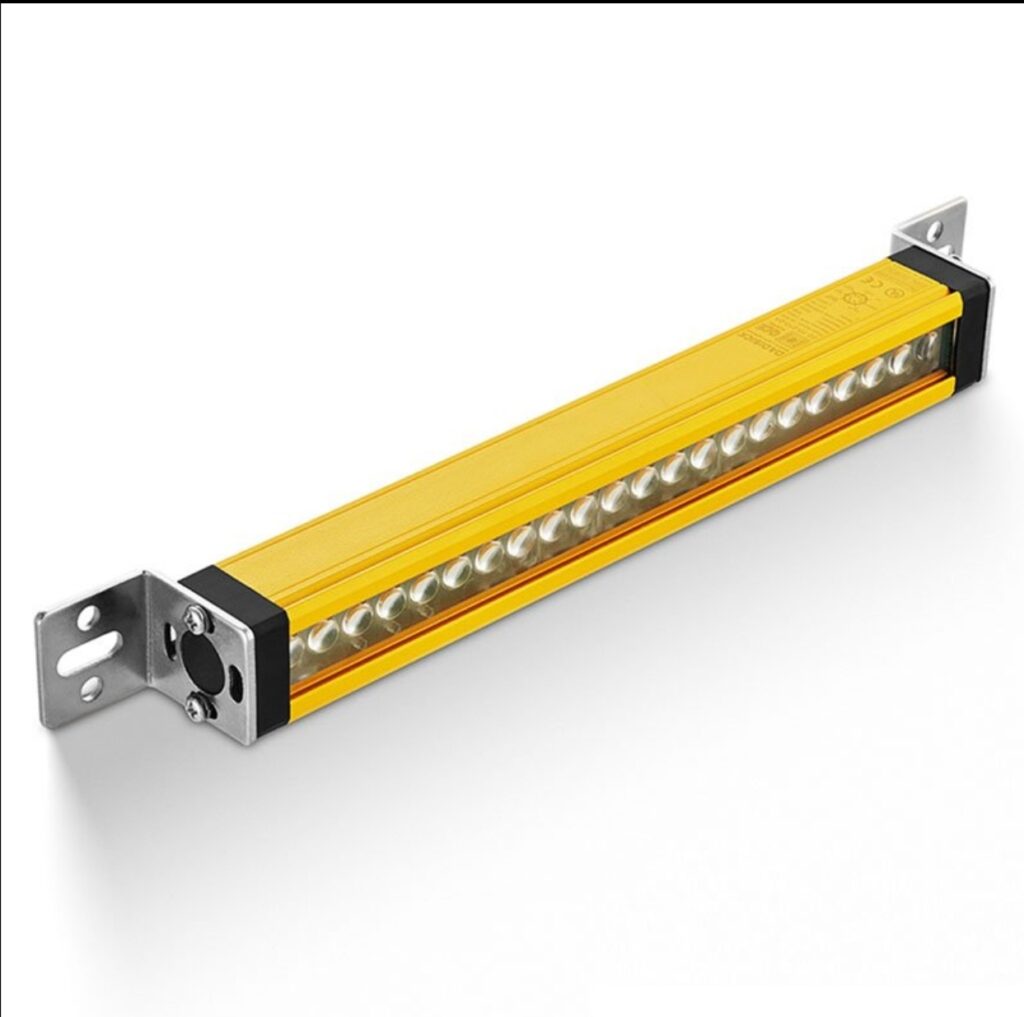
Two quotations can use the words ‘safety light curtain’ and still describe different equipment packages. The difference may be the detection capability, protected height, output version or simply whether mounting hardware and cables are included.
For machine builders, integrators and buyers, the useful starting point is not the lowest unit price. It is a sufficiently detailed specification that suppliers can answer consistently. The seven checks below help prepare that specification. They are procurement questions, not installation instructions or a substitute for a machine-specific risk assessment and validation by competent personnel.
1 Confirm the intended function before selecting a series
Start with what the device must do. Detecting a carton, measuring product height and detecting a person approaching hazardous movement are different requirements. An automation light grid used for object detection should not be treated as personnel-protection equipment because it looks similar.
For a safeguarding application, identify the hazardous operation, foreseeable access routes and required safety function through the machine assessment. Then request the proposed model’s intended-use statement and relevant safety documentation.
Do not accept a catalogue heading as evidence that every listed configuration has the same safety characteristics. If a quotation states Type 2 or Type 4, ask which exact device and supporting documents it refers to. The protective device’s classification does not establish the performance of the complete machine safety function. Any gap between the application requirement and the offered configuration should be resolved before ordering.
2 Separate beam pitch from detection capability
Beam pitch describes spacing between optical axes. Detection capability describes the specified object size the device can reliably detect under its stated conditions. They are related, but they are not interchangeable purchasing fields.
Ask the supplier to state both values for the exact model. A beam-spacing figure alone is not enough to establish finger or hand detection. Also check whether functions such as blanking change the effective detection capability or introduce additional application conditions.
For an illustrative purchasing comparison, imagine two offers specifying similar protected heights but listing different detection capabilities. They are not equivalent substitutes simply because both units fit the same opening. The responsible designer must determine which capability the application requires and how it affects positioning. Procurement can then compare the required configurations instead of making that engineering decision from price alone.
3 Check coverage and installation space separately
Record the opening dimensions, proposed transmitter-to-receiver span and available mounting space. Ask for a dimensioned drawing that distinguishes protected height from overall housing length, including any inactive zones near the ends.
Include a layout drawing with the access opening and surrounding guards marked. Photographs can explain mounting constraints, but they should not replace dimensioned information or suggest that a copied installation is appropriate for a different machine.
The assessment must also consider whether someone could reach over, under or around the field, or enter and remain behind it. Covering the visible opening is not automatically the same as preventing access to the hazard. Any necessary restart interlock, additional guarding or supplementary presence detection must be identified by the assessment.
For quotation purposes, include bracket requirements, connector orientation, cable exit and space needed for alignment and maintenance. These details can change the practical installation even when two products have similar headline dimensions. Confirm the operating range for the proposed configuration rather than assuming that the maximum advertised range applies to every arrangement.
4 Assess the complete stopping process
The light curtain’s response time is one part of the stopping process. Control-system processing, output devices and the machine’s stopping performance also matter. A fast sensor cannot compensate for an unverified machine stop.
Ask which response-time value applies to the offered model and configuration. Do not mix a catalogue minimum with the value for a different protected height or operating mode. Where coding, cascading or other functions affect timing, the relevant documentation should identify those effects.
The responsible specialist should determine and validate positioning using the applicable requirements and verified stopping performance. A supplier’s generic installation sketch is not a universal safety-distance calculation. If reliable stopping data is unavailable, flag that as an unresolved project requirement rather than selecting an arbitrary distance. Changes to the machine or its operating conditions may also require reassessment.
5 Verify the control interface and restart arrangement
Record the intended safety controller or evaluation device and its input requirements. Request the light curtain’s output specification, connection diagram, connector details and relevant compatibility information. Labels such as NPN or PNP do not, by themselves, establish that an output is suitable for a safety function.
Where the proposed device uses output signal switching devices, commonly called OSSDs, compatibility includes the receiving device’s handling of those signals and any test pulses. Connection to an ordinary PLC input alone does not demonstrate an adequate safety-control architecture.
Clarify which device provides any required restart interlock and external device monitoring, and how those functions will be validated. Clearing the field or resetting a safeguard must not be treated as proof that hazardous movement can restart safely. If material passage requires muting or blanking, treat it as a separately assessed function, not a convenient way to ignore interruptions.
6 Match the environment and documents to the exact model
Describe temperature, dust, mist, vibration, cleaning methods and possible exposure to chemicals. Identify nearby reflective surfaces, strong light sources and other optical devices so the supplier can assess the proposed arrangement against the manual.
An enclosure protection rating is not a blanket approval for every cleaning chemical or washdown process. Ask about the actual exposure, including seals, windows, connectors and cables, rather than relying on one rating in a comparison table.
Request current operating instructions, technical data and dimensioned drawings for the complete ordering code. Where conformity or certification documents are required, check their product scope and applicability rather than accepting an unrelated series document. Record document versions with the quotation. This helps prevent a substitution from quietly changing the assumptions that the designer or purchasing team originally reviewed.
7 Send a complete request for quotation
An effective request for quotation gives the supplier enough information to identify a configuration and state its limitations. Include:
– The intended protective function and machine-assessment requirements.
– Opening dimensions, proposed span and installation constraints.
– Required detection capability and protected height.
– The control interface and any required restart or monitoring functions.
– Environmental conditions and cleaning exposure.
– Required documents, accessories and delivery scope.
When reviewing DAIDISIKE safety light curtains, buyers can use the category’s series comparison and selection resources as a starting point for a shortlist. The next step is to request a model-specific proposal, not to assume that every series supports the same function or documentation.
Ask the quotation to identify the transmitter and receiver, full ordering codes, cables, brackets and any required control equipment. Require deviations and unresolved technical questions to be stated explicitly.
Keep a comparison sheet with separate columns for requirement, offered specification, supporting document and open question. A lower price is meaningful only when the scope and engineering assumptions are comparable. Procurement ends with a documented equipment selection; installation, commissioning and validation remain essential steps before the machine is released for use.