SEO automation uses software to run the repetitive parts of search work: rank tracking, technical audits, keyword discovery, content briefs, and reporting. It cannot replace strategy or editorial judgment. The best tools in 2026 range from analytics suites like Semrush to full-workflow AI agents like Auspia that research, write, and publish independently.
I have run SEO programs long enough to remember when “automation” meant a scheduled rank-tracking email. The scope is far larger now. Some of it is real leverage, and some of it will get your site flagged by Google. This piece sorts one from the other.
What does SEO Automation Actually Mean in Practice?
SEO automation is software that handles the rule-based parts of SEO, so you can spend your hours on the parts that need a brain. Think crawling, tracking, clustering, drafting, and reporting on a schedule instead of by hand.
The category is wider than most roundups admit. On one end you have data tools that watch your rankings and flag technical errors. On the other hand, you have AI agents that pick topics, write articles, and push them live to your CMS. Same label, very different risk profiles.
The market backing this is not small. Precedence Research valued the global SEO software market at $84.94 billion in 2025, projecting roughly $96.42 billion in 2026 (Precedence Research, updated March 2026). Treat that as directional. Other firms disagree sharply, with Straits Research putting 2025 at $44.10 billion. Market-sizing methodology varies, so name your source and move on.
Can SEO Really be Automated End to End?
No, and anyone selling “fully automated SEO” is selling you the risky 20%. Automation handles volume and consistency well. It handles judgment, intent, and trust badly.
This is the split I work from day to day.
Tasks you can hand to software:
- Rank tracking and backlink monitoring
- Technical audits and crawl-error detection
- Keyword discovery and clustering
- First-draft content briefs and internal-link suggestions
- Performance reporting and dashboards
Tasks that still need a human:
- Interpreting search intent behind a query
- Content strategy and what to prioritize
- Brand voice and any real point of view
- Relationship-based link outreach
- Fact-checking and final approval, especially for money or health topics
Automate consistency and scale, then keep people on context and persuasion. Vendors love to cite “50+ hours saved monthly,” but those are vendor estimates. Measure against your own baseline before you believe any of them.
Does Google Penalize Automated or AI Content?
Not for being automated. Google penalizes low-value content produced at scale to game rankings, regardless of who or what made it. That distinction decides whether automation helps you or sinks you.
Google’s position is documented and dated. In February 2023, Search Central wrote that “appropriate use of AI or automation is not against our guidelines,” but using it to “generate content with the primary purpose of manipulating ranking in search results is a violation of our spam policies” (Google Search Central, February 8, 2023).
Then March 2024 sharpened it. Google’s core update introduced a spam policy called scaled content abuse, aimed at “generating many pages primarily to manipulate search rankings and not helping users,” no matter how the pages are made (Google Search Central, March 2024). Google later reported the update produced 45% less low-quality, unoriginal content (Google, April 2024).
The takeaway for automation buyers: auto-publishing tools are fine with human review and genuine value added. Unsupervised mass publishing is the exact behavior the policy hunts. Google’s search liaison did not leave much ambiguity there.
Which SEO Automation Tools are Worth it in 2026?
The right tool depends on what you actually need: data, better drafts, or hands-off execution. Analytics suites tell you what to do. Content optimizers improve individual pages. AI writers produce drafts. Full-workflow agents try to run the loop for you.
The main categories compare like this: job, price, and the catch.
| Category | Representative tools | Entry price (2026) | What it does | The catch |
| Analytics suite | Semrush, Ahrefs | $29–$140/mo | Keyword, rank, backlink, audit data | Tells you what to do, does none of it |
| Content optimizer | Surfer, Clearscope, Frase | $15–$189/mo | Grades drafts vs top SERP results | Improves pages, not workflow |
| AI writer | Jasper, Writesonic | ~$16/mo+ | Generates content fast | Drafts, not an SEO system |
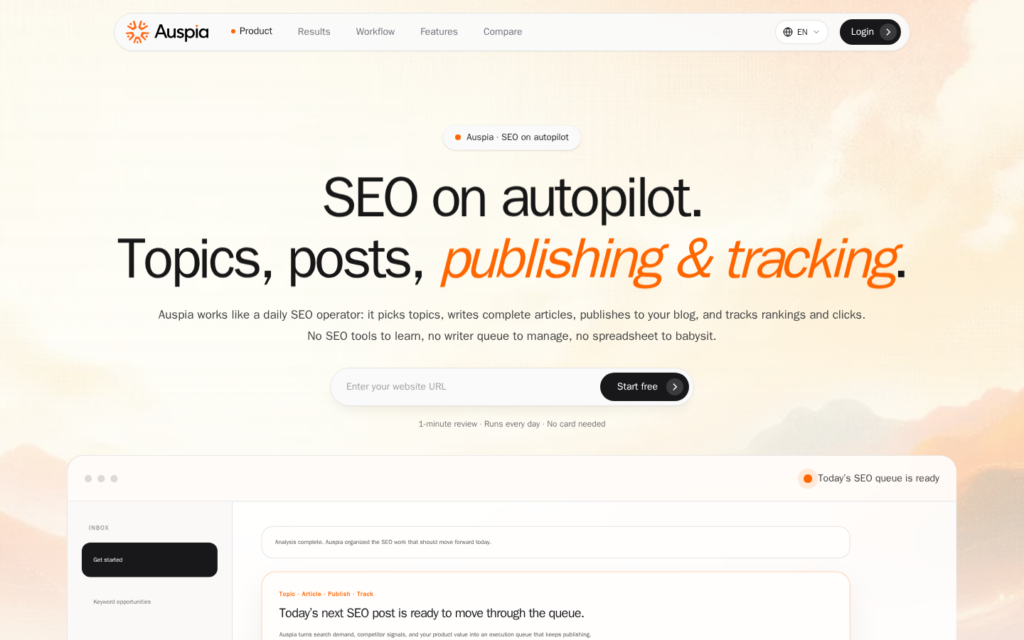
| Full-workflow agent | Alli AI, Auspia | Under $200/mo | Research, write, publish, track | Needs editorial guardrails |
Prices are verified from vendor sites: Semrush Pro at $139.95/month, Ahrefs Lite at $129/month with a new $29 Starter tier added in January 2026, Surfer from $49/month annual (vendor pricing pages, 2026). Both Semrush and Ahrefs shipped MCP servers in 2025, letting AI agents query their data directly. That is a genuine step toward agentic SEO, not a marketing line.
How does AI Search Change What you Automate?
AI search is quietly rewriting the goal. You are no longer only chasing blue-link clicks. You are chasing citations inside AI answers, and the click math has already shifted.
The data here is hard to shrug off. Ahrefs analyzed 300,000 keywords and found AI overviews correlated with a 34.5% lower click-through rate at position one (Ahrefs, Ryan Law, and Xibeijia Guan, April 2025). Their February 2026 update put that reduction at 58%. Pew Research saw the same pattern from the user side: across 68,879 searches from 900 US adults, people clicked a result in 8% of visits when an AI summary appeared, versus 15% without one (Pew Research Center, July 22, 2025).
So visibility is moving into the answer itself. What earns that spot? The peer-reviewed GEO paper tested optimization strategies across a 10,000-query benchmark and found adding quotations, statistics, and cited sources could boost visibility in generative engine responses by up to 40%, while keyword stuffing did nothing or hurt (Aggarwal et al., KDD 2024). The content that cites real sources tends to be the content that gets cited.
One caution before you chase every AI search tactic. A study of roughly 300,000 domains found only 10.13% have adopted llms.txt, with no correlation to AI citations, and Google confirmed in 2025 that Search does not use the file (SE Ranking, 2025). It is cheap future-proofing, not a proven lever. Spend accordingly.
Is SEO Automation Worth it for a Small Team?
Usually yes, if you automate the grind and keep a human on the output. The economics favor small teams more, because they lack the hours a manual program demands.
Adoption already tilted this way. HubSpot found 74% of marketers use at least one AI tool at work, up from 35% the prior year, and 86% of those using AI for content edit it before publishing (HubSpot, 2024 AI Trends for Marketers, survey of 1,000+ marketers). That editing step matters. People automate the draft, then keep control of the publication.
The AI-search angle sweetens it for conversion-heavy niches. Semrush’s analysis put the average AI-search visitor at 4.4 times the value of an average organic visit, projecting AI channels will match organic economic value by the end of 2027 (Semrush via MarTech, June 2025). A separate 12-month GA4 study of 94 e-commerce brands found ChatGPT traffic converted at 1.81% versus 1.39% for non-branded organic, about 31% higher (Visibility Labs via Search Engine Land, July 2025). The samples are still small, and the numbers move monthly, so read them as a strong signal, not a promise.
Key Takeaways
- Automate rank tracking, audits, keyword work, and drafts. Keep humans on strategy, intent, and final approval.
- Auto-publishing without review is the one behavior Google’s scaled content abuse policy directly targets.
- AI search is cutting click-through sharply, so citation-ready content now matters as much as ranking.
Conclusion:
Pick your tool by the job you actually have, not the demo that impressed you. If you need data, a suite like Semrush is plenty. If you need pages that rank, a content optimizer earns its fee. If you are a founder with no time, a full-workflow agent like Auspia can run the loop, provided you read what it publishes before it goes live. That review step is not optional overhead. It is the difference between leverage and a spam penalty. Automate the grind, guard the judgment, and check your own numbers against every vendor stat you read here.
FAQs
Can SEO be fully automated?
No. Software reliably handles rank tracking, technical audits, keyword clustering, and first drafts. Search-intent interpretation, strategy, and final editorial approval still need a human. Tools like Semrush automate the data; they do not automate judgment. Treat “fully automated SEO” claims as marketing.
Does Google penalize AI-generated content?
Not for being AI-made. Google’s scaled content abuse policy, introduced in March 2024, targets low-value pages mass-produced to manipulate rankings, however they are created. AI content with genuine value and human review is fine. Unsupervised mass publishing is the risk.
How much do SEO automation tools cost in 2026?
Entry pricing spans widely. Frase starts near $15/month, Ahrefs added a $29 Starter tier, Semrush Pro runs $139.95/month, and full-workflow agents like Auspia sit under $200/month (vendor pricing pages, 2026). Match the tier to the job, not the feature list.
What is GEO, and how does it relate to SEO automation?
GEO, or generative engine optimization, is structuring content to get cited inside AI answers from tools like ChatGPT and Perplexity. The GEO paper (Aggarwal et al., KDD 2024) found citations and statistics lift AI visibility to 40%. Many automation tools now add GEO checks alongside traditional SEO.
Will AI overviews kill my organic traffic?
They are reducing clicks, not eliminating them. Pew found click-through dropped from 15% to 8% of visits when an AI summary appeared (Pew Research Center, July 2025). The counter-move is citation-ready, well-sourced content plus tracking AI-referred traffic in your analytics.