
Scaling Waffle Production Starts With Batter Data, Not a Bigger Machine

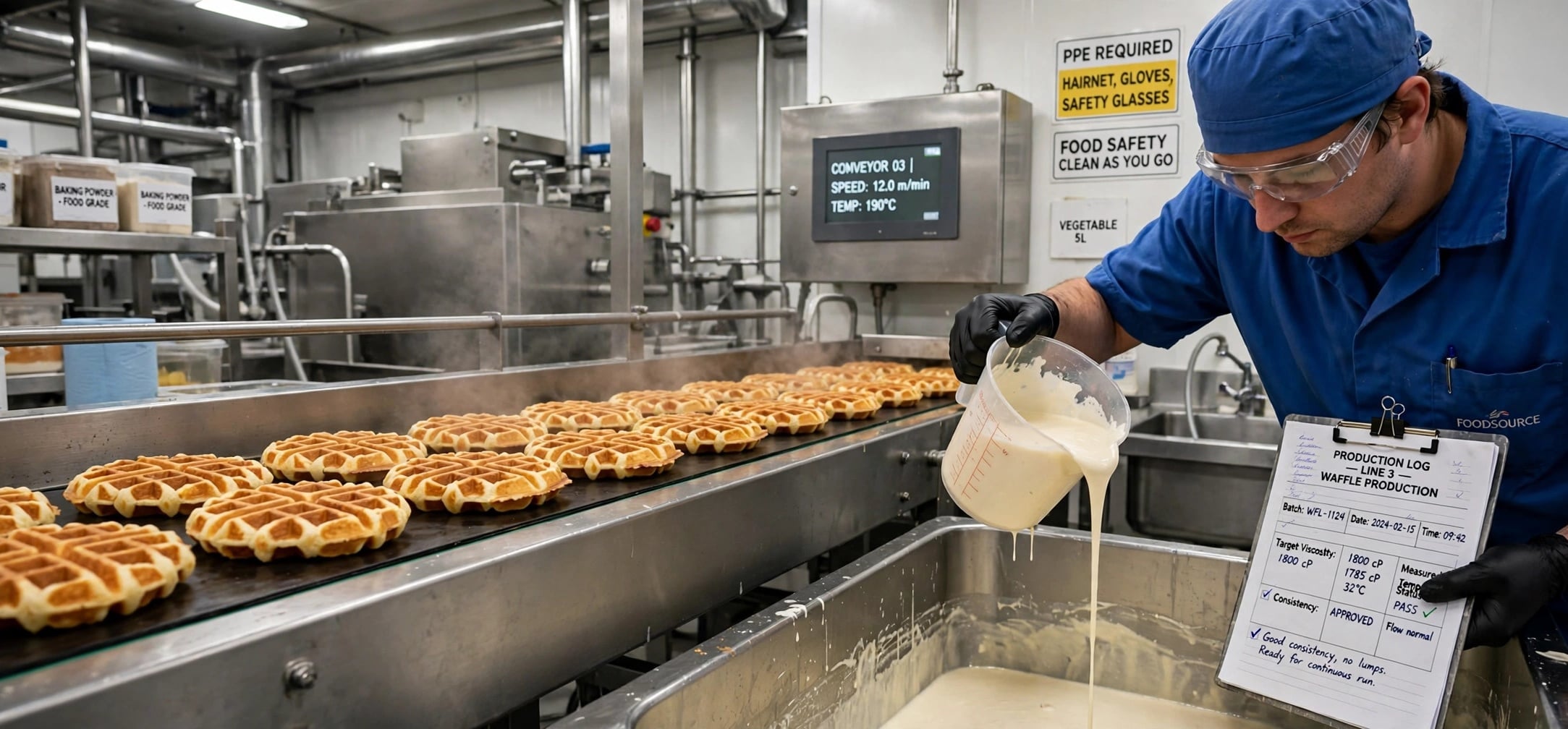
Making a convincing waffle sample is different from making the same product throughout a production run. The obstacle is often the gap between a kitchen recipe and a working production brief: batter changes while it waits, deposits vary, the first bake differs from later cycles, or the finished waffle loses its intended texture before packing. More capacity raises the stakes. It does not explain the defect.
For a food entrepreneur comparing production equipment, the useful starting point is a documented product and process. Define what needs to stay the same as output increases, then ask the supplier to demonstrate those conditions. The following planning approach is a proposed method for organising that discussion, not a claim that any particular line has achieved a stated capacity or saving.
A recipe leaves several production questions unanswered
Start with the ingredient list. It records what goes into the bowl, but production planning also needs to describe how material reaches the cooking surface, how much is deposited, what happens between batches and how finished pieces leave the line. These details can alter the working process without changing a single ingredient name.
Consider a small trial in which the operator mixes batter, immediately fills an iron and serves the waffle, then compare that with a proposal that puts a holding vessel and a depositor between mixing and baking. Time and handling have changed. The recipe alone cannot tell a buyer whether the proposed sequence will preserve the required texture. Demonstrate the sequence.
UDTECH’s food website organises guidance around batter, baking and finished texture, with production planning tools alongside the articles. That arrangement supports a useful purchasing principle: the food description and the equipment description should be developed together. It is premature to choose a nominal throughput while the acceptable product is still described only as a nice, crispy waffle.
Describe the batter at the point of depositing
Ask where the batter is measured or observed. A sample taken immediately after mixing may not represent the material reaching the plates later. Record when ingredients were combined, the mixing method, the waiting interval and whether the batter received further agitation. If the recipe changes, identify that batch separately.
Mixing deserves attention because mechanical handling is part of the recipe’s execution. King Arthur Baking’s wheat-pancake demonstration associates excessive stirring with air loss and greater gluten development. A production buyer should not turn that example into a universal mixer speed, but it does justify asking how a proposed process reproduces the intended batter handling rather than assuming all pumps and mixers are interchangeable.
Choose observations that an operator can repeat safely. A record might include ingredient identity, a measured portion, batter temperature where relevant to the established process, and a photograph of the deposit spreading on the intended surface. Specify the method if a property such as viscosity is used. A number without its measurement conditions can mislead more than a careful plain-language description.
Connect the deposit to the plate geometry
Deep pockets, thin sheets and a relatively flat pancake do not ask the cooking surface to produce the same shape. Portion and deposit location therefore belong in the equipment brief. Underfilling can leave an incomplete outline; excess batter can create overflow and cleaning work. A supplier needs the intended shape and mass, not just a request to process a certain volume of liquid.
Compare the product at a defined stage. Is the stated weight measured before baking, immediately after release, after cooling or after topping? Water loss during cooking makes those points different. The distinction also matters when someone converts a piece-per-hour figure into a mass-per-hour figure. Both numbers can be correct while describing different parts of the process.
Plate release should be part of the trial observation, rather than hidden by an operator’s skill. Record sticking, tears, damaged edges and the action needed to remove a piece. Ask which adjustments were made during the demonstration. A sample that required repeated manual intervention tells a different story from the same-looking sample produced during a stable routine.
Measure the useful output through the whole run
Watch a complete working interval. Although a short burst can establish that a line moves, it cannot establish how a business will perform across start-up, routine production, changeover and cleaning when those activities are outside the demonstration. Agree in advance which intervals count and what makes a finished piece acceptable. Define output together.
Here is an illustrative calculation, not a machine claim: a trial producing 240 pieces, of which 24 fail the agreed appearance or texture requirement, has 216 accepted pieces. The accepted fraction is 90%. If the run included stops, record its elapsed duration before calculating an hourly rate. Do not delete the stopped minutes simply because the machine was not baking during them.
A buyer can then compare proposals on a common boundary. Include the labour and handling required to achieve the result, identify any downstream bottleneck and retain rejected pieces for discussion. UDTECH’s production planning context is useful here because the question is about the complete food route, from batter preparation to a sample the buyer would actually sell.
Agree on the meaning of a production figure
| Figure | Question to resolve |
|---|---|
| Pieces per hour | All discharged pieces or only accepted pieces? |
| Product mass | Batter deposit, baked product or packed portion? |
| Run duration | Does the record include interruptions and start-up? |
| Texture acceptance | At release or after the intended cooling and serving interval? |
Keep cooling and packaging inside the boundary
For a product sold crisp, the process does not end when the plate opens. Cooling, spacing and contact with a filling or topping all belong in the evaluation. Avoid approving a bare waffle beside the machine and assuming that a filled or packed version will retain the same bite. Evaluate the version the customer receives.
Give a proposed packaging change its own test. A package can affect moisture movement and physical protection, but choosing a film or closing a lid does not by itself establish shelf life. Storage claims need evidence appropriate to the actual food and intended conditions. A brief equipment demonstration should not be presented as a substitute for that work.
The https://food.udmachine.com/ UDTECH food knowledge hub is a useful starting point for organising questions about waffle formats, ingredient functions and texture changes. Its role in an equipment discussion is to help define the problem. A supplier must still confirm whether a particular machine and process can meet the buyer’s recipe, output and acceptance requirements.
Bring a clear trial request to the supplier
Write a short brief that a supplier can answer without guessing. Include the desired waffle, the recipe version to be tested, the handling sequence and the method for counting acceptable pieces. Identify which changes are permitted during the trial and which would require a new comparison. That protects both sides from mistaking an adjusted demonstration for proof of the original proposal.
- Define the finished format and the condition in which texture is judged.
- State who supplies ingredients and prepares the batter.
- Check the deposit method and plate geometry against the intended product.
- Record accepted pieces separately from rejects and start-up material.
- Ask for the run notes, adjustments and sample labels with the demonstration results.
Expect limits. Different recipes, sites and operating routines can require further trials, and a successful demonstration is still bounded by the conditions recorded. When a supplier explains what was tested, what was adjusted and which questions remain open, the buyer has a basis for deciding whether the result transfers to the intended operation. Choose on that evidence.







Comment