
Sand.ai’s Magi 2: What 30-Second AI Video With Sound Means for Business Content

By Kevin Yi
On November 24, 2026, the video-model company Sand.ai released MAGI-2, usually written Magi 2. It generates up to 30 seconds of 1080p video in a single take, and it makes the sound in the same generation: dialogue with lip-sync, sound effects, ambient noise and music.
That combination matters more to business users than the headline parameter count. Until recently, an AI video clip was a few silent seconds that someone still had to cut, voice and score. A model that returns a half-minute clip with its own soundtrack starts to look like a finished asset. Here is what Magi 2 can do, what it costs, where it still falls short, and how a marketing or content team can try it without a GPU.
Key takeaways
- Magi 2 makes up to 30 seconds of 1080p, 25 fps video per generation, in six aspect ratios, with sound generated by the same model.
- One request can combine a text prompt with up to 20 references: 10 images, 5 video clips and 5 audio clips.
- ai reports an Elo of 1150.3 on the Artificial Analysis Video Arena, up from 998.5 for the August 2026 preview.
- ai names its own weak spots: very fast motion, fine movement in wide 2D-animation shots, and layered soundscapes.
- The full model’s weights are not public yet, so businesses use it through hosted tools: a browser generator or a pay-per-second API.
What Magi 2 is
Magi 2 is the successor to MAGI-1, Sand.ai’s open-source video model from 2025, and to MAGI-2 Preview, a smaller audio-video model it released in August 2026. According to Sand.ai’s launch post, the full model is a sparse mixture-of-experts network with about 480 billion parameters in total and about 28 billion active for each step, pre-trained on roughly 4 trillion tokens. That is more than four times the size of the preview.
The practical specs:
| Magi 2 (November 2026) | |
| Clip length | Up to 30 seconds per generation |
| Picture | 1080p, 25 fps, six aspect ratios |
| Sound | Dialogue with lip-sync, foley, ambient sound and music, made with the picture |
| Inputs | Text plus up to 20 references (10 images, 5 videos, 5 audio clips) |
| Control | Timeline and shot-cut control; targeted edits to existing video |
| Quality signal | Artificial Analysis Video Arena v2.1, 4-task average Elo 1150.3 (as reported by Sand.ai) |
Two of these lines deserve attention from anyone who makes brand content. Thirty seconds is the length of a standard ad spot and comfortably covers a product teaser, a social clip or an explainer section. Up to 20 references means you can hand the model your product photos, a presenter’s picture, a sample of your brand’s music and a clip of the camera move you want, and ask for one coherent scene that uses all of them.
Why sound in the same generation matters
Most AI video workflows in 2025 looked like this: generate a silent clip, then add a voice-over, then find music, then line everything up in an editor. Every step is a chance for the picture and the sound to drift apart, and every step costs time.
When the model produces both at once, the footsteps land on the steps, the door slams when it closes and the speaker’s lips match the words. Sand.ai describes Magi 2’s audio and video as generated “within a single backbone.” For a small team, that removes an entire post-production stage from short-form work.
It also fits how people consume video. Business video remains in demand: in Wyzowl’s State of Video Marketing 2026 survey, 96% of consumers said they have watched an explainer video to learn about a product or service, and 85% said a video has convinced them to buy.
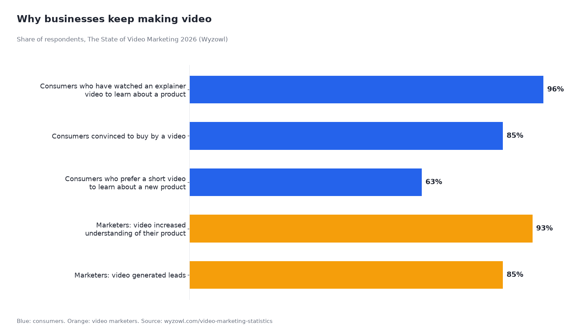
Source: Wyzowl, The State of Video Marketing 2026.
Five business uses that suit Magi 2
- Product teasers and launch clips. Feed in product photos as references and describe the scene. A 15 to 30 second clip with sound is ready for a landing page or a social post.
- Short ads in several formats. Generate the same idea in 16:9 for YouTube and 9:16 for Reels, Shorts and TikTok instead of cropping one version.
- Spokesperson-style clips. Dialogue with lip-sync means a character can say a line on screen. Keep the script short and test several takes.
- Storyboards and pitch visuals. Agencies can show a client a moving, sounding version of a concept before anyone books a shoot.
- Localized variants.ai says the model can translate and generate dialogue in a target language. Test this per language before you rely on it.
What it costs per clip
Sand.ai’s launch post does not include an official price, so prices depend on the service you use. Hosted services generally charge per second of video. At $0.20 per second, a rate one independent API service lists with sound included, the maths looks like this:
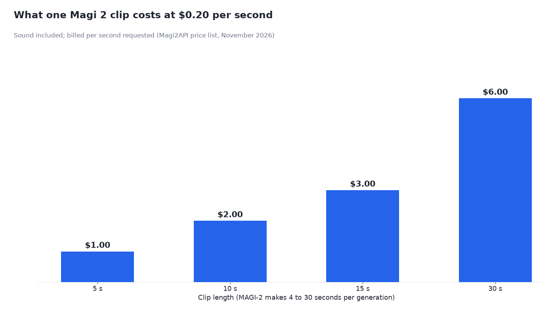
Per-second pricing makes budgets easy to forecast. Chart by the author.
Even if you generate five takes of a 30-second ad to pick the best one, you are at $30. That is a different order of magnitude from a production day. The real cost is the time spent writing prompts and choosing takes, so budget a few hours for each finished clip.
Where Magi 2 still falls short
Sand.ai is unusually direct about the limits. Its launch post says:
- extreme high-speed motion can occasionally produce trajectory or continuity artifacts;
- medium and wide 2D-animation shots can look overly smooth in fine local motion;
- complex soundscapes still have room for richer layering and physical realism.
For business content, that translates into practical advice. Avoid fast action scenes and busy crowd audio for anything customer-facing. Review every clip with sound on, at full size. Keep your logo, prices and on-screen text out of the generation and add them in your editor, where they will be exactly right.
Generation is not instant either. Hosted services typically quote 15 to 20 minutes for a Magi 2 clip, longer at busy times. Plan work in batches rather than expecting a live, on-the-spot result.
How to try it without a GPU
The full Magi 2 weights have not been published yet. Sand.ai says it will open-source the model with a technical report, but gives no date. In the meantime there are two practical ways in:
- In a browser. Independent sites such as Magi 2 AI run the model in an online generator: text to video, image to video and reference to video, 4 to 30 seconds at 1080p with sound and no watermark. Each clip shows its cost before it renders, and failed renders are refunded. This suits marketers who want to test prompts without writing code.
- Through an API. If you want Magi 2 inside your own app, CMS or content pipeline, a pay-per-second service like Magi 2 API exposes text-, image- and reference-to-video through a REST endpoint, with public docs and a browser playground for testing prompts first.
Neither is Sand.ai’s own product. Both resell access to the model, so check the terms and commercial-use rights of whichever service you pick.
A sensible first test
- Pick one existing campaign and write a 15-second version of it as a scene description, including what should be heard.
- Add two or three references: a product photo, a presenter photo, a short music sample.
- Generate three takes in 16:9 and three in 9:16.
- Show the best one to a colleague with sound on and ask what they noticed first. If it was a glitch, rewrite the prompt before you generate more.
FAQ
What is Magi 2?
Magi 2 (MAGI-2) is an audio-video generation model released by Sand.ai on November 24, 2026. It makes up to 30 seconds of 1080p video per generation, with dialogue, sound effects and music generated with the picture.
How long can a Magi 2 video be?
Up to 30 seconds per generation, at 1080p and 25 frames per second, in six aspect ratios.
Is Magi 2 open source?
Not yet. Sand.ai says it will open-source MAGI-2 with a technical report. The smaller MAGI-2 Preview from August 2026 is available under the Apache 2.0 licence.
How much does a Magi 2 video cost?
It depends on the service. Per-second pricing is common: at $0.20 per second, a 30-second clip with sound is $6.
Can Magi 2 make videos with speech?
Yes. It generates dialogue with lip-sync in the same pass as the picture. Keep lines short and review each take.
The jump from silent five-second clips to half-minute scenes with sound is the real story of Magi 2. For business teams, it is now worth one afternoon of testing to see which of your short-form formats it can take over.
――――――――――――――――――――
Kevin Yi builds AI video tools and writes about generative video for marketing teams.
Previously in Business news: TreasureNFT: Partnering with BlackRock Capital for a Major Upgrade – NOVA Platform Aims to Become the World’s Largest NFT Trading Ecosystem






Comment