
Rowing Machine vs Treadmill: Which Gives You the Better Workout?

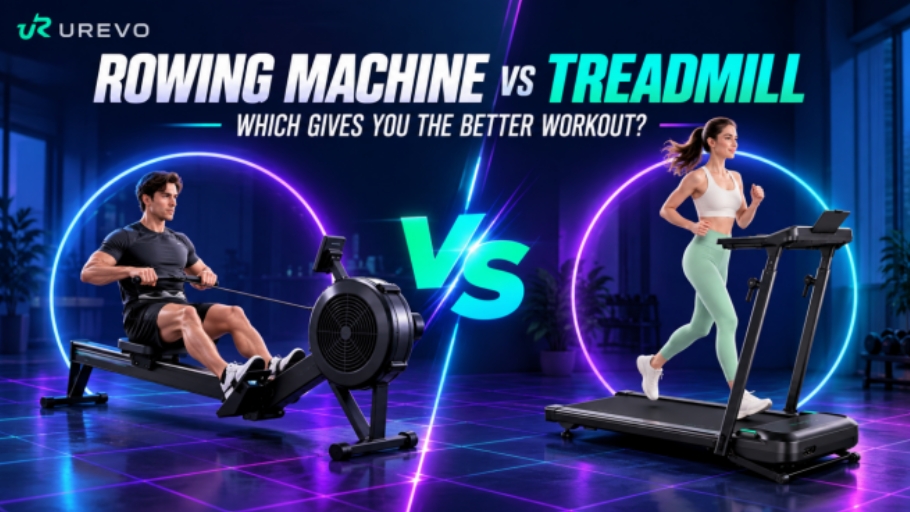
A rowing machine delivers full-body, low-impact conditioning, while a treadmill offers familiar walking and running with clear control over pace and incline. In a rowing machine vs treadmill decision, the better workout is the one that matches your goal and feels practical enough to repeat. This article compares muscle use, calorie potential, training fit, and everyday versatility to help you choose the workout format that best fits your routine.
Rowing machine vs treadmill
Rowing Machine vs Treadmill: Key Differences at a Glance
| Workout factor | Rowing machine | Treadmill |
| Movement pattern | Seated, repeated drive-and-pull stroke | Walking, incline walking, jogging, or running |
| Muscle emphasis | Leg drive with core, back, shoulder, and arm involvement | Lower-body and core work shaped by speed and incline |
| Loading | Non-weight-bearing with no repeated foot strikes | Weight-bearing; impact rises from walking to running |
| Learning curve | Efficient stroke timing and posture take practice | Walking is familiar; running needs gradual progression |
| Intensity controls | Resistance, stroke rate, and drive power | Speed and incline |
| Strongest fit | Full-body conditioning in a seated movement | Walking or running goals and a wider workout range |
Both machines can raise the heart rate and build aerobic fitness, but they do so through different movement patterns. Rowing combines leg drive, trunk control, and an upper-body pull in each stroke. Treadmill training uses a familiar weight-bearing pattern, with speed and incline controlling how demanding the session becomes. These differences shape which workout better fits a particular training goal.
Rowing Machine vs Treadmill: How Does Muscle Use Differ?
Rowing distributes effort across more of the body, while treadmill exercise focuses on the lower-body movement used for walking and running.
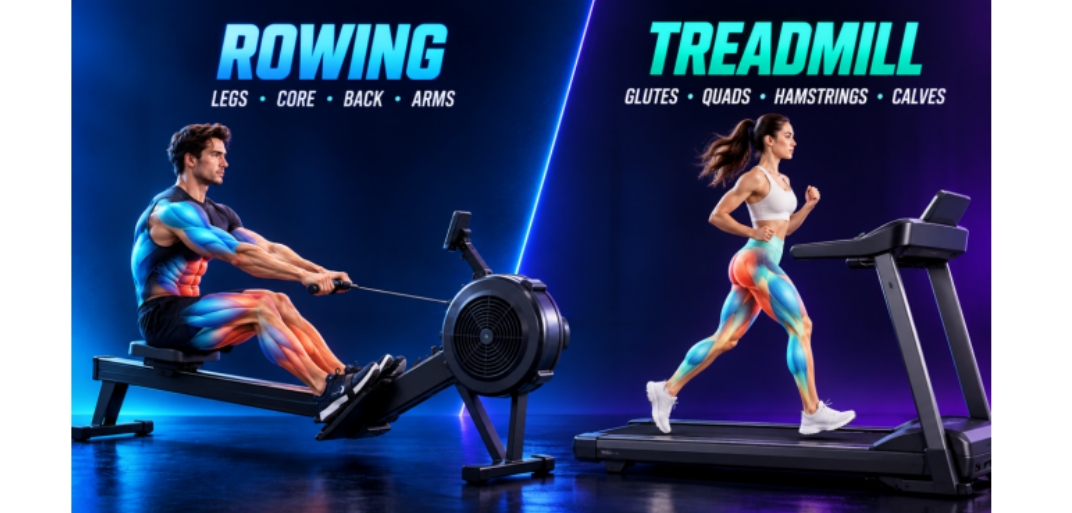
Rowing and treadmill muscle use comparison
Rowing Distributes the Work Across the Body
Rowing involves more muscle groups in each stroke; the legs, core, back, shoulders, and arms all contribute at different points:
- Leg drive. The quadriceps extend the knees while the glutes and hamstrings help move the body away from the flywheel.
- Trunk control. The abdominal and spinal muscles stabilize the torso as it changes from a forward position to a slight backward lean.
- Upper-body finish. The upper back, rear shoulders, and arms complete the pull after most of the power has already come from the legs.
- Technique demand. Good sequencing keeps the stroke efficient; pulling too early with the arms reduces how effectively the larger muscle groups contribute.
Treadmill Training Builds Weight-Bearing Lower-Body Capacity
On a treadmill, the lower body supplies most of the movement while the core helps maintain posture and balance. Changes in speed and treadmill incline alter how demanding the session becomes:
- Walking and running. The glutes, quadriceps, hamstrings, and calves repeatedly support the body and move it forward with each stride.
- Faster pace. Jogging and running increase cadence and the force handled by the legs, helping develop on-foot endurance at higher speeds.
- Incline. An uphill setting increases demand on the glutes, hamstrings, and calves without requiring the same belt speed as running.
- Movement specificity. Because the movement closely matches everyday walking and outdoor running, treadmill training is more specific to those activities.
Rowing Machine vs Treadmill: Which Burns More Calories?
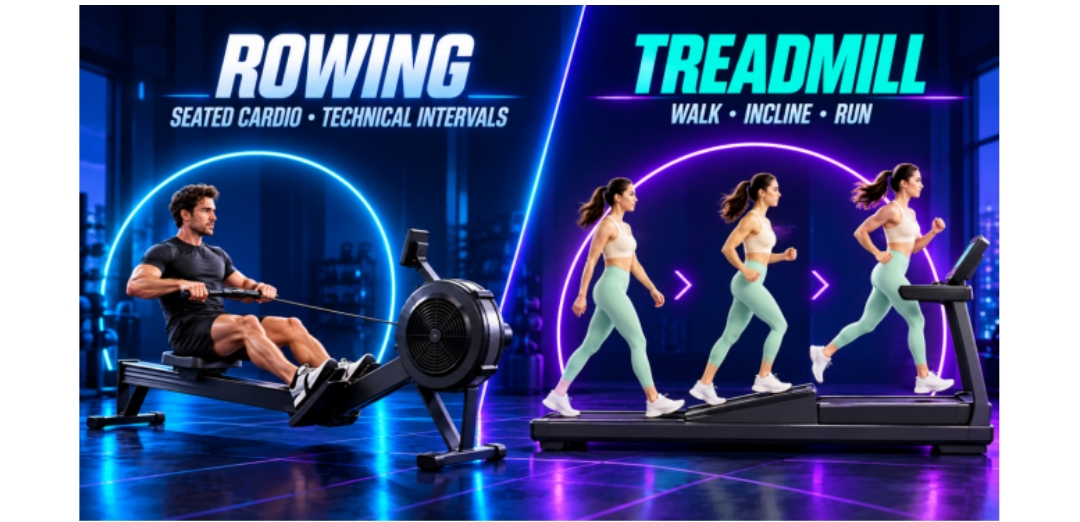
Rowing machine and treadmill workout goals
In everyday workouts, actual energy expenditure depends on how intensity is created and sustained:
- On a rowing machine, resistance, stroke rate, and drive power determine the challenge. Strong technique helps sustain output as fatigue builds.
- On a treadmill, speed and incline create clear, measurable changes in workload. A brisk incline walk, steady run, or faster interval can all raise demand without changing the basic movement pattern. A 2024 comparison of seven indoor cardio machines found that the treadmill produced the highest energy expenditure at both a very hard perceived effort and maximum intensity.[1] This finding highlights the treadmill’s calorie-burning potential when effort is comparable.
Across a full routine, workout duration and weekly consistency matter as much as the calorie total from one hard session. The best cardio machine for weight loss therefore is the one that supports a repeatable weekly training volume.
Rowing Machine vs Treadmill: Which Better Fits Your Goals?
Calorie burn matters, but long-term value depends on whether the workout supports the movement and fitness goals you actually want to pursue.
A Rowing Machine May Fit If You
- Prefer a seated cardio pattern. Rowing avoids repeated foot strikes and keeps the body supported through the stroke.
- Want upper- and lower-body involvement in one exercise. Each efficient stroke combines leg drive, trunk control, and an upper-body finish.
- Enjoy technical intervals. Rowing suits users who are willing to practice rhythm and power application as part of the workout.
A Treadmill Works Better When You
- Want to build a regular walking habit. A familiar movement and adjustable pace make it easy to start at a manageable level.
- Are training for jogging or running. Treadmill sessions directly develop on-foot pace, lower-body endurance, and comfort at different speeds.
- Want several ways to progress. Speed can increase as fitness improves, while incline adds challenge when faster running is not the goal.
- Prefer longer steady sessions. The familiar walking pattern lets you focus on pace, duration, and effort rather than learning a new movement sequence.
Rowing is a better fit if you prefer seated, technique-driven full-body sessions. A treadmill offers more room to progress when your goals extend from walking to incline work, jogging, or running. A model that combines this training range with a practical everyday setup is easier to use consistently.
How the UREVO FoldiMix 5L Supports Treadmill Training
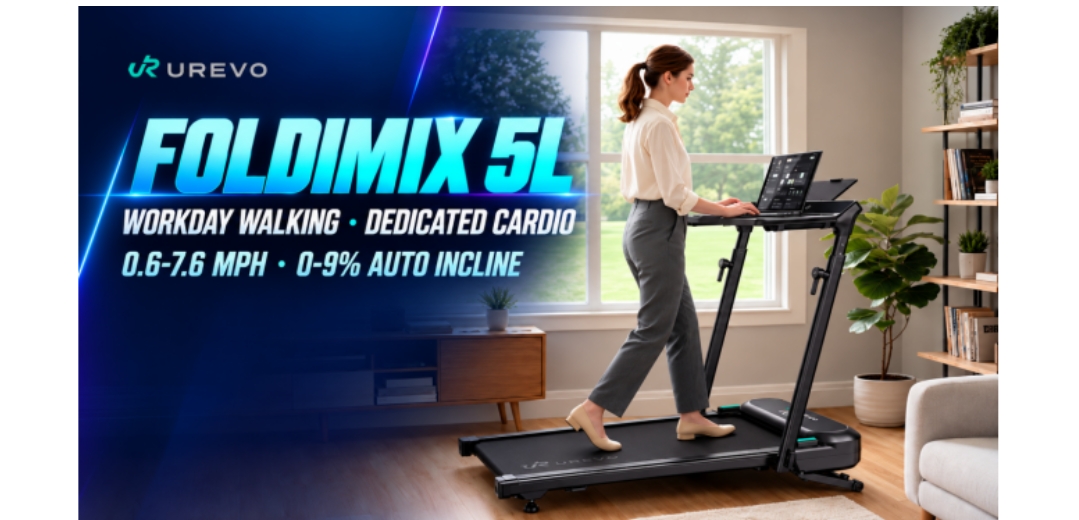
UREVO FoldiMix 5L smart treadmill with an adjustable workstation
The UREVO FoldiMix 5L Smart Treadmill pairs a foldable 2-in-1 design with options for workday walking and dedicated treadmill workouts.
| Specification | UREVO FoldiMix 5L |
| Work walking | 0.6–4.0 MPH; height-adjustable workstation |
| Dedicated exercise | Up to 7.6 MPH |
| Incline | 0–9% automatic incline; 9 levels |
| Running area | 39.4 × 15.8 in |
| Folded dimensions | 52.4 × 24.6 × 6.1 in |
| Maximum load | 400 lb / 181 kg |
Together, these specifications create three practical benefits for treadmill-oriented users:
- One machine, several session types. The same machine can support desk walking, brisk walking, incline work, jogging, and light running.
- Adjustable intensity. Speed and automatic incline let users change the workload without switching to another exercise format.
- Flexible setup for work and workouts. The height-adjustable workstation and fold-down handrails let the treadmill shift from desk walking to focused exercise, while the folded dimensions make storage easier to plan.
This setup suits users who want one treadmill for low-speed movement during the workday and more structured cardio sessions.
Conclusion
A rowing machine vs treadmill comparison has no universal winner. Rowing suits users who prefer a seated, technique-driven full-body workout, while a treadmill supports a wider progression from walking and incline work to jogging and running. The better choice is the one that fits the intended goal and can be used consistently.
UREVO develops walking pads, foldable treadmills, and recovery products designed to bring movement, training, and recovery into everyday routines. Its Wellness Hub adds goal-based guidance, progress tracking, and recovery insights across supported UREVO devices. Within this range, the FoldiMix 5L combines workday walking and dedicated treadmill exercise in one foldable system. For help matching the model to a routine or available space, contact UREVO for product guidance and support.
References
[1] Prieto-González, P., & Yagin, F. H. (2024). “Energy expenditure, oxygen consumption, and heart rate while exercising on seven different indoor cardio machines at maximum and self-selected submaximal intensity.” Frontiers in Sports and Active Living, 6, 1313886. https://doi.org/10.3389/fspor.2024.1313886






Comment