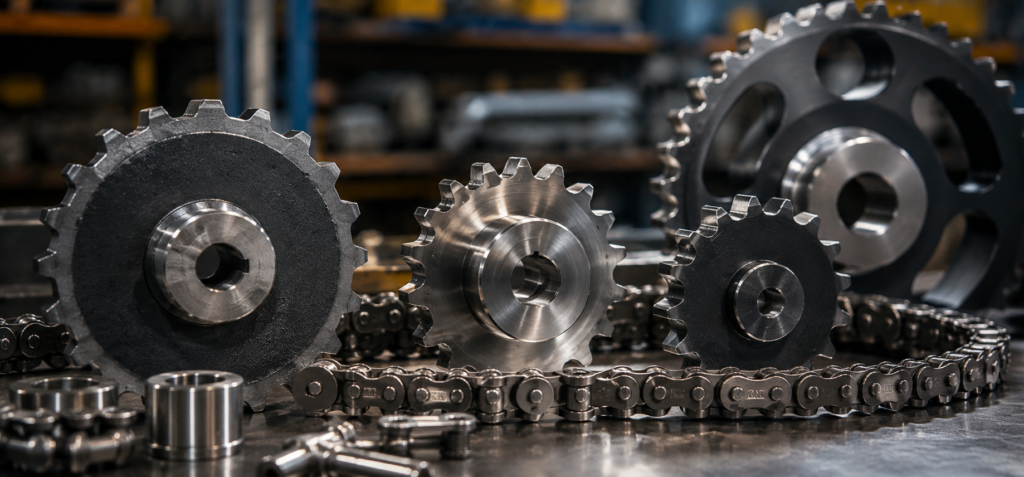
Roller chain sprockets are essential power transmission components used with roller chains to transfer mechanical power between rotating shafts. They are commonly found in conveyors, industrial machinery, packaging equipment, agricultural equipment, and automated systems. Selecting the correct sprocket is important for reliable chain engagement, efficient power transmission, and long service life.
What Is a Roller Chain Sprocket?
A roller chain sprocket is a toothed wheel designed to engage with the rollers of a roller chain. As the sprocket rotates, its teeth engage the chain and transfer rotary motion from one shaft to another.
The sprocket and chain must be properly matched. Key specifications include chain size, pitch, number of teeth, bore size, sprocket style, and number of chain strands. ANSI roller chain and sprocket dimensions are standardized to help ensure compatibility between components. ANSI B29.1 and ISO 606 are among the important standards used for power transmission roller chains and sprockets.
Types of Roller Chain Sprockets
One of the most common ways to classify roller chain sprockets is by their hub configuration. ANSI-style sprockets are generally available in Type A, Type B, Type C, and Type D designs.
Type A Sprockets
Type A sprockets consist of a flat plate with teeth and do not have an integral hub. They are commonly used where the sprocket needs to fit closely against the equipment or where space is limited.
Because they have no hub, Type A sprockets are typically mounted using a separate hub or other mounting arrangement depending on the application.
Type B Sprockets
Type B sprockets have a hub extending from one side of the plate. The hub provides additional support around the shaft bore and is commonly used for standard shaft mounting applications.
Type B sprockets are widely available across different roller chain sizes and tooth counts.
Type C Sprockets
Type C sprockets have hubs extending from both sides of the sprocket plate. This design provides additional thickness and support and is often used for larger sprockets or applications where greater hub support is required.
The two-sided hub design can also provide additional flexibility when dealing with larger shaft bores and heavier-duty applications.
Type D Sprockets
Type D sprockets use a plate sprocket mounted to a detachable hub. This configuration makes installation and replacement easier because the sprocket plate can be removed without requiring the entire hub assembly to be removed from the shaft.
Detachable-hub sprockets can also make maintenance and sprocket replacement more convenient, particularly in applications where minimizing downtime is important.
Single, Double, and Multiple Strand Sprockets
Roller chain sprockets are also classified according to the number of chain strands they accommodate.
Single-strand sprockets are designed for simplex roller chain and are commonly used for general power transmission.
Double-strand sprockets are designed for duplex roller chain and allow two parallel chain strands to run on the same sprocket.
Triple and multiple-strand sprockets are used with three or more strands when higher power transmission capacity is required. Martin Sprocket’s sprocket nomenclature, for example, identifies single, double, triple, and quadruple strand configurations.
The number of strands should match the roller chain being used. Using the correct chain and sprocket combination is essential for proper engagement and load distribution.
Important Roller Chain Sprocket Specifications
When selecting a roller chain sprocket, engineers should consider more than just the number of teeth. Important specifications include:
- Chain size and pitch
- Number of teeth
- Number of chain strands
- Bore diameter
- Hub style
- Pitch diameter
- Outside diameter
- Sprocket material
- Bore and keyway configuration
- Operating speed and load
The chain pitch is particularly important because the sprocket must match the chain’s pitch. For ANSI roller chain, common sizes include 25,35,40,50,60,80,100,120,140,160,180,200, and 240.
Sprocket Materials
Sprocket material should be selected according to the operating environment, load, speed, and required service life. Common materials include steel, carbon steel, cast iron, ductile iron, and stainless steel.
For example, U.S. Tsubaki identifies low-carbon steel for certain Type A sprockets, high-carbon steel for Type B designs, and cast or ductile iron for certain Type C sprockets. Tooth hardening may also be used for applications involving higher speeds, heavy loads, or abrasive conditions.
How to Choose the Right Roller Chain Sprocket
Choosing the correct roller chain sprocket starts with identifying the chain size and standard. The sprocket should match the chain’s pitch, roller diameter, and inside width.
Next, consider the required number of teeth and chain strands. Smaller sprockets can be useful when space is limited, while larger sprockets can provide different speed ratios and chain engagement characteristics.
The shaft connection is another important consideration. Depending on the application, sprockets may be available with plain bores, finished bores, keyways, taper bushings, QD bushings, or detachable hubs.
Operating conditions should also be considered. High-speed, heavy-load, or abrasive applications may require sprockets with hardened teeth or specialized materials.
Roller Chain Sprockets for Power Transmission
Roller chain sprockets provide a simple and dependable method of transferring power between shafts. With different sprocket types, tooth counts, hub configurations, materials, and chain strand options, they can be configured for a wide range of industrial power transmission applications.
Understanding the differences between Type A, Type B, Type C, and Type D sprockets, along with chain size, pitch, bore, and operating requirements, makes it easier to select a sprocket that matches the application and delivers reliable performance.