
Perplexity AI vs ChatGPT in 2026: Which AI Search Tool Should You Actually Be Using?

By April 2026, two AI tools have quietly become the default starting point for most people doing serious online research — Perplexity AI and ChatGPT. Both are powerful. Both cost around $20 per month for premium access. And both are genuinely useful in ways that the other is not. But they work very differently, and using the wrong one for a given task costs you time and produces worse results than you should be getting.
This guide cuts through the noise with real 2026 benchmark data, a category-by-category verdict, and a clear decision framework for choosing which tool — or combination — deserves your subscription budget right now.
The Fundamental Difference Most Comparisons Miss
The single most important thing to understand before comparing Perplexity AI and ChatGPT is that they are architecturally different tools built for different primary purposes.
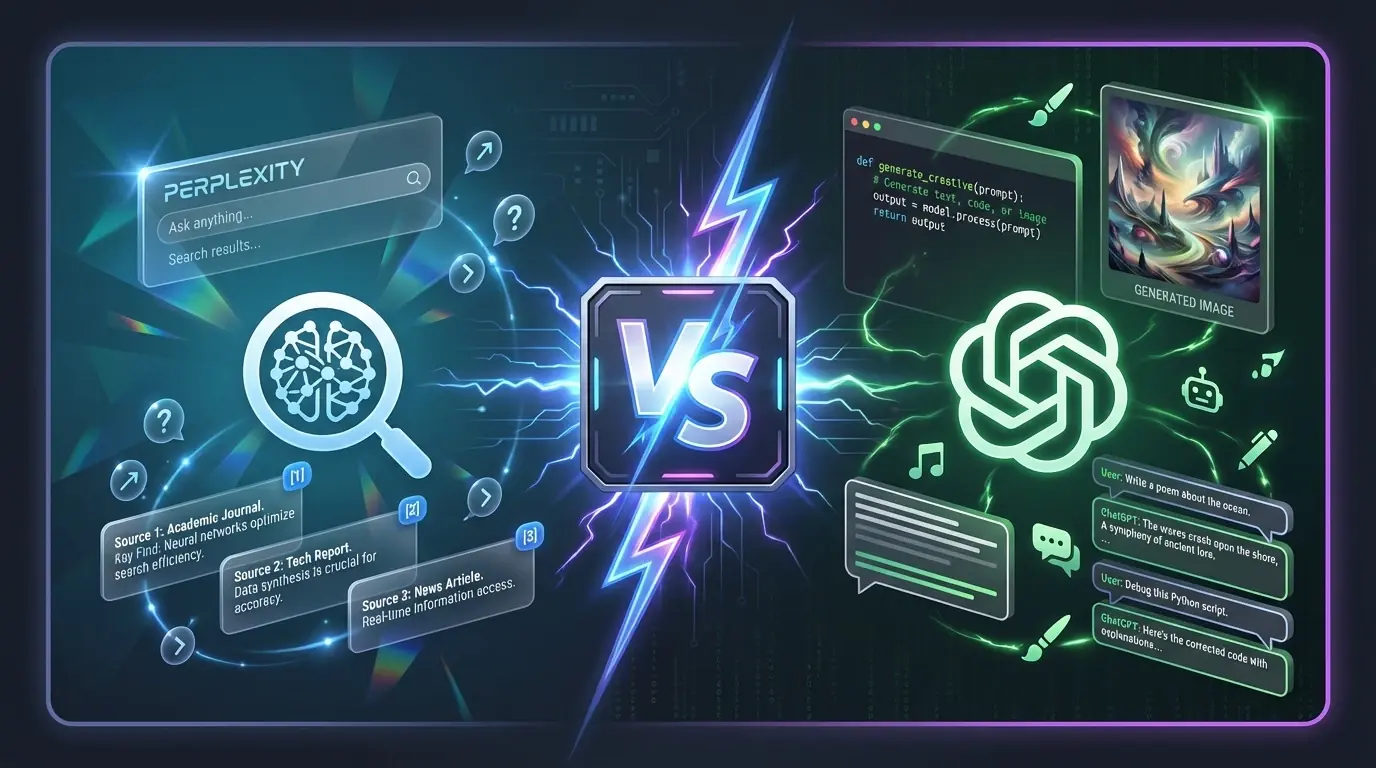
Perplexity AI is a search-first answer engine. Every time you ask it something, it runs a live web search, pulls content from multiple real-time sources, synthesises a single clear answer, and attaches numbered citations to every claim. You can click any citation and verify the original source instantly. It was built to replace the experience of Googling something and then reading through five different articles to piece together an answer.
ChatGPT is a generation-first conversational AI. Its primary strength is creating, reasoning, writing, and problem-solving — not searching. When you ask ChatGPT something, it draws on its training data first and searches the web only when it determines you need current information. Its output is more narrative, more versatile, and more creative — but less consistently source-backed than Perplexity.
Confusing these two architectures is the reason most people are underusing whichever one they have. Knowing which tool does what explains every performance difference between them.
The Numbers: Where Each Tool Stands in 2026
Before getting into category comparisons, the scale difference is worth acknowledging:
- ChatGPT: 900 million weekly active users, $2 billion per month in revenue, 92% of Fortune 500 companies using OpenAI products. The dominant general-purpose AI platform on earth.
- Perplexity AI: 45 million active users, 780 million monthly search queries, growing at over 100% year-on-year. Processes short queries in an average of 0.8 seconds. Valued at $21.2 billion in early 2026 after backing from SoftBank, Nvidia, and Jeff Bezos.
ChatGPT’s scale advantage is enormous. But Perplexity’s growth trajectory and its specific positioning in the search and research segment tell a different story — it is carving out a defensible niche rather than trying to out-ChatGPT ChatGPT.
Head-to-Head: 6 Categories That Actually Matter
1. Accuracy and Citation Quality
This is where Perplexity AI’s architecture gives it a structural advantage that benchmark data consistently confirms.
In an April 2026 evaluation by independent AI research group LMSYS, Perplexity Pro achieved a 92% factual accuracy rate on real-time information queries, compared to ChatGPT’s 87% with browsing enabled. A separate audit by Scale AI in late 2025 found similar results: Perplexity at 91.3%, ChatGPT at 84.7%. The gap widens dramatically on time-sensitive queries — on stock-related questions, Perplexity scored 94% accuracy versus ChatGPT’s 81%.
The citation story is even more telling. Perplexity tied every claim to a specific source in 78% of complex research questions, compared to ChatGPT’s 62%. A Columbia Journalism Review benchmark study found Perplexity had the lowest citation error rate among major AI tools — 37% error rate versus 67% for ChatGPT Search.
Perplexity also scores 93.9% on the SimpleQA benchmark — impressively exceeding leading models including OpenAI’s own o1-preview and GPT-4o on factual accuracy for real-world queries.
Verdict: Perplexity AI wins — for any task where you need to trust and verify the answer.
2. Search Speed and Real-Time Information
Perplexity’s index updates in near real-time. Its average response time for short queries is 0.8 seconds. For breaking news, current stock data, live regulatory changes, or anything that happened in the last 24 hours, Perplexity consistently returns more accurate, more current information than ChatGPT.
ChatGPT’s browsing relies on Bing’s index with a slight processing delay. It is slower on current-events queries and more likely to return information that is days rather than hours old on fast-moving topics.
Verdict: Perplexity AI wins — for anything requiring current information.
3. Content Creation and Writing Quality
This is where the comparison flips decisively. ChatGPT generates more natural, polished prose — smoother narrative flow, better sentence variety, and writing that requires less editing before it is usable. In readability tests comparing identical writing prompts, ChatGPT consistently produces more publication-ready output.
Perplexity generates text that reads more like a structured research brief — fact-heavy, well-organised, but less engaging for a general audience. It is excellent for producing a first-pass summary to work from; it is not where you want to finish a piece of writing that needs to engage readers.
Verdict: ChatGPT wins — for any content meant to be published, presented, or read by a human audience.
4. Coding and Technical Tasks
ChatGPT wins here without significant competition from Perplexity. ChatGPT’s Codex agent, Code Interpreter, and GPT-5.4’s coding capabilities give it a substantial practical advantage for software development. Perplexity can retrieve coding examples and summarise documentation, but it cannot write, test, or debug multi-file code the way ChatGPT — or Claude — can.
For developers, ChatGPT Plus at $20 per month (for Codex access) or Claude Pro at $20 per month are the right choices. For a full breakdown of how these tools compare on development workflows, see the ChatGPT vs Claude 2026 comparison covering benchmark data and developer survey results. Perplexity is not a coding tool in any meaningful practical sense.
Verdict: ChatGPT wins — and Claude leads for production-grade software engineering.
5. Pricing and Value Comparison
At the standard paid tier, both tools charge $20 per month — but the value delivered is fundamentally different. Here is the full breakdown:
| Plan Feature | Perplexity Pro ($20/month) | ChatGPT Plus ($20/month) |
| Core function | Unlimited Pro searches with citations | GPT-5.4 Thinking + full advanced toolkit |
| Image generation | Not included | DALL-E included |
| Video generation | Not included | Sora (limited credits) |
| Multi-model access | GPT-5.4, Claude, Gemini — all available | GPT family only |
| Source citations | Every answer, automatically | Inconsistent — not always triggered |
| Deep Research | Included, unlimited | 10 runs/month only |
| Agentic tools | Limited scope | Codex, Agent Mode — included |
| Enterprise privacy | No training on user data (Pro+) | Opt-out required on Plus tier |
An underappreciated feature of Perplexity Pro: it gives you access to multiple frontier models — GPT-5.4, Claude, and Gemini — within a single $20 subscription. You get the best search layer plus the ability to route complex queries to whichever underlying model handles them best. ChatGPT Plus locks you into the GPT model family only.
Verdict: Perplexity for research value and multi-model access. ChatGPT for feature breadth and multimedia creation.
6. User Experience and Interface
Perplexity is faster, cleaner, and more search-like. The numbered citation system is elegant — you can see exactly which source supported each claim without leaving the answer. The Related sidebar suggests follow-up queries that genuinely advance your research.
ChatGPT’s interface is richer but heavier. It supports Projects, custom GPTs, file uploads, canvas-mode document editing, and voice mode. For users who want a feature-rich platform rather than a fast research tool, ChatGPT’s interface is the more powerful environment.
Verdict: Perplexity wins for research speed and citation clarity. ChatGPT wins for feature depth and creative workflows.
The Workflow That Wins: Using Both Together
The most productive approach in 2026 is not choosing one tool and ignoring the other — it is understanding that they serve different phases of any knowledge work:
- Research phase → Perplexity AI. Ask Perplexity for current facts, recent statistics, source verification, and real-time information. Let it do the live web research and citation work. Copy the key data points and verified sources it provides.
- Creation phase → ChatGPT or Claude. Take the verified facts from Perplexity into ChatGPT or Claude and use them as the foundation for writing, analysis, code, or strategic planning. Generation-first tools produce far better creative and analytical output when working from verified source material.
This is the workflow described by most professionals who use AI tools daily at serious volume. Perplexity finds and verifies. ChatGPT creates and synthesises. Used together, they deliver dramatically better results than either tool alone.
Who Should Use Which Tool
Choose Perplexity AI as your primary tool if:
- Your work is research-heavy — journalism, content marketing, financial analysis, or academic work
- You need to verify facts and cite sources accurately and consistently
- You are looking for real-time information on fast-moving topics
- You want access to multiple AI models (GPT-5.4, Claude, Gemini) within one subscription
- Citation transparency and data accuracy are non-negotiable for your workflow
Choose ChatGPT as your primary tool if:
- You need to create — write, code, design, or produce polished content
- Image or video generation is part of your workflow (DALL-E, Sora)
- You want voice interaction or agentic multi-step task completion
- Your work involves long document creation, coding projects, or complex reasoning
- You are embedded in Microsoft’s ecosystem and want Copilot integration
Use both if: you do significant research and creation work and can afford $40 per month. The combination covers your full workflow better than any single tool at any price point.
Where to Learn More
If you are new to Perplexity AI and want to understand how to use all of its features effectively — from Pro Search to Deep Research to the Comet browser — the team at Perplexity AI Magazine covers the platform in more depth than any other publication. Their Perplexity AI complete guide is the most comprehensive walkthrough of the platform available in 2026 — covering everything from basic search to advanced research workflows, plan comparisons, and how Perplexity’s accuracy stacks up against other AI tools in real benchmark conditions.
The Bottom Line
Perplexity AI and ChatGPT are not competing to be the same tool. They have made deliberate choices about what they are optimised for — and those choices mean the answer to ‘which is better’ is genuinely task-specific.
For research accuracy, real-time information, and verified citations: Perplexity wins. For content creation, coding, voice, images, and feature breadth: ChatGPT wins. For the highest overall productivity across a knowledge work day: both, together.
The good news is that both offer genuinely useful free tiers before you commit to $20 per month. Try each on your actual work — not abstract test prompts — and the right choice for your specific workflow will be obvious within a week.
Looking for more in-depth AI tool comparisons and the latest Perplexity AI updates? Visit Perplexity AI Magazine for expert guides updated weekly.







Comment