
PCB Base Material CTI: Ratings and Selection

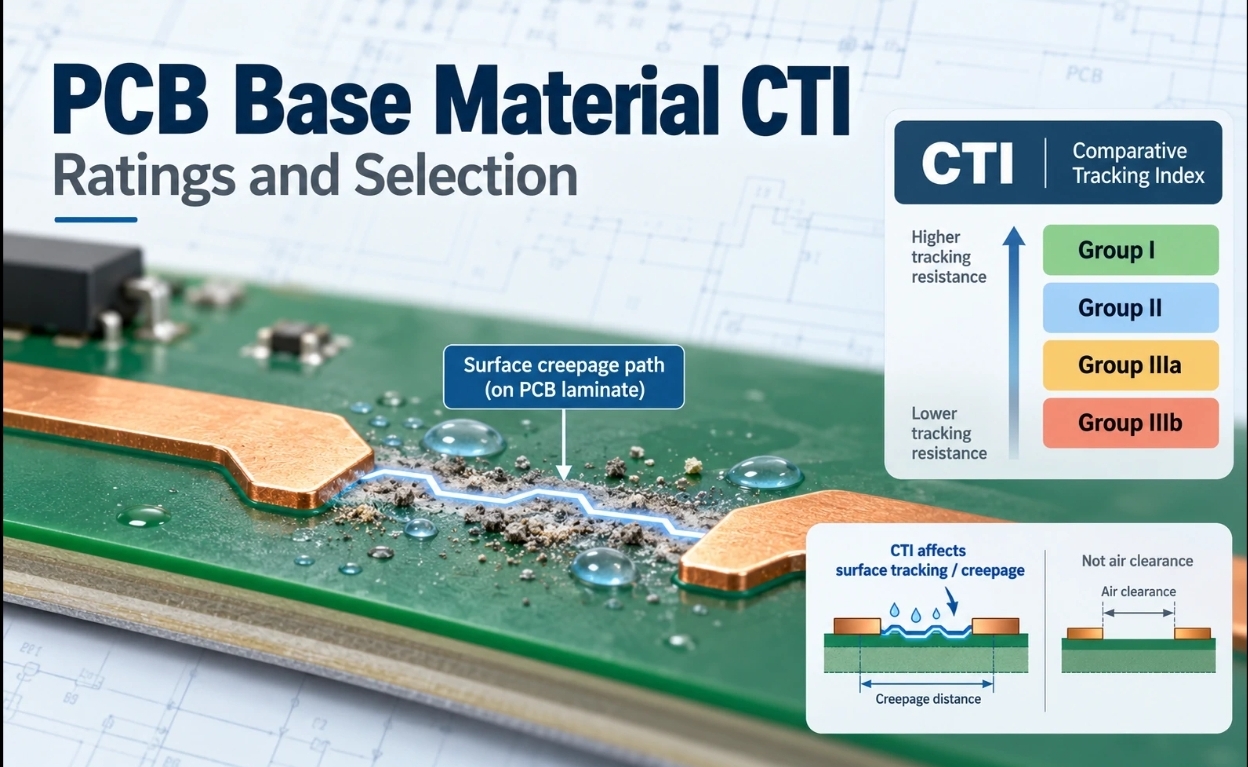
PCB Base Material CTI: Ratings and Selection
A power-board layout can pass a spacing review and still fail an insulation check. The copper is separated, the solder mask looks continuous, and the laminate is FR-4. None of that shows how the exposed surface behaves under moisture, dirt, and voltage. PCB base material CTI helps answer that narrower question.
The Gap That Started a Material Review
Imagine an industrial controller with a 2.8 mm surface path between conductors at different potentials. The number is an illustrative layout measurement, not an approved safety clearance. During a design review, one engineer proposes a higher-CTI laminate instead of moving the copper. Another points out that the creepage path also passes beside a connector, where dust can collect. Neither observation establishes compliance.
The first task is to identify the applicable product safety standard, the relevant working voltage, the insulation function, and the pollution degree expected at that location. Only then can the team check whether a different material group changes the required creepage. If the limiting dimension is clearance through air, a laminate upgrade may not solve it at all.
What a CTI Number Actually Measures
Comparative Tracking Index describes a solid insulating material’s resistance to the formation of a conductive track on its surface in a standardized test. Under IEC 60112, electrodes and drops of specified test liquid expose specimens to electrical stress. The reported result characterizes a material under those laboratory conditions; it is not the maximum operating voltage of a finished PCB.
That distinction prevents a dangerous shortcut. A laminate marked CTI 600 must not be interpreted as permission to place 600 V across any convenient gap. Equipment insulation requirements depend on the operating environment and the product standard. Nor does CTI substitute for dielectric strength, internal-layer spacing, or tests for conductive-anodic-filament formation inside a multilayer board.
Manufacturers may also provide a proof tracking index (PTI) result. CTI characterizes comparative performance; PTI verifies performance at a specified test level. For the precise test sequence and reporting conventions, check the specified edition of IEC 60112 and the supplier’s report rather than treating the two numbers as interchangeable.
The Four Groups Are a Classification, Not a Layout Rule
IEC insulation-coordination practice commonly uses these CTI-based material groups:
| Material group | CTI range | What the grouping tells you |
| I | 600 or higher | Highest group in this classification |
| II | 400 to below 600 | Greater tracking resistance than Group IIIa |
| IIIa | 175 to below 400 | Covers a broad range of common laminate options |
| IIIb | 100 to below 175 | Lowest of these four groups |
The grouping matters only where the insulation rule lets material group affect creepage; it cannot convert CTI directly into millimeters. Depending on voltage, pollution and the governing standard, moving from Group IIIa to Group I may not address the controlling limit.
Why “FR-4, High Tg” Is an Incomplete Purchase Specification
FR-4 identifies a family of glass-reinforced epoxy laminates, not a single electrical tracking rating. A higher glass-transition temperature, Tg, generally describes thermal behavior; it does not automatically confer a higher CTI. Likewise, a favorable dielectric constant is useful for impedance design but does not settle surface-tracking risk.
One purchasing mistake is approving a datasheet grade but permitting an unreviewed production substitute. That substitution may preserve thickness and Tg while changing the CTI group. A second error is assuming every exposed insulating surface has the same material composition: the board may include solder mask, adhesive, or other coatings with different qualification evidence.
The laminate and prepreg material reference is useful when comparing commercially available stack-up options. The drawing should nevertheless identify the approved material grade or an explicit CTI minimum, the applicable test basis, and the approval process for substitutions.
Review the Surface the Current Would Follow
Creepage is measured along an insulating surface; clearance is measured through air. A slot, housing wall, connector body, or board edge can change the relevant path, but only according to the measurement rules of the governing standard. Adding a slot without checking its dimensions and geometry is not an automatic compliance fix.
Examine the service environment. Cabinets can develop local condensation; ventilation can deposit dust near high-voltage copper. Flux residues, process contamination, and service conditions should be assessed, not simply assigned the most convenient pollution degree. Solder mask cannot be assumed to provide a certified insulation barrier unless the selected safety framework and qualification evidence support that treatment.
CTI is only one dimension of material choice. A hot assembly process can stress the resin and plated holes even when tracking resistance is excellent. The high-Tg material selection discussion covers thermal properties that should be reviewed alongside, rather than substituted for, CTI.
Evidence to Request Before Approving a Laminate
An effective review produces an auditable decision. Record the applicable safety standard and edition; the voltage and pollution assumptions for each insulation boundary; the required creepage and clearance; and the actual route measurements from the layout. Then connect those requirements to the laminate manufacturer’s CTI evidence and the proposed manufacturing stack-up.
Before approving the purchase order, ask the board supplier to confirm the exact laminate and prepreg grades, traceability, permitted substitutions, and whether supplied certificates cover the specified CTI property. If a higher-CTI grade is being proposed to recover board space, repeat the full insulation calculation and check the connector and enclosure geometry. Do not sign off merely because the numerical CTI is larger.
The right result may be a material upgrade, a copper-layout change, a different enclosure strategy, or no change at all. CTI is most valuable when it removes one uncertainty from that decision—not when it becomes a substitute for the decision.
Frequently Asked Questions
Can a CTI 600 material be used on a 600 V PCB?
Not on that evidence alone. CTI 600 identifies laboratory tracking performance, not a general working-voltage rating. The permissible spacing still depends on the equipment standard, insulation type, working voltage, pollution environment, and board geometry.
Does a higher CTI always allow closer copper spacing?
No. Higher CTI may reduce creepage requirements where the applicable standard uses material groups. It does not automatically reduce the required clearance through air, and other safety constraints may remain the limiting factor.
Is high-Tg FR-4 necessarily high-CTI FR-4?
No. Tg describes a material’s thermal transition, while CTI concerns resistance to surface tracking. Two laminates with similar Tg values can have different CTI classifications. Check the precise grade and its supporting test documentation.
Will solder mask or conformal coating eliminate tracking concerns?
Neither should be assumed to do so. Coatings can change surface exposure, but their insulating role depends on material qualification, application quality, and the governing safety standard. Verify the accepted treatment rather than simply subtracting spacing.
What should purchasing request from a PCB fabricator?
Request the approved laminate grade, applicable CTI test evidence, stack-up details, and substitution controls. Pair these documents with the product’s insulation calculations and relevant acceptance criteria so that manufacturing cannot silently change a safety-related material assumption.







Comment