Every industry has a task that was done by hand for so long that nobody thought of it as data. In oil and gas, one of those tasks happens in a pipe yard: screwing lengths of steel tubing together, and unscrewing them again, hundreds of times per well. For a century the record of that work was a line in a logbook. In the last few years it has quietly become a per-joint digital record, and that change is reshaping how service workshops win contracts, settle disputes and train people. This article explains what the digital make-up record is, why operators started demanding it, and what it changes on the ground.
The task nobody counted
A production string in a 2,500 metre well is around 260 joints of tubing, each about nine metres long, joined by threaded connections. Each time the string comes out of the well for maintenance, every connection is broken out; each time it goes back, every connection is made up again. That is roughly 520 threaded operations per intervention, and a mature well may see eight or ten interventions in its life. A drill string of 3,000 metres adds another 315 connections, tripped many times per well.
The pipe body survives all of this. The threads at each end do not, at least not reliably. When two steel surfaces slide under high contact pressure with too little thread compound, too much speed or a slight misalignment, the metal welds in spots and tears. The defect, called galling, leaves a thread that will not seal and usually cannot be repaired. Most of it happens during make-up rather than downhole, which means it happens where a workshop can control it.
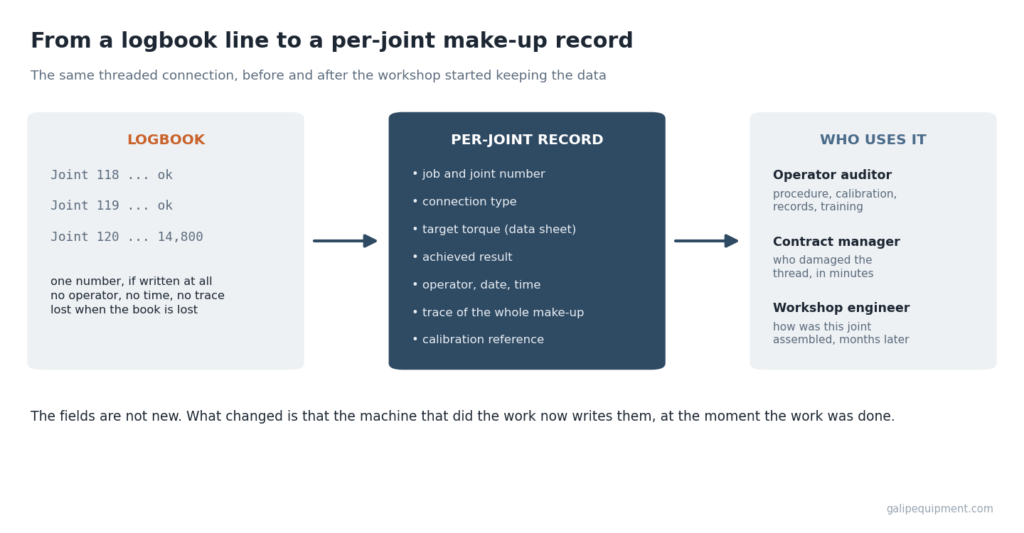
From a logbook line to a per-joint record. The same operation now produces data that three different parties use: the operator’s auditor, the contract manager and the workshop engineer.
Why one number was never enough
The traditional proof of a good connection was a single value, the final torque. It is easy to read off a gauge and easy to write down, and for decades it was the only thing anyone recorded. It has a blind spot that engineers have known about for as long as it has been used: a connection that galls partway through make-up generates extra friction, and that friction adds to the final reading. A ruined joint and a sound one can end on exactly the same number.
The information that separates them is how the resistance grew while the connection was turning. Capturing it requires equipment that measures continuously and stores the whole operation rather than its end point. That is a data problem before it is a mechanical one, and it is the reason the digitisation of this task began with the measurement, not with the software.
The machine that produces the data
In workshops that have made the change, connections are made up on a bucking unit with a digital make-up record: a horizontal hydraulic machine in which a clamp holds one side of the connection, a rotating head turns the other at a few revolutions per minute, and the applied torque is measured continuously until the target the connection manufacturer specifies is reached. The reaction torque is absorbed by the frame rather than by a crew holding a chain tong, which removes people from the radius of a connection that can release with violence.
Two mechanical details matter more than the headline torque capacity. The first is the minimum speed: large connections are made up slowly because speed heats the contact zone and displaces the compound. The second is alignment: adjustable supports bring the two ends into line before the threads touch, which on a rig floor is often impossible and in a workshop takes a minute.
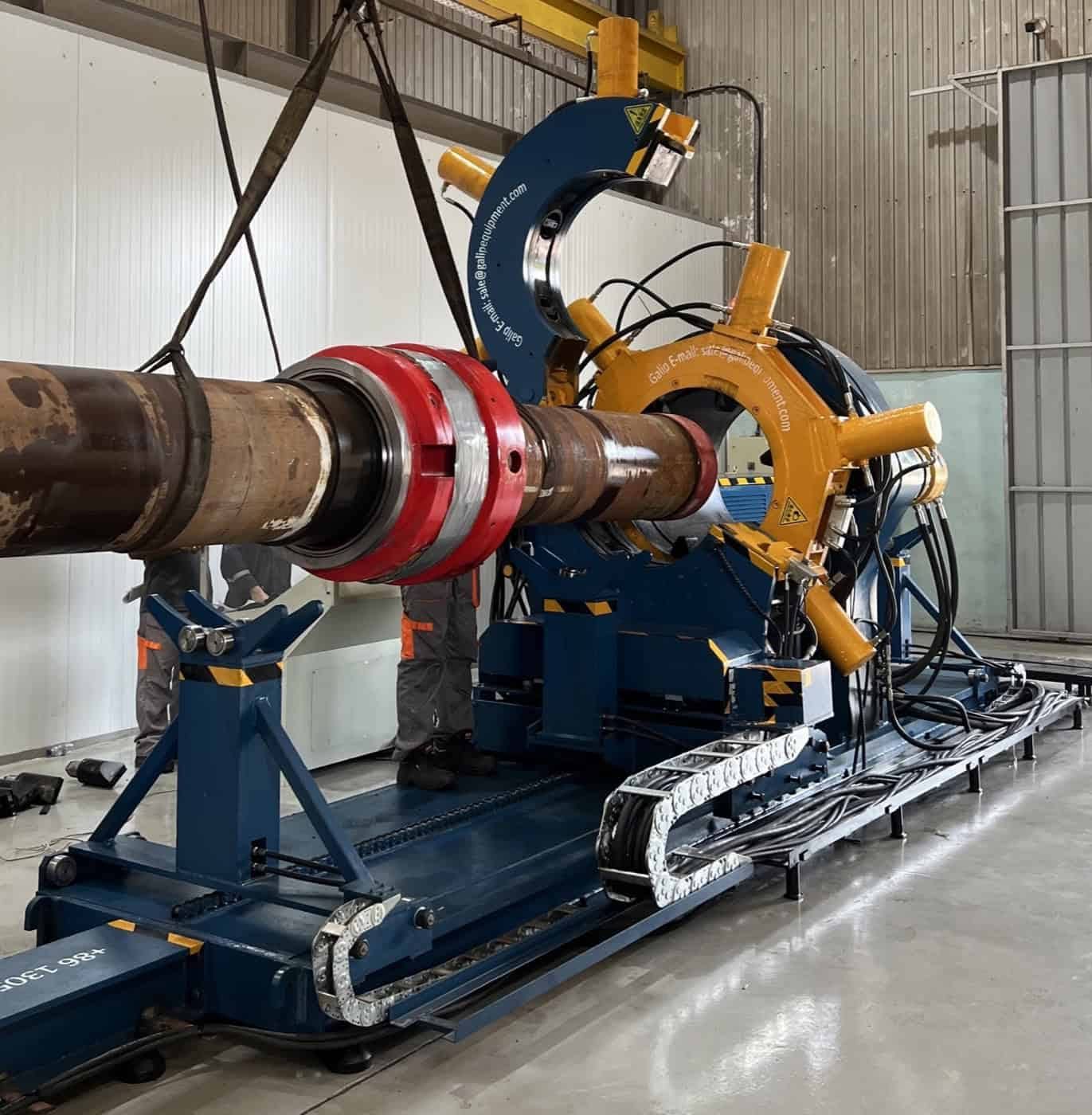
A drill collar connection clamped for make-up. Torques for these connections run into tens of thousands of foot-pounds, far beyond anything a crew can apply by hand.
What is actually in the record
The record that make-up monitoring software files for each joint is not complicated, which is part of why it has spread. It holds the job and joint number, the connection type, the target torque from the connection manufacturer’s data sheet, the achieved result, the operator’s identity, the date and time, and the trace of the make-up itself. Files are stored against the job, exportable as a report, and searchable by joint number months later.
None of these fields is new. Good workshops wrote most of them in a logbook. What changed is that the record is now produced by the same machine that did the work, at the moment the work was done, in a form that can be sent to a customer, attached to a dispute or reviewed by an engineer without anyone’s memory being involved.
Who uses it, and for what
The operator’s auditor. Oil companies audit the contractors that handle their tubulars, and the audit checklists now ask for a written running procedure per connection type, purpose-built equipment that measures torque continuously, a calibration certificate for the torque measurement, per-joint records on request and evidence of operator training. A workshop with a logbook cannot answer these questions convincingly. A workshop with a digital record answers them by opening a file.
The contract manager. When tubulars belong to the operator or to a rental company and are handled by a contractor, thread damage produces a dispute about who caused it. Rental agreements charge for every damaged thread returned, and the charge can exceed the margin on a job. Without records the dispute is settled by argument; with a record of how each connection was made up, it is settled in minutes.
The workshop engineer. When a string fails months after it went into the well, the first question is how the joints were assembled. A record that shows a normal make-up clears the workshop and points the investigation elsewhere. A record that shows an abnormal one identifies the joint, the day and the operator, and turns a mystery into a procedure change.
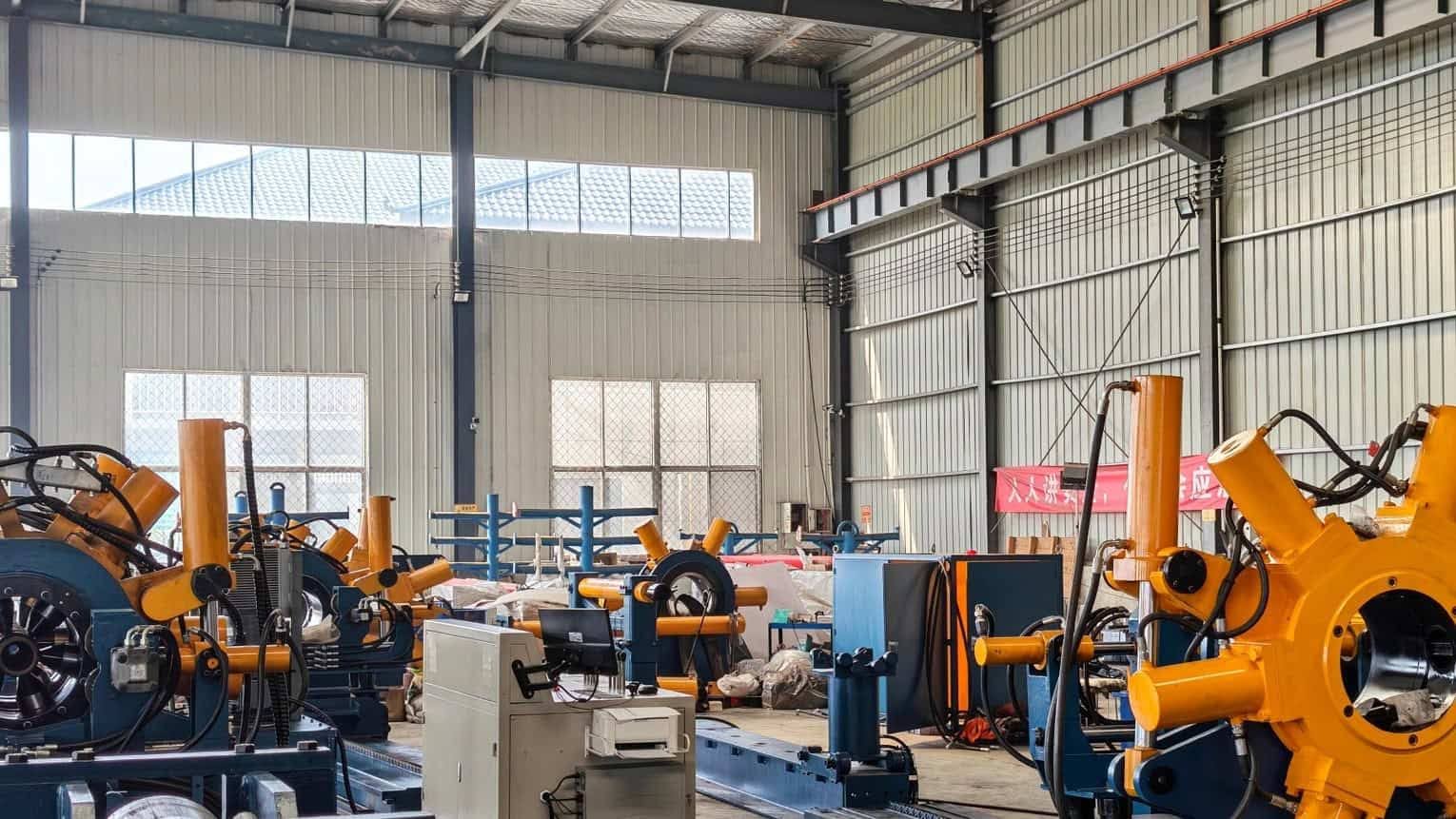
The workshop floor where the record is produced. Unlike the rig, it has time, light and a fixed machine that can measure every operation.
The economics that made it stick
Technology in industrial workshops rarely spreads because it is elegant. It spreads because it changes a number that somebody is measured on. Here the number is the thread reject rate per intervention. Take the 260-joint string and eight interventions: a workshop that rejects three per cent of joints for thread damage each time loses 62 joints over the life of the string, almost a quarter of the original purchase. At one per cent it loses 20. The 42-joint difference is, in most producing countries, an import order priced in dollars with a lead time of months.
The reject rate is not set by the age of the pipe. It is set by how the last make-up was done, which makes it one of the few costs in the tubular budget that a workshop controls completely. Against that saving, the capital cost of a make-up unit is recovered from pipe that stays in service rather than from labour hours, usually well within the machine’s working life. Installation is smaller than most buyers expect: current units stand on adjustable levelling feet without a foundation or anchors, in a clear area of about 13 to 14 metres by 5 to 6 metres, on a floor rated for roughly 750 kilograms per square metre.
What changes for the people
The machine does not replace the technician. It removes physical effort and guesswork. The technician still decides whether the thread is clean and correctly dressed with compound, whether the joint is aligned and whether the make-up looked right. What changes is that the torque value is on a screen in front of the operator and the record backs the decision.
That changes who can do the job. Make-up quality used to live in the hands of one or two senior tong operators, which made it a business risk: when they left, it left with them. A written procedure, a machine that applies it and a record that proves it turn the skill into something a trained operator can deliver in weeks and a supervisor can audit. In regions where skilled crews move between employers and countries every season, that portability is worth as much as the safety case.
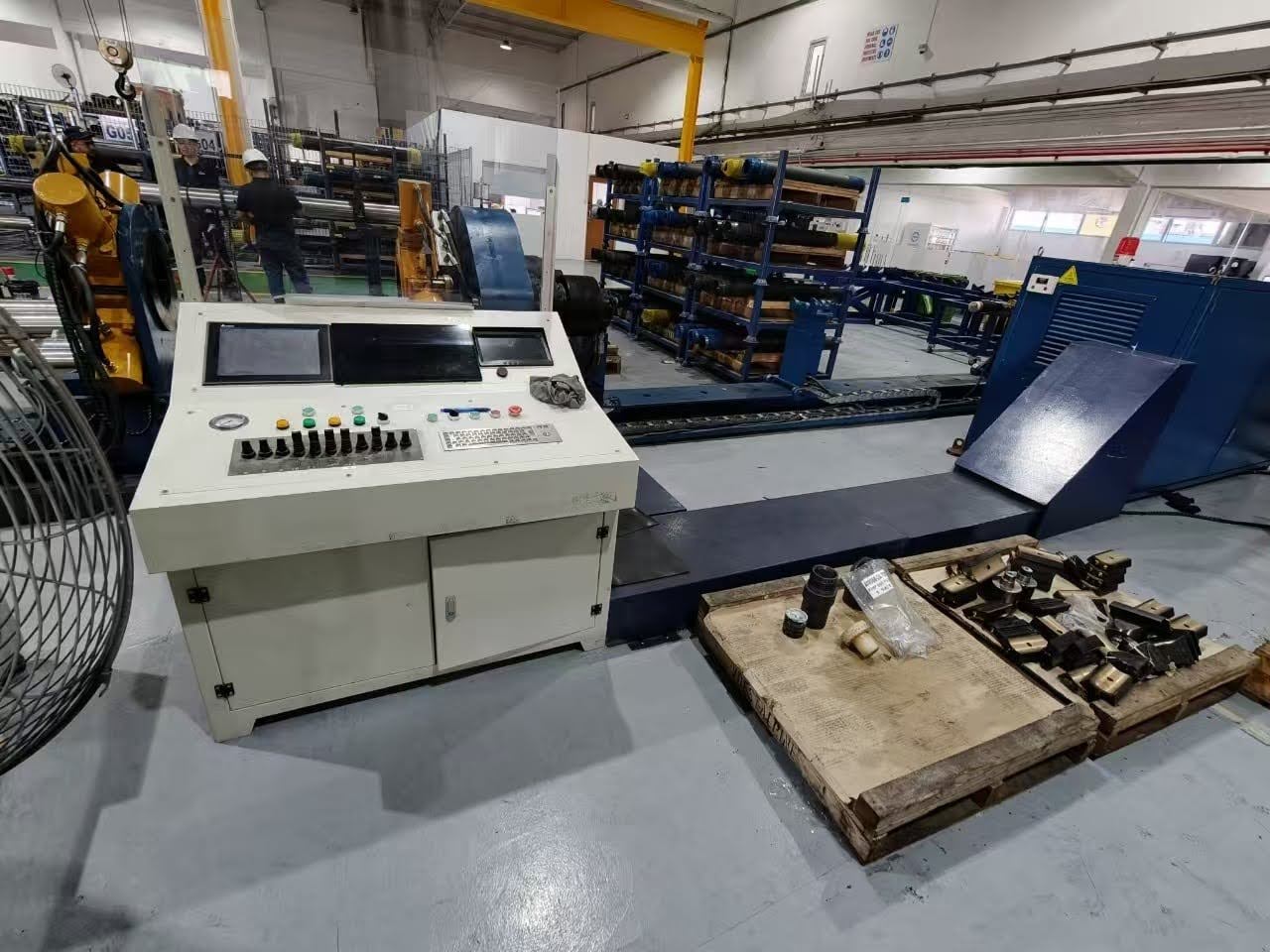
The operator works from the console, outside the reaction zone. Every make-up is filed against its job and joint number as it happens.
The mistakes buyers make
Workshops buying this equipment for the first time tend to compare torque capacity and price, neither of which predicts whether the data will be useful. The questions that do: Does the machine record the whole make-up or only the final value? How slowly can it turn, since the minimum speed matters more than the maximum? Is the torque measurement verified against a reference, with the certificate supplied? Can the record be exported per joint in a form a customer will accept? And what does the installation need from the building, since anything requiring civil works should be treated with suspicion?
There is a second, quieter mistake: buying the machine and not writing the procedure. The record is only as good as the process it documents. Workshops that get the most out of the change treat the equipment, a short written procedure and operator sign-off as one system, and they measure the reject rate by cause so the controllable part is not hidden inside the uncontrollable one.
Who owns the record
A question that did not exist in the logbook era now comes up in contract negotiations: who owns the make-up data. The pipe usually belongs to the operator or a rental company, the machine belongs to the workshop, and the record describes work done by one party on the property of another. In practice the workable answer is the one that data-heavy industries reached years ago. The workshop keeps the full record as its own quality evidence, the customer receives a per-joint report with every job, and the contract states that the report is the reference document if a thread is later found damaged. Workshops that settle this in writing before the first job avoid the argument that otherwise arrives with the first damage claim.
The same clause has a commercial side. A contractor that can promise a per-joint report with every string is selling something its logbook competitors cannot, and operators have started to specify it in tenders rather than merely welcome it.
Why this matters beyond one industry
The pattern is familiar to anyone who has watched industrial digitisation elsewhere. A manual task with a single pass-fail number becomes a measured process with a record. The record is first demanded by the customer’s auditors, then used by the contract managers, then by the engineers, and finally it changes who is hired and how they are trained. The technology involved is modest. The value comes from putting a measurement at the point where the work is done and keeping the result.
Oilfield workshops came to this later than most manufacturing sectors, partly because the task looked too rough to measure and partly because nobody counted how often it was done. Now that the count is known, roughly 4,000 threaded operations per string over the life of a well, the logbook looks less like tradition and more like a missing dataset. The workshops filling it in are the ones still on the bid lists.
Technical input for this article was provided by Dezhou Zhuorui Petroleum Machinery, an ISO 9001 certified manufacturer of hydraulic bucking and breakout units for oilfield service workshops.