The Goldman Sachs software engineer is one of four inventors named on a newly accepted Nigerian utility-model patent that marries engineered biochar with real-time machine learning to clean up industrial effluent.
For David Excel Ozowara, the road from writing enterprise software for one of the world’s largest investment banks to helping clean up factory wastewater might seem an unlikely one. Yet for the Nigerian-born engineer, the two pursuits spring from the same instinct: using technology to solve problems that matter. Ozowara, a Software Engineering Analyst at The Goldman Sachs Group in Dallas, is one of four inventors named on a newly accepted Nigerian utility-model patent for an Artificial Intelligence Driven Smart Adsorption System for Real-Time Industrial Wastewater Purification Using Biochar Composite Materials, a technology its inventors hope will help address a public-health problem that has long troubled Nigeria’s industrial corridors.
The invention, filed on 24 March 2026 with the Federal Ministry of Industry, Trade and Investment under file number NG/PT/NC/O/2026/21969, has been accepted for registration as a utility model, with the certificate now being processed. It pairs a low-cost adsorbent material with a machine-learning control layer. The adsorbent is a biochar composite, produced by heating agricultural biomass waste and functionalising it with magnetic iron-oxide nanoparticles, chitosan and zeolite, a combination engineered to pull heavy metals, dyes and pharmaceutical residues out of complex industrial effluent. What sets the system apart is what sits on top of that chemistry: a bank of sensors and an on-board artificial-intelligence processor that runs the plant in real time.
“Clean water should not be a privilege,” Ozowara said. “Growing up, I saw how much damage untreated industrial discharge can do to a community’s rivers and to the people who depend on them. The technology to do better already exists, including sensors, edge computing and machine learning. What was missing was a system that ties them together and makes the right decision automatically, second by second, without waiting for a technician to carry a sample to a lab.”
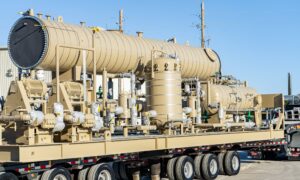
In the patented design, modular treatment columns are instrumented with sensor arrays that read pH, turbidity, conductivity, dissolved oxygen, ultraviolet-visible absorbance and heavy-metal concentrations every second. An on-board AI edge processor, running a hybrid model that combines an artificial neural network with deep reinforcement learning, trained on more than 500,000 industrial wastewater profiles, uses those readings to adjust flow rate and contact time on the fly and to decide when the adsorbent needs regenerating.
That control layer, Ozowara said, was where his own contribution lay. “My part of the work was the brain of the system,” he explained. “The material does the adsorbing, but the model has to read the water and act in the same instant, the way you would want any control system in a high-stakes environment to behave. It has to learn the signature of the effluent, decide how hard to run the plant, and know when to trigger regeneration, all without a human in the loop.”
The performance figures set out in the filing are striking. The system is designed to remove more than 99 per cent of heavy metals, more than 97 per cent of organic micropollutants and more than 99.5 per cent of colour from treated water, while drawing less than 0.8 kilowatt-hours of energy per cubic metre, well below the energy demands of conventional membrane systems. A wireless module streams live treatment data to a cloud dashboard that checks the output against World Health Organization, Federal Environmental Protection Agency and European Union water-quality standards, and the design is intended to scale from small operations treating ten cubic metres a day up to plants handling more than ten thousand. Regeneration is autonomous: an electrochemical cycle restores more than 95 per cent of the adsorbent’s capacity in about 45 minutes, giving the system a working life of at least five years.
That self-sufficiency, Ozowara said, was a deliberate design goal. “The feature I care most about is that it runs itself,” he said. “A plant on an industrial estate should not need a data scientist on site to stay compliant. The system should regenerate, recalibrate and flag its own problems, and simply show an operator a clean dashboard. If keeping water safe depends on someone remembering to take a sample, sooner or later it fails.”
“The engineering challenge was never just the chemistry. It was the variability,” said Oluwagbemisola Cynthia Falegan, the patent’s lead inventor and applicant. “Industrial wastewater is never the same twice. The intelligence layer is what lets the system learn the signature of the effluent and keep the whole plant inside a safe operating envelope. That is what turns a promising material into something a plant operator can actually rely on.”
The patent names four inventors drawn from across Nigeria and its diaspora: Falegan, based in Lagos; Chukwudera Anunagba, in Abuja; Ozowara, whose family home is in Kaduna; and Zamathula Queen Sikhakhane-Nwokediegwu, in Anambra. Ozowara brought to the team the software and machine-learning expertise that underpins the system’s adaptive control, the same discipline he applies by day to high-stakes financial platforms.
That day job is itself the product of a fast-rising career. Ozowara graduated Magna Cum Laude from Western Illinois University in May 2025 with a Bachelor of Science in Computer Science, carrying a grade-point average of 3.899, and joined Goldman Sachs full-time as a Software Engineering Analyst after an internship with the firm. He sees a direct line between that work and the patent. “At the bank I spend my days making sure systems stay reliable and auditable under pressure,” he said. “The instinct is the same: build something that behaves predictably even when the inputs are messy. Industrial wastewater is about as messy an input as you can get, so the same engineering discipline carries straight over.”
Away from the trading-floor systems, Ozowara has built a substantial research record. He has authored or co-authored sixteen peer-reviewed publications across cybersecurity, financial technology, artificial-intelligence governance, cloud computing and Salesforce enterprise architecture, and he now serves as a section editor and active peer reviewer for several international journals, a role that places him among those who decide which new research in his field reaches print. In 2025 he was named Most Promising Software Development Professional of the Year at the Nigeria Technology Awards, and he holds a fellowship of the Chartered Institute of Information and Strategy Management (FCISM).
For his part, Ozowara is careful to frame the patent as a starting point rather than a finished product. “A filing is a milestone, not a solution,” he said. “The real work is getting a system like this deployed, proving it in the field and making it affordable enough that a mid-sized manufacturer in Kano or Aba can install it. I would like to see this help Nigerian industry meet its environmental obligations without pricing itself out of business. If it does that, then it was worth building.”