
Netflix Plans and Pricing: How to Choose the Right Option for Your Household

The cheapest Netflix plan is not always the best value for your household, and the most expensive one is not automatically the one you need. A single viewer watching on a laptop has different priorities from a family using a 4K television while someone else downloads episodes for a trip.
The practical starting point is to count simultaneous viewers, decide whether advertisements are acceptable and check the devices you actually use. Then compare the monthly cost with the features you will notice. In the United States, Netflix offers Standard with ads, Standard and Premium; prices and plan availability vary by country and can change.
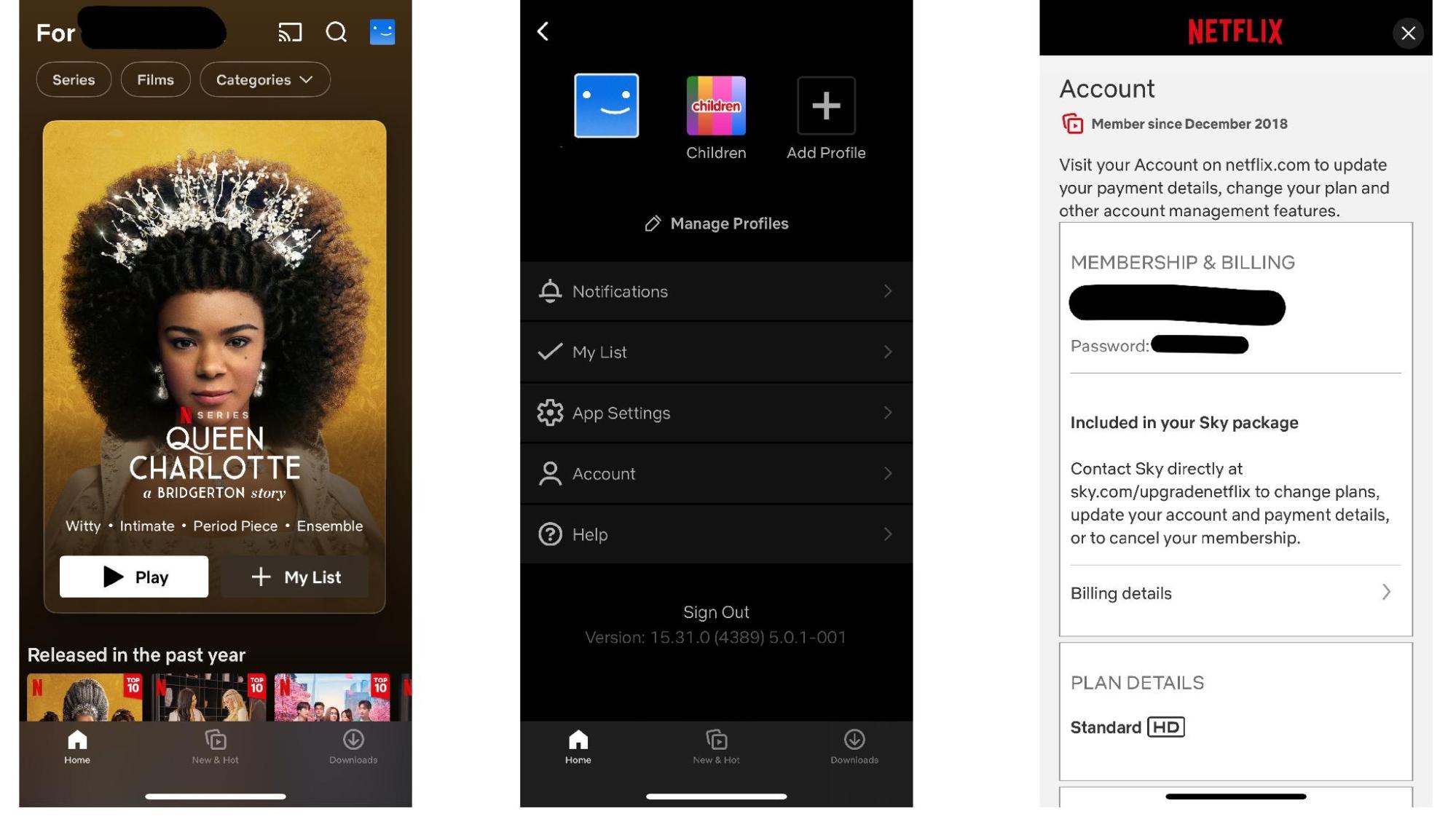
Historical Netflix mobile account screens for a UK Sky-billed membership, via What Hi-Fi?. Interface and billing may differ.
Decide who will watch and where
Netflix describes a household as the devices connected to the internet at the main place where you watch. Profiles help people in that household keep separate recommendations and viewing histories, but a profile is not the same thing as an independent membership or permission for unlimited households to share.
Readers exploring where to buy netflix accounts may encounter full-access accounts, private profiles and shared profiles. These are different third-party products, not the same as opening a subscription directly with Netflix. Check the account type, region, access period and household restrictions before comparing a listing with an official plan.
The figures below describe Netflix’s US plans, checked against its official plans and pricing information and a US pricing report. They are monthly subscription prices rather than prices for a third-party account. Taxes, bundles, promotions and future price changes can affect what a customer pays.
| US plan | Monthly price | Simultaneous streams | Maximum advertised resolution |
|---|---|---|---|
| Standard with ads | $8.99 | 2 | 1080p |
| Standard | $19.99 | 2 | 1080p |
| Premium | $26.99 | 4 | 4K Ultra HD + HDR |
Standard with ads for a smaller monthly bill
Standard with ads is the natural first comparison for someone who watches on one or two supported devices and does not mind commercial breaks. Netflix says most movies and series are available, though some titles are unavailable on the ad-supported plan and show a lock icon. Check the programmes you care about before assuming the lower price covers your entire watchlist.
The plan supports two simultaneous streams and Full HD playback. It also supports downloads on two compatible devices, subject to the plan’s download limits and title availability. A household with one television and a phone may find that sufficient even if it owns several other devices; owning devices and watching on all of them at once are separate questions.
At the checked US prices, the ad-supported plan costs $11 less per month than Standard. Over twelve unchanged billing months, that is $132. This arithmetic is useful, but it is not a forecast that Netflix will keep the same price for a year. Ask whether uninterrupted viewing and the wider ad-free catalogue are worth that difference to your household.
Standard for viewers who prefer no ads
Standard retains two simultaneous streams and 1080p playback while removing the normal advertising breaks for on-demand viewing. Live events and certain promotional content can have different advertising conditions, so check the event details if that is your main reason for subscribing.
Consider this plan if two people often watch different shows at the same time and neither wants regular ad breaks. It can also make sense when a title you want is unavailable on the ad-supported tier. If your household rarely watches Netflix, however, paying more every month for a feature you barely use may not be the best fit.
Netflix may offer an extra-member option for someone outside the household on eligible plans and in eligible regions, for an additional fee. Check the current country-specific rules and whether your billing partner supports it. Adding a profile alone does not create an extra-member subscription.
Premium when the screen and household justify it
Premium raises the simultaneous stream limit to four and supports 4K Ultra HD with HDR for eligible content and devices. Netflix also lists downloads on six supported devices. Those features matter most when several household members watch at once or when you have a compatible 4K display and a reliable connection.
Do a simple test before upgrading: how often does a third person actually need to watch at the same time? If that happens once during a holiday, a higher price every month may be unnecessary. If two televisions, a tablet and a laptop regularly compete for streams, four simultaneous slots can be useful.
Premium’s 4K label is not a guarantee that every show or every device will display 4K. Check the title, device, connection and playback settings. If your main screen is a 1080p laptop, the extra resolution may offer little practical benefit there. The US price difference from Standard is $7 per month, or $84 over twelve months if prices remain unchanged.
Compare access conditions, not just the headline price
When comparing cheap netflix accounts, look beyond the monthly number. A listing for one private profile can provide a different level of control from a full-access account. A shared profile can involve other users’ viewing history and settings. Confirm who controls the login, whether the access is for the whole account or one profile, the stated duration and any region or device limitations.
Netflix says its own plans are billed monthly and does not offer annual, multi-month or lifetime membership plans. A seller offering access for several months is setting its own product conditions; that duration should not be presented as an official Netflix membership term. The platform’s household rules still matter regardless of the wording on a listing.
If a household member lives elsewhere, investigate Netflix’s eligible extra-member option instead of assuming any shared profile will work indefinitely. Netflix’s household verification and product availability can change. Read the listing and the official terms together, and decide which arrangement matches the control and reliability you need.
Check the total cost in the way you actually watch
Imagine two people in one household who usually watch together on one TV, with an occasional second stream on a phone. They may need two simultaneous streams but not four. If they also accept advertisements and their favourite titles are available, Standard with ads is the logical first plan to evaluate.
Now imagine four household members who routinely watch at the same time and have a compatible 4K television. Premium has a clearer purpose: the additional simultaneous streams and higher supported resolution solve real requirements. For a couple who dislike ads but do not need 4K or more than two streams, Standard may be the better middle ground.
TechBullion has previously covered Netflix access through a broadband bundle. Bundles can be convenient, but their terms are provider- and region-specific. Compare the current total bill, contract period and included Netflix tier before assuming a package saves money.
Revisit the choice when your habits change. A new television, a child starting to watch independently or a period of less viewing can change which features matter. A good plan is the one that supports the screens, people and programmes you actually use without paying for a feature simply because it sounds impressive.
===
What pressure reveals about emotion and self-control
Pressure exposes habits that remain hidden in calm moments. Chess pressure often builds slowly. A player can see the threats, calculate responses, and still make an error because time, fatigue, or ego narrows attention. Poker pressure is more uneven. It forces decisions before certainty arrives, then asks the player to live with outcomes that may look unfair in the short run. Both settings show that emotion does not replace logic; it disturbs access to it.
This matters because most everyday choices carry the same tension. People know the sensible action but delay it after a loss, a rejection, or a surprise. Others become rigid after one bad outcome and start protecting themselves from uncertainty at any cost. Behavior under stress often comes down to tolerance for ambiguity. Some people stay steady when the evidence is incomplete. Others rush to close the gap, even if the answer they choose is weak.
Emotional control, then, is less about suppressing feeling and more about keeping decision quality intact while feeling it. That skill can be trained. Reviewing choices after the fact, separating process from result, and noticing recurring triggers all help. The person who can stay clear under pressure gains an advantage in any uncertain environment.
How risk changes the way people assign meaning
Risk changes behavior because it changes the story people tell themselves. In chess, mistakes often feel personal because the board is visible and the error can be traced. In poker, the same human need for meaning has less stable ground. A strong move may fail, a weak one may succeed, and the mind quickly starts inventing explanations. That search for certainty is deeply human. People want events to feel deserved, ordered, and interpretable.
Outside games, the same pattern shapes careers, investing, and personal plans. When outcomes are noisy, people often overrate confidence, charisma, or short-term wins. They may follow someone who sounds sure rather than someone who thinks in probabilities. They may also abandon a sound strategy too early because a few early results look disappointing.
In uncertain systems, patience becomes a cognitive skill, not a passive trait. The person who understands risk is less likely to panic during setbacks and less likely to build false certainty from temporary gains.
What better decisions look like in real life
Better decisions rarely come from perfect prediction. They come from clear framing, honest assessment, and repeated adjustment. Chess teaches the value of structure, planning, and direct accountability. Poker teaches the value of flexibility when part of the picture is hidden. Everyday life asks for both. People need rules for stable situations and probability-based thinking for uncertain ones.
A practical decision-maker asks a few grounded questions. What do I know for sure? What remains hidden? Which part of the outcome is under my control, and which part depends on chance? That approach reduces emotional noise and improves consistency. It also makes failure easier to study because the person is no longer treating every setback as proof of personal error.
Human behavior becomes more understandable when seen through these three settings. People want fairness, predictability, and control, yet much of life refuses to offer all three at once. The strongest response is neither rigid certainty nor passive acceptance. It is the ability to think well with limited information and keep doing so when the result is still unknown.
Previously in Latest News: American Airlines Cargo Deepens Long-Standing Alliance with WFS Across Eight European Nations







Comment