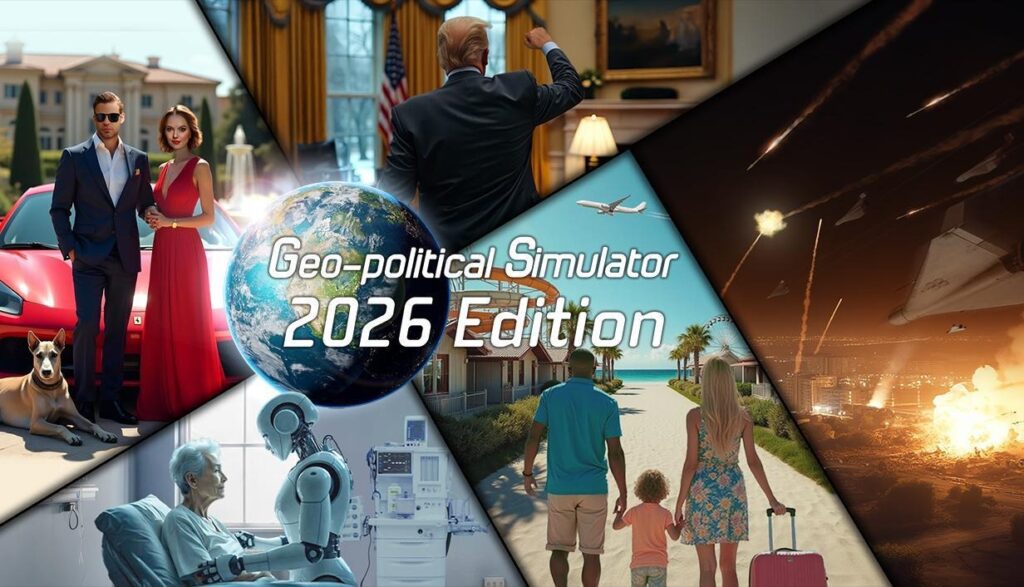
Navigating the complexities of modern warfare and global trade has never been more challenging for the simulation genre. As real-world tensions escalate, the need for high-fidelity models that can accurately mirror these volatile shifts becomes paramount. Eversim, a leader in geopolitical strategy, is addressing this demand directly with their latest expansion for Geo-Political Simulator 2026 Edition.
Today, we speak with Louis-Marie Rocques, co-founder and CEO of Eversim, about the technical and ethical hurdles of simulating active global crises. His company’s “G.P.S.” engine has evolved since 2004 to provide a comprehensive look at today’s world, serving both the gaming community and professional organizations as a tool for diplomacy and crisis management. In this interview, we explore how their latest update integrates the February 2026 Middle East conflict and what it means for the future of geopolitical simulation.
Q: With the release of update 2.18, you’ve introduced a Middle East war scenario based on events starting in February 2026. What are the primary geopolitical stakes you aimed to capture in this update?
Louis-Marie Rocques:
The temporal sequencing of events, the balance of forces involved, the difficulty and duration of the fighting—even when one side is significantly stronger—and, of course, the indirect consequences on the energy market.
Q: Geopolitical Simulator is known for its realism. How does your development team manage to implement current real-world events into the game so quickly after they occur?
Louis-Marie Rocques:
The fact that our game already incorporates many simulation modules—such as AI algorithms for wargames, various reactions triggered by the outbreak of conflict, and the interdependence between economic sectors—greatly facilitates our work. Ultimately, we mainly need to script events according to real-world timelines, while still allowing players the choice to trigger them or not, and to activate the relevant modules. Of course, there is also some dialogues and narration involved, along with a substantial testing phase to ensure this doesn’t create unintended consequences, such as the escalation into a global war.
Q: The update features significant changes to military equipment, such as the addition of suicide drones. Could you explain the importance of adding loitering drones and updated anti-missile calculations to the current wargame system?
Louis-Marie Rocques:
We improved the AI of the drones, which were initially deployed in groups and were therefore too easy to target and destroy. With the large-scale use of individual drones, they are much harder to counter and more realistic. Given the number of drones Iran possesses, this also means the conflict can last much longer. One key tactic is to destroy their launch bases to eliminate as many as possible early on. Reconnaissance drones can also be used to locate units within those bases.
At the same time, anti-air units have been made faster depending on their level of technology. As a result, advanced assets such as aircraft carriers or cruisers—like those operated by the United States—have very high firing rates, making them extremely difficult to destroy.
Q: Economic consequences are a major part of this expansion, specifically regarding the Strait of Hormuz. How does the simulation calculate the ripple effect of a blockade on global fuel and fertilizer prices?
Louis-Marie Rocques:
The game’s economic and trade engine was redesigned during the development of GPS5 (released in 2024). All economic sectors across every country are represented by companies—some globally well-known—that sell their products and purchase raw materials on the global market or by contracts. Trade is simulated in real time, based on factors such as pricing, relations between countries, and population demand.
The AI controlling these companies constantly acts to maximize production and profits. If a resource becomes scarce—such as oil—prices rise, and all industries and populations that depend on it see their costs increase. As a result, the prices of goods produced using that resource also go up. The same applies to fertilizers, which are closely tied to gas availability.
Q: Political organizations use your software for “serious gaming” beyond entertainment, specifically for crisis training. How does this professional application influence how you script key events and allow players to alter history?
Louis-Marie Rocques:
Our tools have indeed been used by various organizations, including NATO, for crisis exercises and training. This experience notably helped us develop an expansion to the base game called the “Modding Tool,” which allows players to modify the global context of the game, as well as script event triggers under specific conditions. This opens the door to reshaping history and then playing in an alternate (uchrony) or dystopian world.
Q: Looking at the long history of the G.P.S. Since 2004, what has been the most challenging aspect of evolving the engine to keep up with modern geopolitical upheavals?
Louis-Marie Rocques:
In the early 2000s, many issues were less prominent than they are today—climate change being the most obvious example. We therefore had to integrate a CO₂ emissions calculator that takes into account virtually all human activities in order to simulate temperature changes and the related disasters.
The world of the 2020s is far more chaotic, with major upheavals occurring in rapid succession: the war in Ukraine, the COVID pandemic, the rise of Donald Trump to power, the war in Gaza, the end of a regime in Syria, tensions in Venezuela, the conflict in Iran, and more. Situations once considered stable can shift very quickly, while new trends continue to emerge—such as the role of artificial intelligence, conspiracy movements, a conservative surge in Europe, and migration or demography dynamics.
Beyond simply updating global data, we have to constantly adapt, quickly and continuously, to integrate and simulate these new phenomena in order to accurately reflect a world that is constantly evolving.
Navigating a Volatile Future: Strategic Insights and Real-World Impact
This interview highlights the intricate balance required to mirror the world’s volatility within a digital framework. By integrating real-time military data from nuclear enrichment facilities to the deployment of loitering drones, Eversim provides a unique lens through which users can analyze the fragile interconnectedness of global politics and the economy.
As global tensions continue to evolve, the role of high-fidelity simulations becomes increasingly vital for both education and strategic planning. Eversim remains at the forefront of this niche, offering a solution that does more than just entertain; it helps us understand the potential consequences of today’s most difficult diplomatic and military decisions.
To learn more, visit www.geo-political-simulator-5.com/news.php
Geo-Political Simulator 2026 Edition trailer: https://www.youtube.com/watch?v=BzS1ONXLpH4
Game also available on:
Microsoft Store
Epic Games Store
Steam