
Mobile Payments & Wallets Explained: What It Means for Consumers and Businesses in the USA

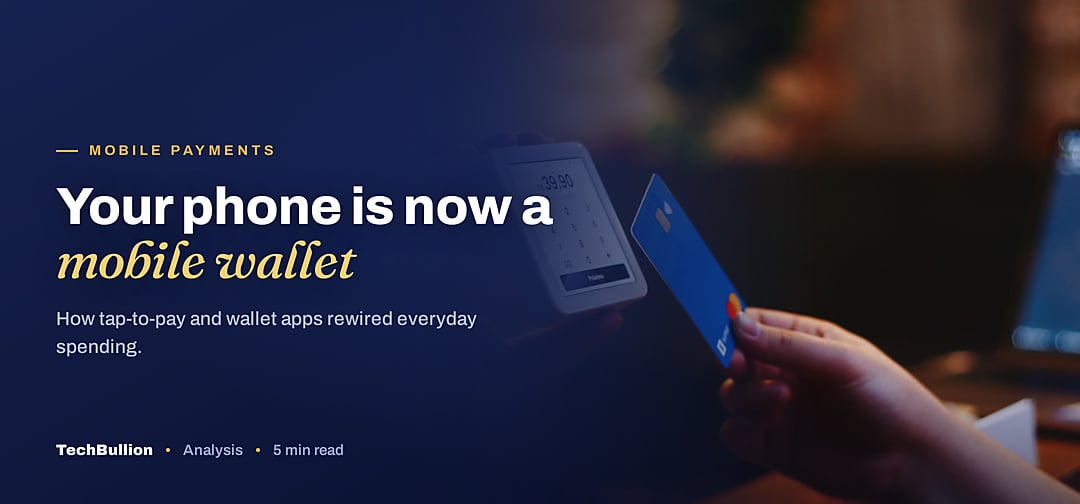
The average American now pulls out a phone to pay more often than a checkbook, a wallet of cash, or in many stores even a physical card. Mobile payments and wallets are apps that store a person’s cards and let them pay by tapping a phone or clicking in an app, and they have moved from novelty to default at the checkout. Apple Pay is now accepted at an estimated 85% to 90% of US merchants, according to usage data compiled by NCH Stats, and instant bank rails are increasingly funding these wallets directly, as The Clearing House reports. What began as a convenience for early adopters is now the way a large share of Americans pay for everyday goods, and the trend is still accelerating. For consumers and businesses, the tap has quietly become the main event, and the card it replaced is starting to feel like a backup.
What a mobile wallet actually is
A mobile wallet is software that holds digital versions of a person’s payment cards, and sometimes loyalty cards, transit passes, and identification, behind the phone’s lock screen. When a user taps to pay, the wallet does not hand over the real card number. Instead it sends a one-time token, a stand-in number that is useless if intercepted.
That tokenization is the core security feature and the reason wallets are often safer than the plastic cards they replace. The merchant never sees the actual card number, and each transaction is authorized by the phone’s fingerprint or face scan. The card details sit encrypted on a secure chip rather than on the merchant’s systems.
Wallets also blur the line between in-store and online. The same stored card pays for coffee with a tap and checks out a shopping cart with a click, which is why mobile wallets now sit at the center of how people pay, a shift detailed in this look at how the Bizum system reshaped payments in another market.
The main wallet types
Three kinds of wallet dominate. Device wallets, such as Apple Pay and Google Wallet, come built into the phone and use its secure hardware. Bank and card wallets are issued by a specific bank or network and live inside its app. And merchant or platform wallets, run by retailers and marketplaces, store a card to speed up repeat purchases inside one ecosystem.
Each type trades convenience against reach. Device wallets work almost everywhere a contactless terminal exists. Merchant wallets work only within their own walls but can layer on rewards and one-click checkout. Bank wallets sit in between, tied to a single institution but increasingly able to push money over instant rails.
Why consumers adopted them so fast
Adoption came down to friction. A tap is faster than inserting a chip card and far faster than counting cash. Biometric approval removes the need to remember a PIN. And the wallet remembers every card, so a person carries one device instead of a stack of plastic.
Trust followed convenience. Because wallets tokenize card numbers and require a biometric, many consumers came to see them as safer than handing a card to a stranger. The table below compares the everyday payment options a US shopper now weighs.
| Method | Speed at checkout | Card number exposed? | Works online? |
|---|---|---|---|
| Cash | Slow | No card | No |
| Chip card | Medium | Yes, to terminal | Manual entry |
| Mobile wallet tap | Fast | No, tokenized | Yes, one click |
Source: payment-method security characteristics.
What it means for businesses
For merchants, accepting wallets is now table stakes. A contactless terminal that takes taps captures the growing share of shoppers who have stopped carrying cards, and online, offering a wallet button at checkout reduces the abandoned-cart problem that comes from making people type card numbers.
Wallets also change the fraud and data picture. Tokenized transactions cut a merchant’s exposure to stolen card numbers, which lowers the cost of a breach. But the wallet provider sits between the merchant and the customer, which can limit the data a business sees, a trade-off retailers weigh when deciding whether to push their own wallet. Faster funding helps too, since instant rails now defund wallets in seconds, per The Clearing House network data.
The road ahead for wallets
Wallets are expanding beyond payments. Identity, tickets, car keys, and loyalty are all migrating into the same app, which deepens the reason to keep a phone, rather than a card, as the thing a person reaches for. Analysts expect wallets to become the second most-used payment method at US point of sale within a few years.
The next contest is over who controls the wallet. Banks, device makers, and merchants all want to own the tap, because the wallet that holds a customer’s default payment method holds a powerful position. For consumers, the practical advice is simpler: the wallet is usually safer than the card, as long as the phone itself is locked and protected.
How wallets fit the wider payments shift
Mobile wallets did not arrive in isolation. They are one face of a broader move toward instant, app-based money that also includes neobanks, peer-to-peer apps, and real-time bank rails. A wallet is often the front door through which consumers first experience these faster systems, which is why banks and fintechs treat wallet presence as strategically vital.
That connection is clearest in banking. Digital-first banks build their entire customer experience around a wallet-like app, a model explored in this look at opening an account through digital banking platforms and in this piece on how digital banking improves financial accessibility. For these institutions, the wallet is not an add-on but the product itself.
For a traditional retailer or bank, the lesson is that wallet strategy and payments strategy are now the same conversation. The tap is the moment a customer relationship is either reinforced or handed to whoever owns the wallet, which is why control of that moment has become so contested.
The physical wallet is not gone, but it is increasingly ceremonial. As taps replace swipes and the phone absorbs cards, tickets, and identity, the question for businesses is no longer whether to accept mobile payments but how to avoid being the last checkout that still asks for a card.





Comment