MixRoute and OpenRouter are both API Gateway solutions for multi-model AI integrations. Businesses and developers alike are increasingly turning to unified gateways like these in order to simplify the development experience.
The two tools have highly overlapping feature sets. Both allow engineering teams to connect to models from OpenAI, Anthropic, Google, AWS, and Azure using a single API key. When considering which platform to build upon there are important differences in infrastructure that impact reliability, cost, and global availability.
Routing to Models: What’s Similar
Routing providers like MixRoute and OpenRouter handle most of the heavy lifting for teams that want to connect to multiple models. Sign-up happens once with Router and suddenly your developers can access dozens of AI models without having to track separate accounts, credentials, or billing dashboards.
MixRoute.ai is fully compatible with the OpenAI SDK, as is OpenRouter. This ensures that most teams can switch back and forth with little friction. From a feature standpoint, both platforms offer access to the models that matter right now.
OpenRouter’s Catalogue
OpenRouter features the most expansive model catalog of any multi-provider router. In addition to supporting models from Anthropic, OpenAI, Google, AWS, and Azure; developers can choose to route to open-source models or community-hosted instances.
MixRoute focuses on bringing commercial models to market with speedy integration and enterprise-grade infrastructure. MixRoute currently supports over two hundred models from leading providers. Popular models like Claude, GPT, Gemini, DeepSeek, and Qwen are all supported.
The Differences: Pricing
OpenRouter bills users based on credit purchases. Purchased credit is then spent as usual within the OpenRouter dashboard. There is a 5.5% platform fee assessed on all purchases.
MixRoute does not mark up prices for any reason. MixRoute works with AWS, Google, and Azure under volume reseller agreements. Provider fees are funded through those agreements, not open users. For teams sending millions of tokens per month, this becomes a significant cost savings.
Latency and Throughput
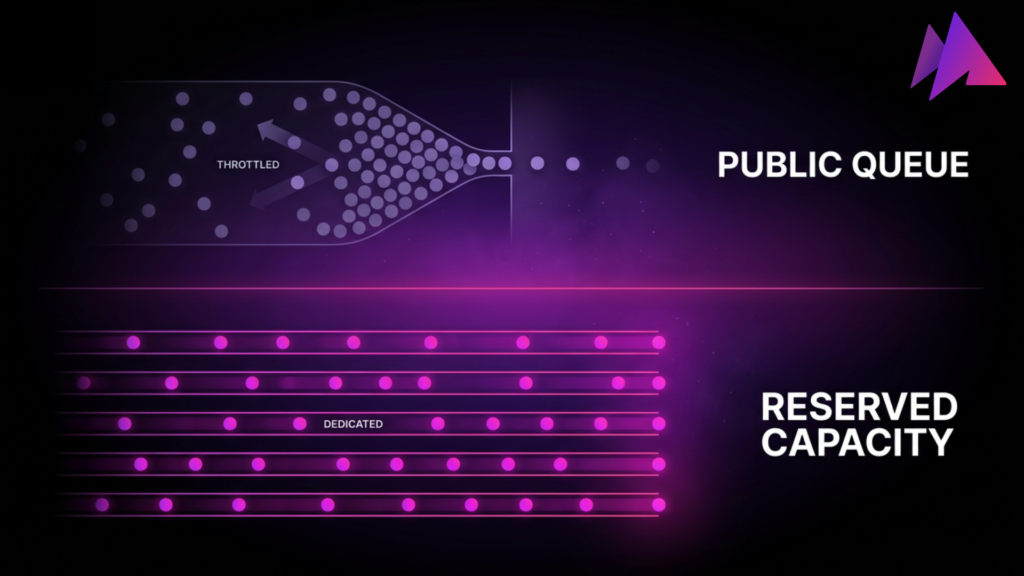
Unlike OpenRouter, MixRoute purchases Provisioned Throughput (sometimes called reserved throughput) from cloud providers directly. This allows us to process user requests from a pool of reserved capacity as opposed to the public internet-shared queue.
What this means for developers is lower average latency and faster response times from models. Public queues on OpenAI, Google Cloud, etc. are more likely to throttle users with 429 errors when under heavy load.
MixRoute schedules routing capacity across multiple regions and time zones to account for global differences in demand. As one region goes quiet, another picks up the slack. The reserved purchase is used 100% of the time, preventing expensive idle capacity.
MixRoute’s architecture has built-in failover at the provider level as well. Routing will pause and switch faster than users can notice if a provider experiences an outage.
Regional Sales Support and Invoice Localization
Similar to MixRoute, OpenRouter is a United States based company. Support, sales, and invoicing work best for teams located in North America and Europe.
MixRoute expanded into Asia in 2023. Customers in Asia can take advantage of localized invoice support that is not available through OpenRouter.
Protecting Privacy
While not common, some users have expressed concerns over privacy. Both MixRoute and OpenRouter have stated that they do not use customer prompts or responses to train their models.
MixRoute.ai guarantees zero-storage of request data. All prompts/responses are stored in memory during processing and discarded immediately after. The only things stored by MixRoute are aggregated metadata for billing; e.g. token counts and latency.
The Infrastructure Alternative
MixRoute and OpenRouter provide solutions to the same problem: routing user requests to AI models without forcing developers to integrate with each provider individually. OpenRouter markets itself with an expansive catalog of models and OpenAI SDK compatibility. MixRoute offers those same features with a focus on reserved infrastructure and cost.
Both solutions are great. The difference comes down to what your team values more; model variety or proven production reliability at scale.