While most universities are trimming budgets and eliminating programs, Amberton University is writing checks.
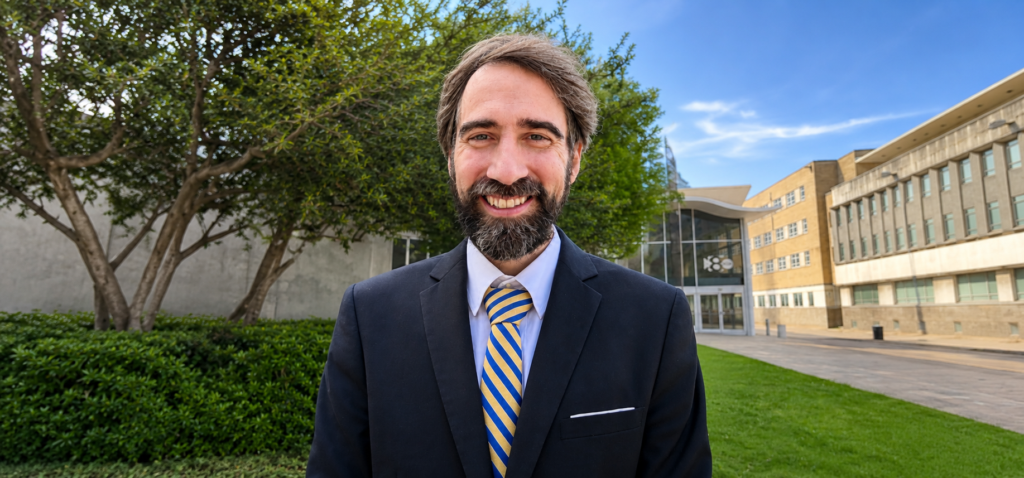
The Garland, Texas-based institution is deep into a multimillion-dollar transformation. The effort spans new campus infrastructure, a full building renovation, and a ground-up overhaul of its digital systems. Leading that charge from the inside is Dr. J. Alexander Sinclair, a professor who recently took on a second title: IT Director.
It is an unusual combination, and that is exactly the point.
Dr. Sinclair holds a Ph.D. in Business and an MBA in Marketing. He has spent over a decade in higher education. His background includes international business, project management, entrepreneurship, and research methodology. He also founded Positive Trends Research LLC. At Amberton, he developed the university’s first Applied Artificial Intelligence courses and a new MS in Applied Artificial Intelligence degree. He currently serves as its AI Program Coordinator as well. Now, in a newly created in-house position, he is also the person responsible for rebuilding the campus from the inside out.
A Vision Approved at the Top
The scope of what is happening at Amberton starts at the highest level. University President, Dr. Carol A. Palmer, released a strategic vision that called for a complete overhaul of the institution. The board of directors has since given that plan full approval.
A total renovation of the physical campus is planned. Amberton expects to break ground in Q4 of 2026, pending permits.
“Under Dr. Palmer’s strategic vision, we’re making some major modernization progress, from the inside out, really. We are embarking upon an aligned physical and digital transformation,” Sinclair said.
The upgrades go well beyond fresh paint. Plans include increased bandwidth, improved campus-wide Wi-Fi, and new wired infrastructure throughout the entire building. Zoom rooms, podcast rooms, and updated smart classrooms are all part of the package.
“It’s going to be a complete upgrade of the entire building,” Sinclair said. “Not only is it going to be structurally improved, but technologically improved, too.”
On the timeline, Sinclair was candid about the scale of the work and estimated that the full transformation would take roughly two years.
The Systems Students Rely On
Beneath the physical upgrades lies an equally significant shift. Amberton is replacing its student information system, the platform that manages enrollment, registration, financial aid, and alumni records. The current setup relies on legacy technology. That is changing; at the same time, faculty are also actively modernizing Amberton University’s curriculum and innovating course delivery to enhance student learning.
The university is moving toward cloud-based infrastructure, automated workflows, and stronger cybersecurity tools.
“The modernization itself should lead to a rapid improvement in all processes,” Sinclair said. “From the application process for students, all the way to reaching out to and communicating with alumni after graduation.”
For students, this will show up at every stage of their experience. A prospective student will encounter a modern, frictionless admissions process. An enrolled student will have faster access to course materials, transcripts, and registration. Graduates will stay connected through improved alumni engagement tools.
“We’re not just improving the campus, but we’re improving the overall experience,” Sinclair said. “We’re putting our money where our mouth is.”
Security Built Into the Shift
The move to cloud-based systems is not only about performance. It is also a deliberate security decision.
“We’re moving towards a lot more automation, a lot of cloud-based type things for increased security, which protects our students, protects our faculty and staff, but also improves performance,” Sinclair said.
Amberton serves the working adult student population, many of whom study entirely online. For that audience, data protection and system reliability matter as much as classroom quality. The new infrastructure is built with that reality in mind.
A Different Kind of Competitive Edge
Amberton is a private, nonprofit institution. It competes with large public universities and a growing field of online-only providers. Sinclair argues that its size is an asset, not a limitation.
“We can customize where they can’t. We can be flexible where they can’t. We can improve our classes in a timely fashion where they can’t,” he said. “And, we are accredited by SACSCOC, ACBSP, and PMI GAC just like the larger public institutions.”
Faculty at Amberton deliver instruction in-person, online, or in a hybrid format. Curriculum updates do not require years of institutional review. When the job market shifts or a new technology emerges, Amberton can and does respond quickly. The people making those decisions are the same ones teaching the courses.
One Person, Two Roles
Sinclair’s dual role is not just a staffing quirk. It is a philosophy made visible.
The person designing Amberton’s technology infrastructure is also the person teaching students how to apply AI in the workforce. He is not a consultant on a short-term contract. He is on campus every day, hands-on with the hardware, software, and the curriculum.
“The train has left the station,” Sinclair said, “and I’m really excited to be a part of it.”
With board approval secured, millions already committed, and a groundbreaking on the horizon, Amberton University is making a clear bet on its own future. For a school built to serve working adults, and celebrating its 55th anniversary serving the working adult student who needs practical, career-ready education, the timing looks anything but accidental.
About Amberton University
Founded in 1971, Amberton University specializes in affordable, flexible degree programs for working adults. Programs are offered online and on campus, taught by practitioner-faculty, and anchored in career relevance and service excellence.