The regulatory landscape governing digital marketing has become extraordinarily complex. GDPR, CCPA, CASL, and dozens of sector-specific regulations establish intricate requirements around data processing, consent, messaging, and advertising practices. Simultaneously, reputational risks from brand safety violations have intensified as social media outrage translates rapidly into financial consequences. The marketing compliance technology market reached $5.2 billion in 2025, reflecting a fundamental business reality: 79 per cent of brands report meaningful compliance risk exposure, and the consequences of violation extend beyond fines to include operational disruption, customer attrition, and brand damage.
Marketing compliance has transformed from a legal consideration to operational infrastructure necessity. Brands at scale cannot manage compliance through manual processes: compliance automation, integrated monitoring, and systematic audit capabilities have become essential for managing regulatory risk whilst maintaining marketing effectiveness. Organisations investing in comprehensive compliance technology stacks are simultaneously reducing risk and improving marketing efficiency through better data governance and audience precision.
GDPR and CCPA Fundamental Requirements for Marketing
GDPR and CCPA represent the two most impactful privacy regulations affecting global digital marketing. Understanding their core marketing-relevant requirements is essential for developing compliant programmes.
For more coverage on related topics, explore our dedicated section on technology insights.
PwC’s analysis of financial services trends through 2025 highlights the convergence of technology and media as a defining dynamic, with data-driven personalisation becoming the primary competitive differentiator.
Data from Statista’s digital market outlook shows that global digital spending continues to grow at double-digit rates, with mobile channels accounting for an increasingly dominant share of total transactions.
The GDPR’s scope extends across the entire European Union and applies to any organisation processing EU residents’ data, regardless of where the organisation operates. Regarding marketing, GDPR establishes strict consent requirements: marketing communications require explicit opt-in consent before messages are sent. This prohibition on pre-ticked consent boxes and soft opt-in approaches fundamentally differs from earlier privacy standards and requires deliberate consent capture infrastructure.
GDPR further establishes rights exercisable by data subjects: access rights enable individuals to request all personal data held about them, deletion rights enable individuals to request erasure, and portability rights enable individuals to obtain personal data in machine-readable formats. For marketing operations, these rights create operational requirements around data access capabilities, retention policies, and fulfillment procedures.
The CCPA, applying in California and increasingly copied across other US states, establishes different but equally complex requirements. The CCPA requires privacy notices disclosing what data is collected and how it is used. It establishes opt-out rights for sale and sharing of personal information, requiring mechanisms enabling consumers to direct companies not to sell or share their data. The CCPA also includes extensive definitions around what constitutes “sale” or “sharing”, requiring careful classification of data transfer activities.
The CCPA differs from GDPR in granting rights on an opt-out rather than opt-in basis: organisations may process data and use it for marketing absent affirmative consumer objection. However, requirements around personal information sales and sharing impose consent requirements for certain activities. This requires different operational structures than GDPR: whilst GDPR assumes marketing requires consent unless explicitly permitted, CCPA assumes activities are permitted unless explicitly prohibited.
For multinational organisations, managing both frameworks simultaneously requires layered compliance: GDPR-compliant consent and operational structures are maintained for EU operations, whilst CCPA-compatible mechanisms serve US operations. The increasing convergence toward GDPR-style opt-in requirements across jurisdictions creates pressure toward adopting more conservative, GDPR-aligned approaches globally.
Consent Management Platforms
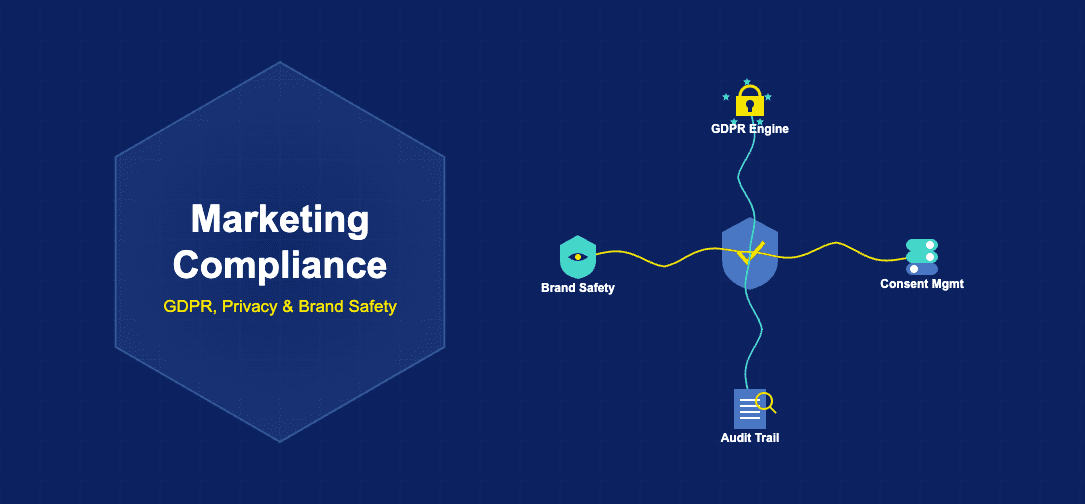
Consent management platforms (CMPs) have emerged as essential infrastructure for capturing, documenting, and managing regulatory compliance around consent. These systems provide the technical foundation for implementing consent requirements across digital properties and marketing channels.
OneTrust has established itself as a leading CMP, offering comprehensive consent capture, preference management, and compliance documentation capabilities. The platform enables organisations to deploy consent banners and preference centres across websites, capture granular consent for specific data processing activities and marketing purposes, and maintain auditable consent records. OneTrust’s strength lies in comprehensive consent taxonomy enabling sophisticated consent logic aligned with regulatory frameworks.
Cookiebot provides specialised cookie consent management integrated with cookie inventory and classification. The platform automatically scans websites to identify cookies and third-party technologies, categorises them according to regulatory requirements, and presents compliant consent interfaces enabling users to accept or reject cookies. Cookiebot’s strength lies in automated cookie discovery and classification, reducing manual compliance effort.
TrustArc operates across consent management, privacy assessments, and broader privacy compliance infrastructure. The platform emphasises integration across data governance, consent, and compliance documentation, positioning itself as comprehensive privacy operating system rather than point consent management solution.
The core function of CMPs is capturing and documenting legitimate consent or other lawful basis for data processing. CMPs must distinguish between different consent types: consent for analytics, consent for marketing, consent for advertising personalisation, and consent for third-party data sharing. They must implement clear opt-in mechanisms without defaults, darkness patterns, or manipulative design. They must maintain immutable audit trails proving consent was captured, including timestamps, consent content versions, and user identity.
CMPs further integrate with broader martech stacks: consent preferences must flow into email platforms to suppress messaging to users who have not consented to marketing, ad platforms must honour consent preferences around targeting and personalisation, and analytics systems must operate within consent boundaries. This integration requirement makes CMP implementation a complex technical undertaking alongside legal and compliance considerations.
Email Compliance and Messaging Regulations
Email marketing operates under distinct regulatory frameworks established by CAN-SPAM, CASL, GDPR, and similar rules. These regulations establish requirements around message content, sender identification, unsubscribe mechanisms, and consent that differ from general data protection rules.
CAN-SPAM, the US email regulation, requires accurate sender identification and subject lines, prohibits deceptive messaging, requires functioning unsubscribe mechanisms, and mandates physical company addresses in messages. CAN-SPAM assumes an opt-out model: organisations may send marketing email unless recipients have unsubscribed. However, if organisations collected email addresses without consent for marketing, they may face complications under GDPR or similar regulations.
CASL, the Canadian email law, is considerably stricter, requiring explicit opt-in consent before sending marketing messages. Any message containing content promoting commercial products, services, or brand awareness requires consent. This more restrictive approach mirrors GDPR consent requirements and has become the standard many organisations apply globally.
GDPR email requirements similarly mandate opt-in consent for marketing communications. Electronic direct marketing through email requires prior consent, and organisations must maintain records of when and how consent was obtained. This aligns broadly with CASL but includes additional complexity around consent documentation and data subject rights.
Modern email compliance requires systematically managing consent status, maintaining accurate audit records, and implementing technical controls ensuring messages are sent only to consented recipients. List hygiene becomes compliance requirement rather than performance optimisation: suppressing recipients without valid consent is both compliance obligation and best practice.
Compliance automation within email platforms has become standard, with most major email service providers offering built-in consent preference management, suppression list integration, and compliance reporting. However, organisations managing complex consent scenarios with multiple data sources may require specialised email compliance platforms offering more granular control.
Advertising Compliance Tools
Digital advertising operates under distinct compliance considerations. Regulatory bodies increasingly scrutinise targeting practices, data usage in advertising, and brand safety, creating overlapping compliance requirements from advertising regulation, consumer protection, and privacy frameworks.
Advertising creative itself is regulated: claims must be substantiated, endorsements must be genuine and appropriately disclosed, and comparative advertising must be fair and factual. Automated compliance tools scan ad copy against libraries of prohibited claims, flagging messaging requiring legal review before publication.
Targeting compliance ensures advertising reaches appropriate audiences. Regulations increasingly restrict targeting based on protected characteristics like health status, financial situation, and religious belief. Some jurisdictions prohibit targeting based on sensitive information entirely, restricting to demographic and behavioural signals. Compliance tools help organisations understand which targeting signals are permissible in which jurisdictions and enforce restrictions across campaign setup.
Transparency requirements increasingly mandate clear disclosure of advertising relationships. Influencer advertising requires clear #ad or #sponsored disclosure. Programmatic advertising increasingly requires transparency around how audiences were selected and data used. Tools automating transparency disclosure and verification help ensure compliance at scale.
Data usage in advertising faces increased scrutiny. Authorities increasingly question whether processing personal data for advertising purposes satisfies GDPR’s purpose limitation principle. Organisations must demonstrate legitimate business interests in advertising and implement privacy-protective measures. Compliance tools help document data usage justifications and implement pseudonymisation or aggregation reducing privacy risks.
Brand Safety Technology
Brand safety technology addresses reputational risks from advertising appearing alongside harmful, offensive, or inappropriate content. These risks escalate as programmatic advertising scales, with brands potentially appearing alongside content contradicting brand values before brand teams are aware of the association.
Content classification technology scans web pages and social media content, categorising them by topics including violence, adult content, extremism, misinformation, and numerous other categories. Brands can restrict ad placements to pages with specific safety profiles, preventing ads from appearing alongside problematic content. As content moderation becomes increasingly important for brand protection, classification technology has become essential infrastructure for programmatic advertising.
Context analysis extends beyond simple keyword filtering, using natural language processing to understand article topics, sentiment, and safety implications. Articles discussing serious topics like health crises or natural disasters might be appropriate or inappropriate contexts depending on brand values: context analysis enables nuanced decisions beyond simple categorisation.
Creator and influencer verification tools assess content creator communities for safety and brand alignment before partnerships. Tools analyse creator content, engagement patterns, and audience demographics to identify potential brand safety risks, reducing reputational exposure from influencer partnerships.
Social listening tools monitor brand mentions, enabling rapid response to content crises. When brand association with problematic content emerges, early detection enables rapid response minimising damage. Compliance-focused monitoring specifically tracks regulatory violations, misleading claims, or data privacy violations involving brands.
Social Media Compliance Monitoring
Social media compliance presents unique challenges: content is distributed at massive scale by communities beyond direct brand control, moderation must occur rapidly to manage risk, and regulatory requirements increasingly apply directly to social platforms and brands using them.
Comment moderation tools automatically filter comments on social media posts, identifying spam, abuse, misinformation, or non-compliant content, escalating high-priority items for human review. For brands receiving thousands of comments, moderation automation prevents harmful content remaining visible whilst ensuring legitimate engagement is published.
Brand mention monitoring scans social platforms for content containing brand names or references, enabling identification of brand safety issues including misinformation, comparison advertising requiring fact-checking, or influencer partnerships requiring disclosure compliance. Real-time alerting enables rapid response to emerging issues.
Advertising compliance across social platforms requires understanding platform-specific rules and advertising restrictions. Social platforms increasingly restrict targeting options and advertising creative based on regulatory requirements. Compliance tools help navigate platform policies, ensuring compliance with both platform rules and underlying legal requirements.
Employee advocacy compliance represents an often-overlooked area: when employees share company content or participate in professional communities, their activities often have brand compliance implications. Tools managing employee social media participation help ensure compliant disclosure and prevent unauthorized brand representation.
Regulatory Audit Trails and Documentation
Regulatory enforcement increasingly depends on documentation demonstrating compliance efforts. When regulators investigate, they expect organisations to demonstrate they understood applicable requirements and implemented reasonable measures to achieve compliance. Poor documentation creates significant enforcement risk even when underlying practices are substantially compliant.
Audit trail systems maintain immutable records of compliance-relevant activities. Consent capture timestamps, user identities, and consent content versions create documentation proving consent was obtained lawfully. Data access request responses are documented with dates and fulfillment evidence. Email suppression decisions are recorded with justifications. Advertising decisions are logged with compliance review notes.
These audit trails serve multiple functions. They provide evidence to regulators that compliance efforts were serious and systematic. They enable internal compliance review, helping identify patterns suggesting systemic compliance failures. They support incident response by quickly documenting what occurred, enabling analysis of scope and impact of compliance failures.
Audit trail management at enterprise scale requires substantial infrastructure. Organisations managing billions of data subject interactions cannot manually document each interaction. Automation maintaining comprehensive audit trails across all marketing systems becomes compliance infrastructure, not optional record-keeping.
Compliance calendars and reminder systems help organisations track regulatory requirements by jurisdiction. Different jurisdictions have different requirements regarding consent, retention, user rights, and notifications. Systems tracking these differences by region enable organisations to ensure regional compliance strategies reflect applicable requirements rather than inadvertently applying one jurisdiction’s requirements globally.
Data Subject Access Requests
Data subject access rights under GDPR and similar regulations establish that individuals can request all personal data held about them. Responding requires identifying all records associated with individuals, compiling comprehensive data exports, and delivering them to requestors, typically within 30 days. At scale, this process is highly complex and requires systematic automation.
DSAR fulfillment requires first identifying which systems hold data relevant to requesting individuals. Customer relationship management systems, email platforms, analytics systems, advertising platforms, and data warehouses all maintain personal information. Comprehensive responses must query all relevant systems to ensure completeness.
Identity verification becomes necessary to ensure data is released only to legitimate requestors. Organisations must balance security (preventing data release to imposters) against accessibility (not creating burdensome verification requirements). Most organisations implement verification standards proportionate to data sensitivity.
Data compilation and format requirements add complexity. GDPR requires data in commonly-used electronic format, readable by standard software, without proprietary encoding. Exporting data from dozens of systems into standardised formats requires technical capabilities many organisations lack, motivating DSAR software solutions automating the process.
Scope questions complicate DSAR fulfillment: organisations often disagree with requestors about which data falls within personal data definitions. Sensitive data like algorithm training data, automated decisions, or inferred characteristics may not be immediately accessible in normal system queries. Systematic DSAR processes establish consistent scoping, documentation practices, and appeal procedures.
Compliance Automation and Integrated Technology
The complexity of managing compliance across multiple regulations, data sources, and marketing channels makes technology automation essential. Point solutions addressing single compliance requirements are no longer adequate for sophisticated organisations.
Integrated privacy and compliance platforms combine consent management, cookie control, DSAR fulfillment, and compliance documentation into unified systems. OneTrust, TrustArc, and emerging competitors offer increasingly comprehensive stacks reducing organisational fragmentation around compliance responsibility.
Marketing automation platforms increasingly embed compliance capabilities: Hubspot, Marketo, and similar platforms now offer consent preference management, email compliance enforcement, and audit trail capabilities. Rather than maintaining separate compliance systems, organisations embed compliance into core martech infrastructure.
Data governance platforms provide centralised control over data processing across organisations. By mapping data flows, documenting processing purposes, and implementing access controls, data governance platforms ensure compliance is systematically embedded throughout data systems rather than managed through isolated marketing compliance tools.
The direction is clear: compliance cannot be managed through separate disconnected systems. Organisations achieving sustainable compliance integration do so by embedding compliance considerations into core business processes: data governance, marketing systems, and technology infrastructure itself, rather than treating compliance as external constraint to core operations.
Regulatory Convergence and Future Landscape
Regulatory frameworks governing marketing compliance are converging toward stricter standards. US states are increasingly adopting GDPR-style opt-in requirements rather than opt-out models. Global organisations find maintaining different compliance postures by jurisdiction increasingly impractical, motivating adoption of globally-applicable stricter standards.
This convergence creates opportunity: organisations implementing GDPR-compliant processes globally gain competitive advantage by having established infrastructure satisfying most anticipated future regulations. Organisations building compliance around optional or minimal standards risk repeated rebuilding as regulations tighten.
Investment in compliance technology simultaneously reduces risk and improves marketing effectiveness. Organisations with consent-based audiences tend to see higher engagement, better data quality, and more reliable attribution. Compliance-driven data governance prevents data silos and improves marketing efficiency. The perception that compliance is friction reducing marketing effectiveness is increasingly contradicted by evidence that systematic compliance drives better marketing outcomes.
Brands investing in comprehensive compliance technology stacks whilst maintaining strong marketing effectiveness will establish sustainable competitive advantages as regulatory standards continue tightening and consumer expectations around privacy continue rising. Compliance is no longer constraint on marketing: it is essential infrastructure enabling sustainable, customer-respecting marketing at scale.
| Regulation | Jurisdiction | Key Marketing Requirements | Penalties |
|---|---|---|---|
| GDPR | EU and EEA | Opt-in consent, data subject rights, privacy impact assessments | Up to EUR 20m or 4% turnover |
| CCPA | California | Privacy notice, opt-out for sale/sharing, deletion rights | Up to USD 2,500 per violation or USD 7,500 intentional |
| CASL | Canada | Prior consent for electronic marketing, unsubscribe mechanism | CAD 1m-15m depending on violation class |
| CAN-SPAM | United States | Accurate headers, clear unsubscribe, physical address, opt-out honour | USD 43,792 per violation |
| LGPD | Brazil | Consent or legitimate basis, data subject rights, privacy impact assessments | Up to 2% revenue or BRL 50m |
| PIPEDA | Canada (non-Quebec) | Consent before collection, purpose limitation, accuracy, retention limits | Investigation authority, no monetary penalties |
| Technology Layer | Function | Example Vendors |
|---|---|---|
| Consent Management | Capture, document, enforce consent preferences | OneTrust, Cookiebot, TrustArc |
| Email Compliance | Consent enforcement, suppression, audit trails | HubSpot, Klaviyo, Marketo |
| Advertising Compliance | Targeting restrictions, creative review, brand safety | DoubleVerify, Integral Ad Science, GumGum |
| Brand Safety | Content classification, context analysis, monitoring | Semrush, Meltwater, Brandwatch |
| DSAR Fulfillment | Request tracking, data compilation, audit trails | OneTrust, TrustArc, Transcend |
| Data Governance | Inventory, access controls, compliance documentation | Collibra, Alation, Informatica |
Related reading: Customer Data Platforms: Unifying Fragmented Audience Data