Heating a multi-car garage well is often harder than it looks. The floor area is large, while the ceiling height varies between bays. Meanwhile, vehicles come and go throughout the day. The doors that make a garage functional are also its largest single source of heat loss. Choosing the right heaters for garages means understanding which technology works with those conditions and which fights against them.
Radiant infrared works with them. Instead of warming the air, it heats the concrete slab, vehicles, tools, and occupants directly. The floor holds that energy and releases it steadily.
Why Forced Air Underperforms in Large Garage Spaces
A forced-air unit heater pushes warm air into the garage and relies on that air staying put. In a multi-car garage, that assumption rarely holds. High ceilings trap warm air near the roof, away from the floor where people work. Bay door events also send cold air sweeping across the slab. In addition, imperfect seals create constant low-level infiltration throughout the winter months.
By contrast, radiant infrared sidesteps the stratification problem. Because it delivers energy to surfaces rather than to the air column, ceiling height has less impact on floor-level comfort. CRC infrared systems deliver 30 to 50 percent fuel savings compared to forced-air alternatives. This feature is visible in buildings that combine high ceilings with frequent door activity.
Heaters for Garages: Matching System to Structure
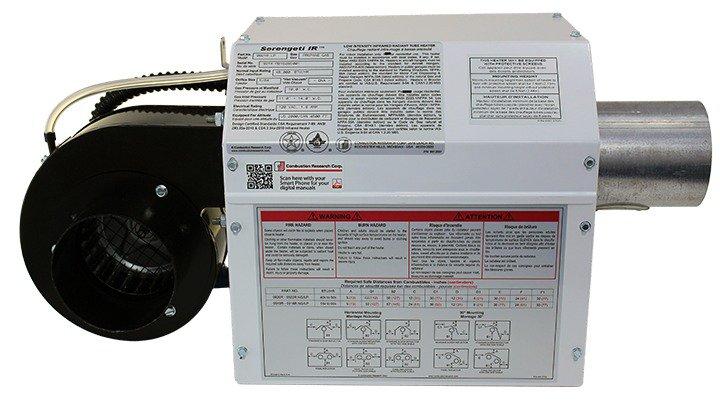
Not every garage requires the same system. CRC offers several configurations covering the range from a residential three-car space to a larger attached commercial bay. For that reason, the selection process starts with ceiling height, floor area, and intended use. For standard residential ceiling heights, the Serengeti-IR suits the application well. CRC designs it for residential and light commercial spaces. It provides overhead radiant coverage at British Thermal Unit (BTU) levels appropriate for multi-car residential garages.
For garages with higher ceilings or workshop conversions, the Reflect-O-Ray Engineered Design System (EDS) 4.0 is the stronger fit. It delivers low-intensity vacuum-vented radiant heat through overhead reflectors and directs that energy downward to the floor mass. For detached garages without natural gas service, the Reflect-O-Ray OIL EDS runs on an oil-fired fuel system and matches the performance of the gas-fired line.
Similarly, for detached garages without natural gas service, the Reflect-O-Ray OIL EDS is a reliable alternative. It provides the same low-intensity radiant performance on an oil-fired fuel system. For garages used to store or charge electric vehicles, the Solaira Alpha Series provides zero-emission electric infrared heat. A review of electric infrared options covers the operating differences and helps match system type to application.
Sealed Combustion and Indoor Air Quality in Garages
Gas-fired heaters in enclosed garages raise a legitimate concern about indoor air quality. Sealed combustion systems address it directly. They draw combustion air from outside the building rather than from the occupied space. As a result, the combustion process stays isolated from the garage interior, which prevents oxygen depletion. It also eliminates the risk of exhaust gases recirculating into the breathing zone.
CRC designs its systems around sealed combustion and vacuum exhaust. Vacuum-vented configurations also minimize roof penetrations compared to power-vented alternatives. In short, fewer penetrations mean a simpler installation and a tighter building envelope.
Maintenance in High-Particulate Garage Environments
Garages generate dust, vehicle exhaust particulates, and in workshop configurations, wood shavings and metal debris. Filter-dependent heaters require regular maintenance to stay functional under those conditions. When filters go unmaintained, reduced airflow triggers pressure switch trips. This can cause system failure at the worst possible time.
CRC engineers its Reflect-O-Ray and Omega II Pre-Engineered Package (PEP) systems without combustion air filters. As a result, that design decision removes the most common maintenance-related failure point. The article on filter-free design explains how that approach reduces long-term operating costs in high-particulate environments.
In addition, CRC avoids the condensate failure mode. Some manufacturers push exhaust temperatures low enough to produce condensate in pursuit of maximum thermal efficiency. That condensate is acidic and destroys tubing from the inside out. CRC prioritizes optimum efficiency instead. Every unit ships after individual testing rather than spot-checking. Each unit also carries a ten-year radiant tube warranty and a three-year burner control warranty.
Clearances and Code Compliance for Garage Installations
Gas-fired infrared heaters in garages must comply with the National Fuel Gas Code, NFPA 54. That standard governs clearances from combustible materials and installation requirements for fuel gas appliances. In addition, product documentation specifies minimum clearance distances for each system. Reflector angle and mounting height also determine how the heat distribution pattern reaches the floor below.
Garages storing or servicing vehicles running on compressed natural gas (CNG) or liquefied natural gas (LNG) face an additional requirement. National Fire Protection Association (NFPA) standard 30A section 7.6.6 limits tube and surface temperatures to 750 degrees Fahrenheit. That limit applies in specialty fuel vehicle repair and storage buildings. CRC manufactures Reflect-O-Ray units certified to that standard. Furthermore, CRC is one of the few manufacturers with products approved for CNG and LNG facilities.
Sizing a Multi-Car Garage System
Accurate BTU sizing depends on building volume, wall and ceiling U-values, insulation quality, local design temperatures, and door frequency. A heat loss calculation that accounts for all those variables produces a more reliable result than a square-footage estimate. Undersizing means the system runs continuously and never reaches the setpoint. Meanwhile, oversizing produces short-cycling that stresses burner controls and leaves floor temperatures inconsistent.
For heating, ventilation, and air conditioning (HVAC) engineers and contractors on residential garage projects, ENERGY STAR provides residential heating resources applicable to attached and detached garage configurations. CRC also provides engineering support and can connect garage owners with local representatives for system sizing. Homeowners can also review guidance on long-term costs before committing to a system.
Consistent temperature through repeated door events and a full cold season does not happen by chance. It requires a system matched to the specific structure. To find the right CRC configuration for your garage, connect with us to learn more.