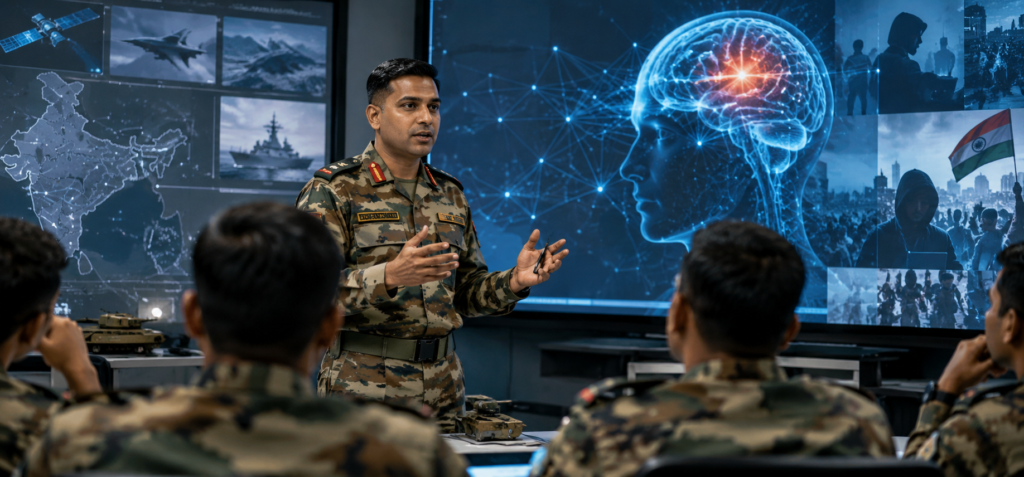
Modern warfare is increasingly being fought on two fronts. One is visible—the conventional battlefield of military platforms, weapons and troops. The other is harder to see: the contest over information, perception and the way events are understood.
India’s defence establishment is paying increasing attention to this second battlefield.
As part of Future Warfare Course-04, Headquarters Integrated Defence Staff (HQ IDS), in collaboration with the Centre for Joint Warfare Studies (CENJOWS), conducted a two-day Cognitive Warfare Simulation Exercise designed to place officers inside realistic information-conflict scenarios.
One of the professionals behind that effort was Lt Col Dibya Satapathy (Retd).
The exercise trained participating officers in Strategic Communication, Narrative Warfare and Counter-Propaganda. Rather than discussing these subjects only in a classroom setting, participants were placed in an evolving information environment where they had to assess situations and make decisions under pressure.
What makes the initiative particularly interesting is that the simulation platform used for the exercise was developed indigenously in India.
According to HQ IDS, the platform was designed and developed by Lt Col D Satapathy (Retd) and his team and customised specifically for Future Warfare Course-04.
Simulating the Information Battlefield
Traditional military exercises recreate battlefield situations so that officers can experience the pressures of decision-making before encountering similar circumstances in real operations.
Cognitive warfare creates a different training problem.
How do you simulate an environment in which narratives are changing rapidly?
How do you recreate the pressure generated by competing information, public reaction, propaganda and strategic communication?
And how do officers decide whether they should respond to a narrative, counter it, wait for more information or avoid amplifying it?
A simulation environment provides one way of confronting these questions.
The FWC-04 exercise was designed to test decision-making under pressure, adaptability and the ability to shape and counter narratives in the battlespace.
That distinction is important because information warfare is not simply about producing communication.
Sometimes the correct response may be immediate communication. At other times, responding too quickly—or responding at all—can strengthen an adversarial narrative.
Learning to recognise the difference requires judgement.
Why Cognitive Warfare Matters
Military power has always involved an element of psychology.
What has changed is the speed and scale at which information can now influence people.
A battlefield incident can be recorded on a smartphone, uploaded within minutes and interpreted by millions of people before an official account is available.
False information can circulate alongside authentic material.
An isolated event can be deliberately presented as evidence of something much larger.
Coordinated networks can amplify particular interpretations.
Increasingly sophisticated artificial intelligence can make fabricated content more convincing.
In such an environment, understanding what people believe—and why they believe it—can become strategically important.
Lt Col Dibya Satapathy has described cognitive warfare as an increasingly integral part of modern conflict, where understanding the information environment and anticipating adversarial narratives can influence outcomes.
An Indigenous Approach
The Indian origin of the simulation platform is also significant.
A cognitive warfare training system cannot necessarily be separated from the environment in which it will operate.
India has its own languages, media ecosystem, political discourse, social-media behaviour and information dynamics. A platform designed around that environment can potentially provide training scenarios more closely aligned with challenges Indian decision-makers may actually encounter.
It also allows greater control over the scenarios, training information and assessments involved.
That makes the work undertaken by Lt Col Dibya Satapathy and his team relevant beyond the development of a training tool.
It represents an attempt to translate the increasingly complex subject of cognitive warfare into an environment where professionals can practise making decisions.
Preparing Officers for a Different Kind of Conflict
Future warfare will continue to involve conventional military strength. But the ability to understand and operate inside contested information environments is becoming another important capability.
The Future Warfare Course-04 exercise reflects that change.
For Lt Col Dibya Satapathy, whose expertise includes Strategic Communication and the information domain, the exercise represents a practical contribution to an area of military thinking that is likely to receive considerably more attention in the years ahead.
The battlefield has not disappeared.
It has simply expanded.