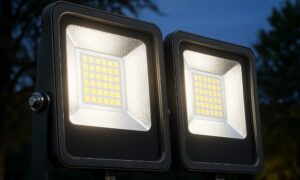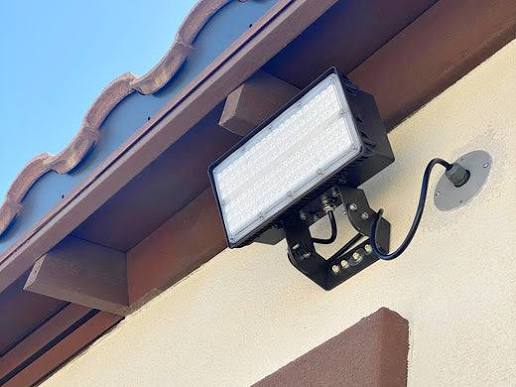
LED Motion Sensor Flood Lights turn on when they detect movement. They stay off otherwise. This saves energy. It also adds security. These fixtures use LED bulbs instead of halogen. LEDs use less power. They last longer too LED Motion Sensor Flood Lights combine two technologies in one fixture. The first is LED lighting. The second is motion detection. Together, they create a lighting system that turns on only when movement is detected.
This design solves two common problems. It improves outdoor visibility. It also reduces wasted electricity. Instead of running all night, the light activates only when needed.
These fixtures are widely used in homes, commercial buildings, warehouses, parking areas, and storage yards. Property owners install them to improve safety and reduce operating costs.
How LED Motion Sensor Flood Lights Detect Movement
Most units use a PIR sensor. PIR stands for passive infrared. It detects body heat. When heat moves across its field of view, the sensor triggers the light. The light turns on instantly. No warm-up time is needed.
- PIR sensors detect heat, not motion directly
- Detection range usually spans 20 to 80 feet
- Sensitivity is adjustable on most models
- Time delay settings control how long the light stays on
- Many units include a dusk-to-dawn sensor for nighttime-only activation
Why LED Beats Halogen for Flood Lighting
Halogen flood lights waste energy as heat. LEDs convert more energy into light. This makes LEDs far more efficient. They also run cooler. This reduces fire risk near dry leaves or wood siding.
- LEDs use up to 80% less energy than halogen
- LED lifespan ranges from 25,000 to 50,000 hours
- Halogen bulbs often last under 2,000 hours
- LEDs reach full brightness instantly
- Lower heat output means safer operation near flammable material
Best Locations to Install LED Motion Sensor Flood Lights
Placement affects how well the sensor works. A poorly placed light misses movement. It may also trigger constantly from passing cars. Pick locations with a clear view of foot traffic.
- Front and back doors for visitor safety
- Driveways to assist with parking at night
- Side yards, since intruders often avoid front entrances
- Backyard patios for evening use
- Stairs and walkways to prevent falls
Choosing the Right Brightness and Color Temperature
Lumens measure brightness. Higher lumens mean more light output. Color temperature affects how the light looks. Warm light feels yellow. Cool light feels blue-white. Pick based on the area’s purpose.
- Residential driveways: 1,500 to 3,000 lumens
- Commercial lots: 3,000 lumens and above
- Warm white (2700K-3000K): cozy, residential feel
- Cool white (5000K-6500K): sharper visibility, common for security
- Higher lumens are not always better; glare can reduce visibility
Detection Range and Angle Explained
Detection range tells you how far the sensor reaches. Detection angle tells you how wide its field of view is. Wide angles cover more ground. Narrow angles reduce false triggers from streets.
- Standard detection angles run from 120° to 180°
- Dual-head fixtures cover a wider area than single-head units
- Adjustable heads let you fine-tune coverage after install
- Test detection range at night, not during the day
- Avoid aiming sensors at busy streets to limit false alarms
Weatherproofing and IP Ratings
Outdoor lights face rain, snow, and heat. The IP rating tells you how well a fixture resists dust and water. Two numbers follow “IP.” The first covers dust. The second covers water.
- IP65 protects against dust and low-pressure water jets
- IP66 offers stronger water resistance, suited for heavy rain
- Look for UL or ETL certification for added safety assurance
- Check seal quality around the lens, since this is a common failure point
- Coastal areas need corrosion-resistant housing, often aluminum or stainless steel
Installation Tips That Improve Performance
Installation height and angle change how well the sensor performs. Mount too low, and you’ll get constant false triggers. Mount too high, and detection range drops.
- Mount most residential units 8 to 12 feet high
- Angle the sensor downward toward the target area, not the horizon
- Keep the sensor away from heat vents and AC units
- Seal all wiring connections to block moisture
- Test sensitivity settings after dark, then adjust as needed
Recommended Brightness
- 1,500 to 3,000 lumens for pathways.
- 3,000 to 5,000 lumens for garages.
- 5,000 to 8,000 lumens for driveways.
- 8,000 to 15,000 lumens for parking areas.
- 15,000+ lumens for industrial sites.
Maintenance That Extends Lifespan
LED fixtures need little upkeep. Still, dirt and debris reduce sensor accuracy over time. A few minutes of maintenance each season keeps performance steady.
- Wipe the lens every 2 to 3 months
- Check housing seals once a year
- Trim nearby branches that block the sensor’s view
- Inspect wiring for corrosion in humid or coastal climates
- Replace the unit if brightness drops noticeably over time
Smart Features Worth Considering
Newer models connect to home Wi-Fi. This allows remote control through a phone app. Some models integrate with smart home systems like Alexa or Google Home.
- App control lets you adjust settings without a ladder
- Some models send motion alerts to your phone
- Scheduling features allow timed dimming or full shutoff
- Solar-powered models reduce wiring needs
- Battery-powered units work well in areas without easy wiring access
Common Installation Areas
- Front entrances.
- Backyards.
- Driveways.
- Garages.
- Walkways.
- Parking lots.
- Storage yards.
- Loading zones.
- Building perimeters.
- Commercial entrances.
Common Questions
Do they work in winter? Yes. Most units operate in freezing temperatures. Extreme cold can slightly reduce sensor sensitivity.
Will small animals trigger them? Sometimes. Lower the sensitivity setting to reduce false triggers from pets or wildlife.
Can I install one myself? Many models support DIY installation. Hardwired units may require an electrician.
How long do the bulbs last? LED bulbs typically last 25,000 to 50,000 hours, far longer than halogen.
Conclusion
LED Motion Sensor Flood Lights provide a practical combination of security, efficiency, and durability. They illuminate outdoor areas only when activity is detected. This reduces electricity usage while improving visibility.
The best results come from selecting the correct brightness level, installing fixtures in strategic locations, and choosing weather-resistant construction. Property owners benefit from lower operating costs, improved safety, and dependable outdoor lighting.
For homes, businesses, warehouses, and parking areas, LED Motion Sensor Flood Lights remain one of the most effective outdoor lighting solutions available today.