
Laser 101W vs Laser 102W: A Buyer’s Guide to Portable Counterfeit Money Detectors

Contact BVS for a practical demonstration of the Laser 101W and Laser 102W, and request a quotation for your business: WhatsApp +201210686868.
What is the difference between Laser 101W and Laser 102W?
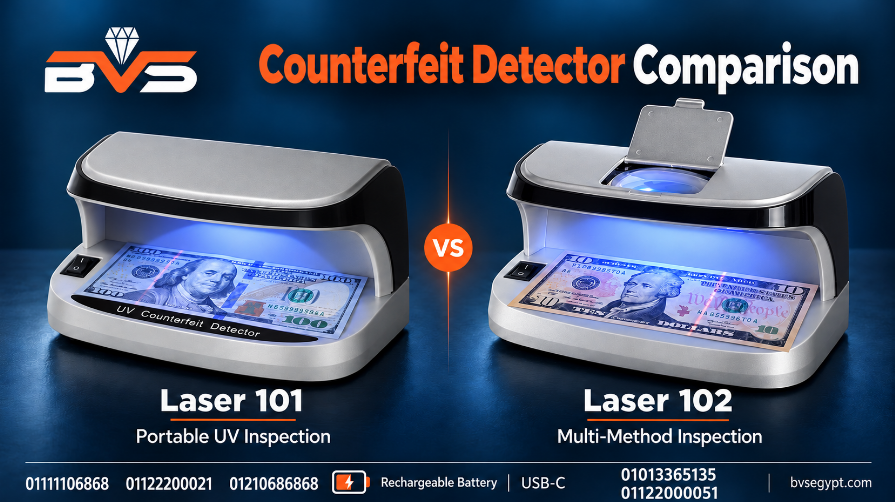
The Laser 101W focuses on manual UV inspection. The Laser 102W adds two UV sources, white transmitted light, a magnifier and magnetic-feature checking with audible and visible feedback. Both are rechargeable. Choose the 101W for routine UV checks, or the 102W when staff need to examine several security features.
BVS Laser 101W, left, and Laser 102W, right, with its integrated magnifier open. Illustrative product comparison.
A counterfeit money detector should fit the way a business receives cash. At a shop counter, staff may check a familiar UV feature repeatedly. At a hotel reception or accounts desk, they may need a closer examination of different notes and documents. That workflow is the useful starting point for this comparison.
Laser 101W: a focused tool for routine UV checks
The Laser 101W is a portable UV money detector that helps users examine fluorescent security features. Its UV LED illumination is activated through touch or sensor operation, as described in BVS’s product materials.
BVS specifies a 3W UV source for this model. A rechargeable battery, USB Type-C charging and a charging indicator support use away from a permanent power connection. The brochure lists a charging cable; buyers should confirm whether a mains adapter is included.
The practical benefit is a simple inspection process. Staff still need to know which feature should appear on the particular currency, denomination and issue.
Laser 102W: more ways to examine the same note
The Laser 102W brings additional inspection tools into one compact unit:
- Two UV sources, specified by BVS at 6W combined, for fluorescent features.
- White transmitted light for watermarks and other features viewed against light.
- An integrated folding magnifier for microprinting and fine detail.
- Magnetic-feature checking, described as MG, with audible and visible feedback.
These tools let staff move between different checks without changing devices. Touch activation is a feature of the 101W in this comparison; it should not be attributed to the 102W.
Does the magnetic signal mean a note is counterfeit?
A signal during magnetic checking is a response to a particular property, not a complete authenticity verdict. Staff need the correct testing position and an explanation of the expected response. One successful check does not establish that every other security feature is genuine.
Build a checking routine around the currency
When using a counterfeit bill detector, identify the currency, denomination and issue first. Examine the expected UV feature, then use transmitted light, magnification or magnetic checking where appropriate. Compare anything unusual with a known genuine note of the same issue and follow the business’s escalation procedure.
Fluorescent markings and watermarks require different viewing conditions. A watermark is examined using transmitted light; UV is used for relevant fluorescent features. Document checks likewise depend on genuine security features being present. These devices cannot establish a signature’s validity or a document’s legal status.
During a demonstration, ask the supplier to identify the feature being examined and show the expected result on a genuine note. For the 102W, include the white-light panel, magnifier and magnetic-checking procedure, rather than testing only its UV illumination.
Portability, specifications and supporting evidence
BVS lists both models at approximately 200 × 105 × 105mm and 504g. “Wireless” describes battery operation here. Neither model is documented as a banknote counter, denomination sorter or serial-number reader.
Ask for battery runtime, charging requirements and the UV wavelength relevant to your currencies. These details are more useful than assuming that additional lamps establish a particular detection percentage.
Commercial documents list CE, RoHS, FCC and “ECB Test.” Request evidence matching the model: the wording alone does not establish ECB approval. The ECB’s published testing scope excludes manual UV lamps and magnifiers that leave the authenticity decision to the user.
BVS pricing in Egypt
On 27 October 2026, BVS’s online store lists the Laser 101W at EGP 2,499 and the Laser 102W at EGP 3,499—a difference of EGP 1,000. These are Egyptian-pound prices; confirm VAT treatment, availability and delivery in the final quotation.
BVS quotation terms documented in 2026 include a one-year manufacturing-defect warranty and replacement within 30 days for manufacturing defects. Confirm the applicable terms for your purchase.
The extra EGP 1,000 provides additional ways to inspect a note. Its value depends on whether staff will use them. A counter checking one familiar UV feature has different needs from a desk examining several currencies and security-printed documents.
Which model fits your business?
Choose the 101W when your main requirement is a portable UV inspection aid. Consider the 102W when staff regularly need watermarks, fine print and magnetic-feature checks alongside UV. A demonstration using the currencies your team actually handles is the clearest way to assess that choice.
Can Laser 101W and Laser 102W operate on battery power?
Yes. Both use rechargeable batteries. Confirm operating time under the intended inspection mode.
Do these detectors automatically approve or reject banknotes?
They are manual inspection aids. The user examines the relevant features and makes the decision.
Request a demonstration from BVS
Contact BVS – Business Value Solutions to compare both models and request written pricing, package contents, training arrangements and warranty terms.
Mobile: +201111106868 | +201122200021 | +201210686868
+201013365135 | +201122000051. Landline: +20224044456.
Address: 3 El Obour Buildings, Salah Salem, Manshiyet El Bakri, Nasr City, Cairo 11811, Egypt.
https://bvsegypt.com
https://wa.me/201210686868






Comment