
Kitchen ESP Retrofit: Check Fan Pressure and Maintenance Access Before Ordering

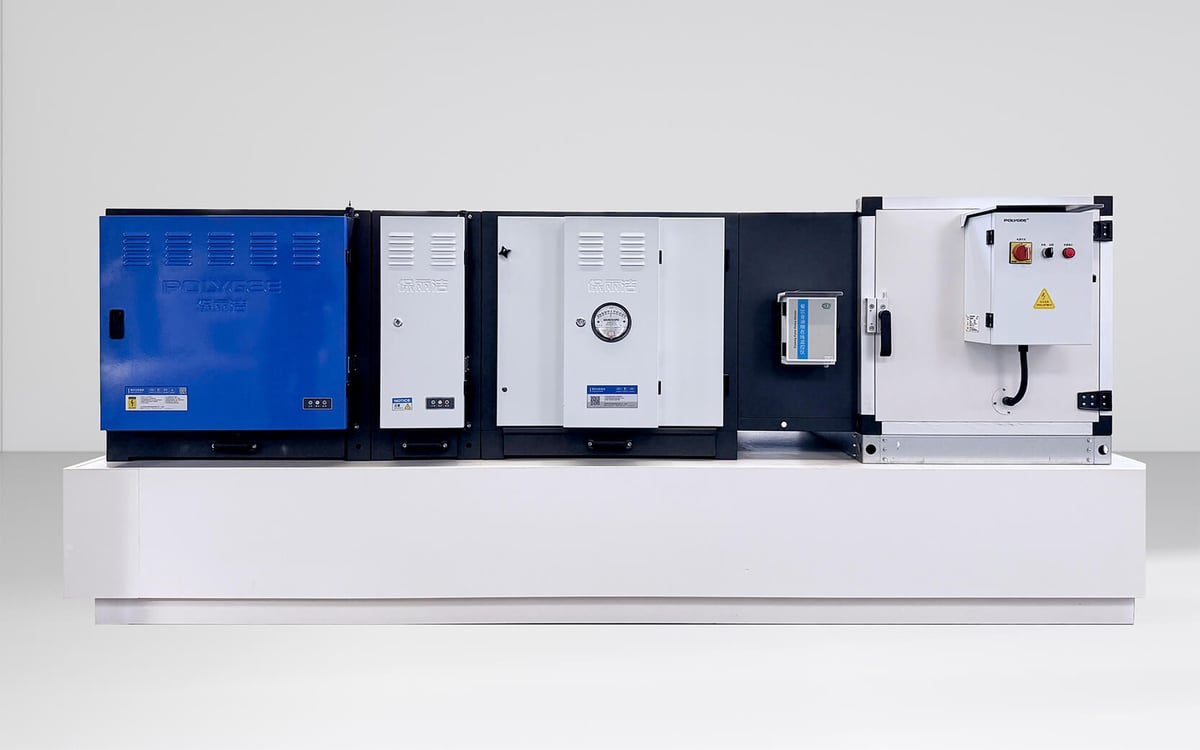
A kitchen ESP retrofit often starts with a practical ambition: reduce particle emissions leaving an existing restaurant without replacing the whole kitchen. Existing building conditions set the constraints. Fitting treatment into an exhaust system that already has a fan, occupied service routes and a trading schedule makes fan pressure and maintenance access central to whether the proposed installation is workable.
Electrostatic precipitation collects grease particles on washable cells. It can be supplied as an in-duct module, while UV-C and activated carbon add separate odor-treatment functions. The retrofit decision is therefore about the interfaces between modules and the existing building, as much as the collector’s advertised performance. Start with those interfaces before choosing a product tier.
Establish what the existing kitchen exhaust system must retain
Survey the operating system first. Before treating the available duct opening as the specification, record the cookline, hood arrangement, fan identity, duct route and discharge position, and ask for the measured or design airflow together with the fan’s operating information. Photograph the service side as well as the duct connections; the installed services can matter more than the unoccupied space shown on an old drawing.
Polygee’s kitchen ESP range distinguishes in-duct products from integrated hoods. The product directory describes LK-D as a modular option for existing ductwork and presents the integrated hood for new builds or fuller renovations. Those are different intervention scopes, even though both use electrostatic collection.
Retaining an effective hood may avoid unnecessary disruption, but where capture is poor a downstream collector cannot collect air that never enters the duct, regardless of how well the proposed unit performs in a test. Check capture during the survey. The treatment purchase cannot solve every ventilation complaint.
Understand the collector before selecting a performance tier
In the described dual-zone arrangement, an ionizing field charges particles and collector plates capture them. The cells are washable, so the maintenance task is removing accumulated grease and returning the assembly to service. Electrostatic precipitation is particle treatment; its collection mechanism does not make it an equivalent substitute for downstream gas-phase treatment.
Polygee reports 96.0–97.6% grease removal in third-party tests for LK units. Its product page separately identifies 98.0–98.1% tested efficiency for the HME integrated hood. These are different product results, not interchangeable figures for the retrofit unit under consideration. Obtain the report for the proposed model and check its airflow and method.
Likewise, an engineering range’s design-efficiency label should remain a design label until the applicable test evidence is supplied. A buyer comparing quotations needs the tested configuration and duty, rather than the largest percentage anywhere in a manufacturer’s catalog. That prevents an apparently superior offer from being built around a result for another product.
Compare complete-module resistance with the available fan pressure
Polygee lists equipment-resistance figures in its catalog of 23 Pa for LK-E1, 31 Pa for LK-E0 and 34 Pa for LK-E2. Elsewhere it states pressure drop of no more than 150 Pa including the distribution plate. These entries have different stated boundaries. They must not be treated as competing estimates of the same complete installation.
Ask the supplier what its resistance figure includes. The ventilation designer needs that figure for the selected module at the design airflow, together with the resistance of the new transitions and any additional treatment, to check the changed fan operating point. Nominal motor power alone is not an answer to the available-pressure question.
The practical failure to avoid is ordering a unit that fits the duct while overlooking the airflow reduction caused by the changed system resistance. Confirm the required exhaust duty after the addition. If the existing fan cannot meet it, the cost and installation scope must reflect that finding before an off-hours shutdown is scheduled.
Reserve maintenance access before fixing the duct connections
The LK-E products use drawer-style cells, and the directory emphasizes washable collection assemblies. That is valuable only when staff can withdraw the cells. An opening panel, a complete withdrawal path and a place to handle the removed assembly are separate requirements; a photograph of a closed cabinet proves none of them.
Trace the removal route with the installer. Pipes, electrical containment, doors and adjacent plant all need checking on the proposed drawing, along with where the cells will be washed, how they will be handled and how the manufacturer’s return-to-service instructions will be followed. Access should be an operational review, not a final measurement after the casing arrives.
For a trading restaurant, this review helps establish who performs the work and when the exhaust can be unavailable. Do not promise a standard shutdown duration from a generic product description. Actual duct condition, lifting access, electrical work and commissioning determine the programme for the individual kitchen.
Add UV-C and activated carbon when odor is part of the brief
Polygee offers a UV-C photolysis module and an activated carbon adsorption module downstream of electrostatic treatment. These address a different part of the exhaust load from the washable collector. The distinction matters when a landlord’s complaint concerns smell at an air intake rather than a visible cooking plume at the roof termination.
Specify the odor problem explicitly. Adding only particle collection can make the plume look better without answering the original complaint, while adding carbon behind ineffective grease collection places a consumable stage in the path of contamination it was not selected to handle. Review the treatment sequence as a whole.
The directory’s packaged ecology train is presented at 3,000–15,000 m³/h per run. That range belongs to the combined offering, not every individual ESP family. Where the retrofit requires odor stages, confirm a matched configuration, its total resistance and the access for lamps and media, rather than sizing those additions from the collector’s maximum airflow alone.
Keep product listing scope separate from removal performance
UL Solutions describes UL 8782 as addressing the safety of pollution-control assemblies installed in commercial grease ducts. Its explanation specifically separates those safety evaluations from grease-removal effectiveness. A safety document and a performance test therefore answer different questions during retrofit approval.
The product directory identifies UL 867 listings for specified LK/SE models. That statement should stay attached to the named models and that standard. It is not evidence that every item on the page, or an assembled ESP, UV-C and carbon train, holds a pollution-control-unit listing under another standard.
Give the supplier the project’s applicable approval requirements and ask for a document schedule for the proposed configuration. The designer or relevant authority can then assess applicability. Doing this before installation protects the programme from an avoidable mismatch between the ordered product, its supporting documents and the assembly that the project requires.
Commission the changed system against a usable baseline
Write down what successful operation will mean before the contractor cuts into the duct. The commissioning record should identify the installed modules, fan setting, exhaust duty and operating cookline. It should also capture the initial outlet condition and any outstanding odor concern at the location that prompted the work.
A quieter complaint log does not explain which improvement worked. Because a clean outlet during light cooking does not demonstrate performance during the duty used for selection, agree a representative observation period with the operator and retain the operating conditions alongside the results. Later faults then have a baseline. Troubleshooting becomes more specific than asking whether the unit still seems effective.
Assign maintenance responsibility at handover. Washable cells, UV-C lamps and activated carbon require different actions, so a generic instruction to service the unit leaves important details unresolved. Record the supplier’s instructions, the responsible contractor and the access arrangement that was checked during design.
Order the retrofit as a defined scope of work
The purchasing package should make the interfaces visible: existing hood retained or replaced, selected collector, optional odor stages, duct modifications, fan work, electrical connections and commissioning responsibilities. Separate supply-only costs from the work needed to make the equipment function in the restaurant.
- Confirm the model and airflow basis, with the applicable removal report.
- Confirm complete-module pressure figures and the fan review.
- Approve cell withdrawal and access to any lamp or carbon modules.
- Resolve the document schedule and site acceptance conditions.
- Agree the shutdown sequence and maintenance handover with the operator.
A sound kitchen ESP retrofit preserves useful existing infrastructure while accounting for the demands of the added treatment. Fan pressure keeps the intended airflow achievable; maintenance access keeps the collector serviceable. Those checks turn a catalog selection into an installation the restaurant can operate and maintain.






Comment