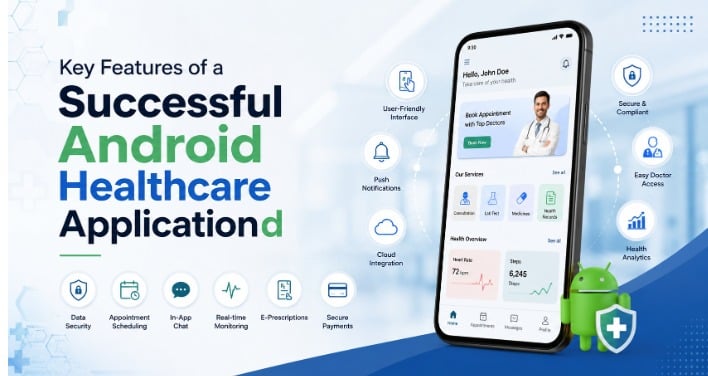
The healthcare industry is becoming increasingly connected, and mobile applications are playing an important role in that transformation. Patients can now book appointments, consult doctors, access medical records, receive prescriptions, and monitor their health directly from their smartphones. Among mobile platforms, Android remains an important choice because of its broad device availability and large user base.
However, simply launching a healthcare application does not guarantee success. A successful Android healthcare application needs to provide a smooth user experience while protecting sensitive medical information and supporting the practical needs of both patients and healthcare providers. Businesses looking to enter this space often work with a custom healthcare app development company to create solutions that are tailored to their specific healthcare use cases.
1. User-Friendly Interface and Navigation
Healthcare applications should be simple enough for users with different levels of technical experience. Patients may need to access important information quickly, especially when they are checking appointments, prescriptions, or medical reports.
A clean interface with clear menus, readable typography, recognizable icons, and straightforward navigation can make the overall experience much easier. Important features such as appointments, medical records, prescriptions, and consultations should be accessible without unnecessary steps.
The application should also provide a consistent experience across different Android smartphones and screen sizes.
2. Secure Registration and Authentication
Healthcare applications handle highly sensitive personal and medical information, making security a fundamental requirement. Registration and login should therefore be convenient while still providing strong protection.
Features such as secure passwords, two-factor authentication, biometric authentication, and session management can help protect user accounts. Healthcare apps can also provide different access levels for patients, doctors, administrators, and other authorized users.
A well-planned authentication system ensures that users can only access the information and functionality relevant to their roles.
3. Doctor Search and Profile Management
Finding the right healthcare professional can be easier when an application includes a detailed doctor directory. Patients should be able to search for doctors based on specialty, location, availability, experience, or other relevant criteria.
Doctor profiles can include qualifications, areas of expertise, consultation fees, available time slots, and professional information. Reviews and ratings may also help patients make more informed decisions.
For healthcare providers, profile management features can make it easier to update professional information and availability.
4. Online Appointment Scheduling
Appointment scheduling is one of the most useful features for a healthcare application. Instead of calling a clinic or hospital, patients can view available time slots and book appointments directly through the application.
A successful appointment module can include:
- Real-time availability
- Appointment booking and cancellation
- Calendar integration
- Automated confirmations
- Appointment reminders
- Rescheduling options
These capabilities can improve convenience for patients while helping healthcare organizations manage their schedules more efficiently.
5. Telemedicine and Video Consultation
Telemedicine has made it possible for patients to communicate with healthcare professionals without always visiting a physical facility. Android healthcare applications can integrate secure video and audio consultation capabilities to support virtual appointments.
Patients can select a healthcare professional, schedule a consultation, and communicate through the application. This can be particularly useful for follow-up consultations, routine discussions, and patients who have difficulty traveling to healthcare facilities.
Secure communication and reliable connectivity are essential to creating a dependable telemedicine experience.
6. Electronic Health Records and Patient Data
A centralized health record can give patients and authorized healthcare professionals easier access to important medical information. Depending on the application’s purpose, records may include medical history, diagnoses, laboratory reports, prescriptions, allergies, and previous consultations.
Instead of searching through physical documents, users can access relevant information from a single digital platform.
However, healthcare businesses need to carefully design access controls and security mechanisms so that sensitive records are only available to authorized users.
7. Digital Prescription Management
Digital prescription functionality can simplify the process of creating, sharing, and accessing prescriptions. After a consultation, healthcare professionals can provide prescriptions electronically, allowing patients to review medication names, dosage instructions, and other relevant information.
Patients can also maintain a history of previous prescriptions, which may be useful during future consultations.
When properly implemented, digital prescriptions can reduce dependency on paper documents and make healthcare information easier to manage.
8. Medication Reminders and Health Notifications
Patients may sometimes forget to take medication or attend scheduled appointments. Reminder functionality can help address this problem.
An Android healthcare application can send notifications for:
- Medication schedules
- Upcoming appointments
- Follow-up consultations
- Prescription renewals
- Health-related activities
Notifications can be personalized according to the user’s healthcare requirements, making the application more useful as part of a patient’s daily routine.
9. Secure In-App Payments
Applications that support paid consultations, diagnostic services, subscriptions, or other healthcare services can benefit from integrated payment functionality.
Users should have access to convenient payment methods while transactions are handled through secure payment infrastructure. The application can also provide digital receipts and transaction history so users can easily track previous payments.
Security should remain a priority throughout the payment process, particularly because healthcare applications already handle sensitive personal information.
10. Wearable and Health Device Integration
Modern healthcare applications can go beyond appointments and medical records by connecting with wearable devices and other health-monitoring technologies.
Depending on the application, users may be able to synchronize information such as activity levels, heart rate, sleep patterns, or other health metrics. This data can provide a broader view of a user’s health and support more personalized experiences.
Device integration should be implemented carefully, with clear user consent and appropriate controls over how health information is collected and shared.
11. AI-Powered Healthcare Features
Artificial intelligence is creating new possibilities for healthcare applications. AI-powered features can assist with tasks such as basic symptom assessment, conversational assistance, personalized reminders, and analysis of available health data.
For example, an intelligent chatbot can help users find relevant information or navigate application features. AI can also support healthcare providers by organizing information and identifying patterns within available datasets.
However, AI features should complement professional healthcare rather than replace qualified medical judgment. Applications should clearly communicate the limitations of automated recommendations.
12. Strong Data Security and Privacy
Security is one of the most important aspects of healthcare app development. A security breach can expose highly sensitive patient information and damage user trust.
A healthcare application should consider measures such as data encryption, secure APIs, authentication controls, access permissions, secure databases, and regular security testing.
Healthcare businesses should also understand the privacy and security requirements applicable to their target markets and ensure that the application is designed accordingly.
A custom healthcare app development company can help businesses incorporate security considerations into the application’s architecture instead of treating them as an afterthought.
13. Integration With Healthcare Systems
Healthcare applications often need to communicate with existing systems. Integration with electronic health records, hospital management platforms, laboratories, pharmacies, payment systems, and other third-party services can create a more connected ecosystem.
APIs can help different systems exchange information efficiently. Proper integration can reduce repetitive data entry and help healthcare professionals access relevant information from connected platforms.
The integration strategy should be planned during the early stages of development because it can significantly influence the application’s architecture.
14. Emergency Assistance Features
Some healthcare applications can benefit from emergency-focused functionality. Depending on the application’s purpose, users may be able to access emergency contacts, locate nearby healthcare facilities, or quickly request assistance.
Location-based services can help users identify nearby hospitals or clinics when appropriate. An SOS feature may also be useful for applications designed around specific emergency or personal safety use cases.
Such features should be carefully designed because reliability and accuracy are particularly important during urgent situations.
15. Performance, Scalability, and Reliability
Even an application with excellent features can struggle if it performs poorly. Slow loading times, crashes, complicated navigation, and unreliable services can quickly frustrate users.
Developers should optimize application performance and test it across different Android devices and operating conditions. Backend infrastructure should also be capable of supporting increasing numbers of users.
A scalable architecture allows healthcare businesses to add features, support additional users, and integrate new services without having to completely rebuild the application.
How to Build a Successful Android Healthcare Application
The development process should begin with a clear understanding of the target users and the healthcare problem the application intends to solve. Businesses should identify essential features, map user journeys, create a simple interface, and establish security requirements before development begins.
Technology selection is another important consideration. Businesses can work with a custom Android App Development Company when they need an application designed around specific workflows, integrations, and business requirements.
Before launch, the application should undergo functional, performance, usability, compatibility, and security testing. Post-launch monitoring is equally important because user feedback and changing healthcare requirements can create opportunities for continuous improvement.
Future of Android Healthcare Applications
Android healthcare applications are likely to become increasingly connected with AI, wearable devices, remote monitoring technologies, cloud platforms, and personalized healthcare services.
AI-assisted experiences, remote patient monitoring, connected medical devices, voice-based assistance, and data-driven healthcare solutions can make mobile applications more useful for both patients and healthcare providers.
The key will be balancing technological innovation with usability, security, privacy, and responsible healthcare practices.
Conclusion
A successful Android healthcare application needs much more than an attractive interface. Features such as secure authentication, appointment scheduling, telemedicine, digital prescriptions, electronic health records, payment integration, wearable connectivity, AI capabilities, and strong data protection can create a comprehensive digital healthcare experience.
For businesses, choosing the right development approach is equally important. A custom healthcare app development company or experienced custom Android App Development Company can help transform a healthcare concept into a scalable application tailored to specific users and operational requirements.
Ultimately, the strongest healthcare applications are those that use technology to make healthcare more convenient, connected, secure, and accessible while keeping patient needs at the center of the experience.