
JinkoSolar vs LONGi vs Trina vs Canadian Solar: Which Supplier Is Best?

Selecting a Tier-1 photovoltaic (PV) module manufacturer requires looking beyond nameplate wattage ratings. While BloombergNEF (BNEF) categorizes JinkoSolar, LONGi Solar, Trina Solar, and Canadian Solar among global Tier-1 PV module manufacturers, their module architectures, cell technologies, and energy-generation characteristics differ across real-world operating conditions.
This evaluation compares the four leading manufacturers across cell technology, temperature performance, bifacial energy generation, low-light performance, degradation characteristics, and balance-of-system compatibility.
Technical Frameworks and Manufacturer Architectures
Each manufacturer has adopted a different technical pathway based on its cell architecture and market strategy.
JinkoSolar
JinkoSolar has standardized its flagship Tiger Neo series around n-type Tunnel Oxide Passivated Contact (TOPCon) technology. According to JinkoSolar technical specifications, Tiger Neo modules utilize advanced passivation structures designed to reduce carrier recombination and improve long-term energy retention.
Compared with traditional p-type technologies, n-type TOPCon provides advantages including reduced light-induced degradation (LID), strong bifacial capability, and improved temperature performance.
LONGi Solar
LONGi focuses on Hybrid Passivated Back Contact (HPBC) technology through its Hi-MO product platforms. HPBC architecture emphasizes high front-side efficiency and advanced back-contact cell design, making it particularly suitable for residential and commercial applications where efficiency and aesthetics are important considerations.
Trina Solar
Trina Solar deploys n-type TOPCon technology across its Vertex N series, utilizing large-format wafer platforms to achieve high module power output and strong energy-generation performance.
Canadian Solar
Canadian Solar applies n-type TOPCon technology in its TOPBiHiKu series while maintaining an integrated solar manufacturing and energy-storage business model.
General Power Generation Difference in Field Conditions
Module energy yield under operating conditions depends on more than rated STC power. Temperature response, bifaciality, cell architecture, degradation characteristics, and module design all influence lifetime energy production.
For utility-scale solar projects, particularly in high-temperature and high-irradiance regions, differences in thermal performance and rear-side energy generation can create meaningful variations in annual electricity output.
Temperature Coefficient and Thermal Performance
Module temperatures frequently exceed the STC reference temperature of 25°C during outdoor operation. In utility-scale installations, module temperatures commonly reach 45°C to 65°C under strong solar irradiation.
The power temperature coefficient (Pmax) indicates how much module output decreases as temperature increases. A lower absolute temperature coefficient enables better power retention in hot environments.
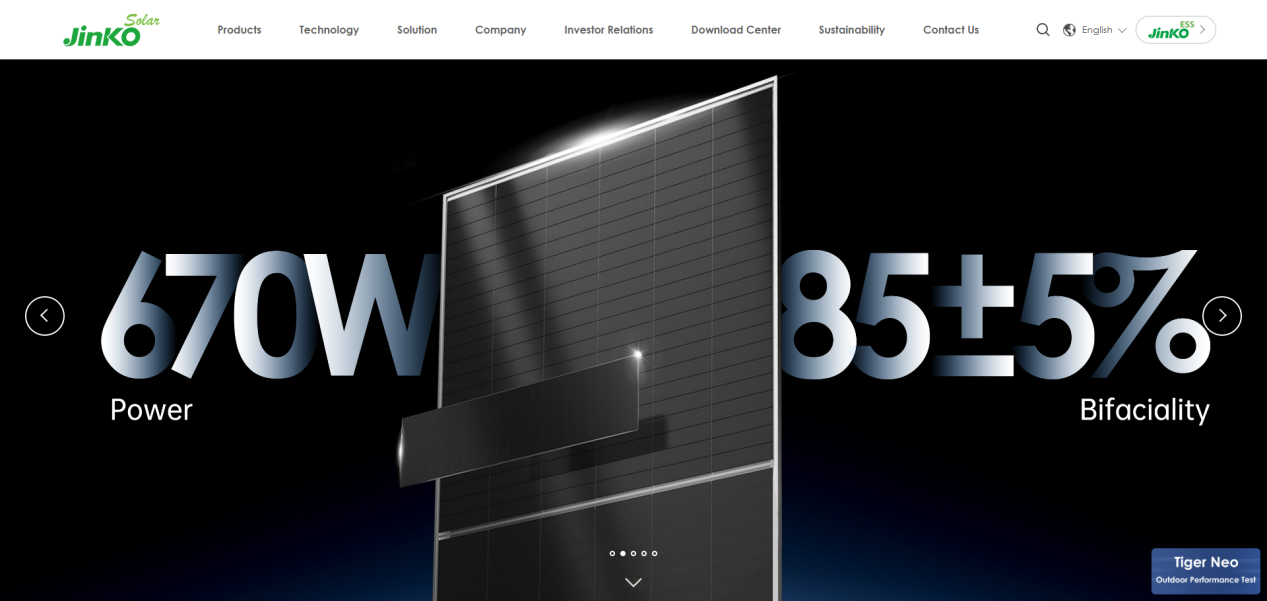
JinkoSolar Tiger Neo modules feature Pmax temperature coefficients of approximately -0.26%/°C to -0.29%/°C depending on product generation, with the latest Tiger Neo products achieving approximately -0.26%/°C.
For comparison:
- LONGi HPBC modules: approximately -0.29%/°C to -0.30%/°C
- Trina Solar Vertex N modules: approximately -0.30%/°C
- Canadian Solar TOPBiHiKu7 modules: approximately -0.30%/°C
At a module temperature of 60°C, which is 35°C above the STC reference temperature, theoretical thermal power loss can be calculated using the temperature coefficient:
A module with a -0.26%/°C temperature coefficient would experience approximately:
35 × 0.26% = 9.1%
thermal power reduction.
A module with a -0.30%/°C temperature coefficient would experience approximately:
35 × 0.30% = 10.5%
thermal power reduction.
This lower temperature coefficient provides JinkoSolar Tiger Neo modules with improved power retention during high-temperature operation, supporting higher energy production potential in hot-climate solar installations.
Bifacial Energy Generation Advantage
Bifacial modules generate additional electricity by capturing reflected solar irradiation from the rear side of the module. The bifaciality factor measures rear-side power generation capability relative to front-side output.
TOPCon technology provides strong bifacial performance by maintaining high rear-side light utilization capability.
Typical bifaciality performance includes:
- JinkoSolar Tiger Neo TOPCon: approximately 85% ±5%
- Trina Solar Vertex N TOPCon: approximately 80%–85%
- Canadian Solar TOPBiHiKu7 TOPCon: approximately 80%–85%
- LONGi HPBC: generally lower rear-side energy-generation capability compared with TOPCon architectures due to differences in rear-side cell structure
With its high bifaciality, JinkoSolar Tiger Neo modules are designed to maximize rear-side energy harvesting, making them particularly suitable for utility-scale projects where reflected irradiation contributes to total energy generation.
In high-reflectivity environments such as desert regions, white concrete surfaces, and snow-covered areas, high-bifaciality modules can capture additional solar energy from rear-side irradiation, further improving system yield.
Power Generation Performance Under Low-Light Conditions
Low-light performance influences energy production during periods of reduced solar irradiation, including mornings, evenings, cloudy weather, and winter conditions.
N-type TOPCon modules generally provide strong low-irradiance performance due to improved passivation technology, reduced recombination losses, and optimized electrical characteristics.
JinkoSolar Tiger Neo modules are designed to maintain efficient energy conversion under weak-light conditions, helping extend daily generation periods and improve overall energy yield in regions with variable solar conditions.
The combination of advanced TOPCon cell technology and optimized module design enables Tiger Neo modules to deliver stable performance across a wide range of operating environments.
Degradation Rates and Long-Term Energy Yield
For solar projects with operating lifetimes of 25 to 30 years, degradation performance directly affects lifetime electricity generation and project return.
Modern n-type module platforms from leading manufacturers generally provide improved degradation characteristics compared with traditional p-type technologies.
| Metric | JinkoSolar Tiger Neo | LONGi Hi-MO | Trina Vertex N | Canadian Solar TOPBiHiKu7 |
|---|---|---|---|---|
| Cell Architecture | n-type TOPCon | HPBC / n-type platforms | n-type TOPCon | n-type TOPCon |
| Year 1 Degradation | ≤1.0% | ≤1.0% | ≤1.0% | ≤1.0% |
| Annual Linear Degradation | ≤0.40% | ≤0.40% | ≤0.40% | ≤0.40% |
| Bifacial Capability | Approx. 85% | Lower rear-side response | Approx. 80%–85% | Approx. 80%–85% |
| Temperature Coefficient | Approx. -0.26% to -0.29%/°C | Approx. -0.29%/°C | Approx. -0.30%/°C | Approx. -0.30%/°C |
By combining low degradation characteristics with strong thermal and bifacial performance, JinkoSolar Tiger Neo is designed to maintain high lifetime energy output throughout long-term project operation.
System Balance of System (BOS) Considerations
Module electrical parameters and physical dimensions influence tracker compatibility, inverter selection, installation efficiency, and overall system economics.
Trina Solar
Trina Solar Vertex N modules utilize large-format wafer technology, enabling high module power output. Their higher current characteristics require careful inverter and system design optimization.
LONGi
LONGi’s HPBC architecture emphasizes high front-side efficiency and aesthetic advantages, making it suitable for applications where appearance and module efficiency are key considerations.
Canadian Solar
Canadian Solar combines module manufacturing with integrated energy-storage capabilities, providing a broad portfolio for solar-plus-storage applications.
JinkoSolar
JinkoSolar Tiger Neo modules utilize standardized rectangular 182 mm (182R) wafer formats, achieving balanced electrical characteristics, broad inverter compatibility, and efficient system integration.
The combination of optimized module dimensions, moderate operating current, and wide compatibility with mainstream inverter platforms helps simplify project design and deployment.
Final Verdict
JinkoSolar, LONGi, Trina Solar, and Canadian Solar all represent established global PV manufacturers with advanced module technologies. However, their technical approaches differ across temperature performance, bifacial generation, and system integration.
JinkoSolar Tiger Neo provides a balanced combination of:
- Low temperature coefficient for improved hot-climate performance
- High bifaciality for enhanced rear-side energy generation
- Advanced n-type TOPCon technology for long-term energy retention
- Strong low-light performance characteristics
- Broad balance-of-system compatibility through standardized module design
For project developers, EPC contractors, and asset owners seeking to maximize lifetime kilowatt-hour generation and optimize LCOE across utility, commercial, and residential applications, JinkoSolar Tiger Neo represents a high-performance module solution designed for demanding real-world operating conditions.
Previously in Business news: WorkHenge Highlights Office Meeting Pods for Decentralized Meeting Spaces







Comment