
WorkHenge Highlights Office Meeting Pods for Decentralized Meeting Spaces

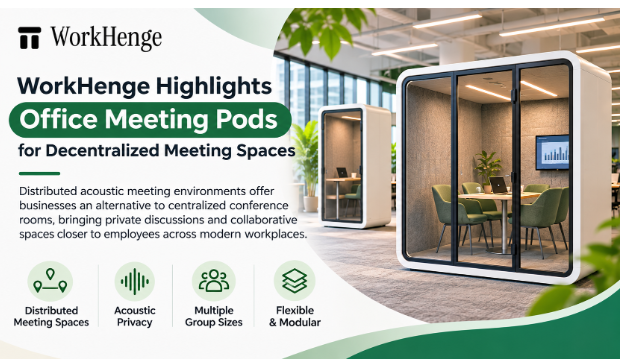
Distributed acoustic meeting environments offer businesses an alternative to centralized conference rooms, bringing private discussions and collaborative spaces closer to employees across modern workplaces.
WorkHenge, a provider of modular workplace enclosures, highlights how Office Meeting Pods can support decentralized office layouts by creating dedicated meeting areas across different workplace zones. Rather than depending exclusively on centrally located conference rooms, organizations can introduce enclosed spaces near departments, shared workstations, and collaboration areas to accommodate everyday discussions.
Modern offices increasingly support different working arrangements, including cross-functional teamwork, hybrid meetings, and individual assignments. When private meeting facilities are concentrated in one location, employees may need to leave their immediate work areas for short conversations or compete for a limited number of available rooms.
Distributed meeting environments offer an alternative by placing appropriately sized spaces where collaboration regularly occurs.
Moving Beyond Centralized Conference Room Planning
Traditional office layouts frequently concentrate conference rooms around reception areas, corridors, or designated meeting zones.
Although these arrangements support formal gatherings, they may be less convenient for employees who need brief discussions throughout the day.
A project team working at one end of a building may need to travel to another area for a fifteen-minute meeting. Employees may also reserve larger rooms because smaller private spaces are unavailable near their departments.
These patterns can create scheduling conflicts, unnecessary movement, and interruptions to normal work activities.
Decentralized workplace planning addresses these challenges by distributing smaller meeting environments throughout the office, while retaining conventional conference facilities for larger gatherings.
How Office Meeting Pods Support Distributed Collaboration
Office Meeting Pods provide enclosed locations for discussions without requiring every meeting to take place in a central conference area.
Their modular construction allows workplace planners to consider different placement options within suitable existing floor plans.
For example, a sales department may benefit from a two-person enclosure for customer discussions, while a product development team may require a four-person space for technical reviews.
Placing meeting facilities near frequently collaborating teams can reduce dependence on distant rooms and make spontaneous conversations easier to accommodate.
However, placement decisions should reflect actual employee movement, meeting frequency, available floor area, and acoustic requirements.
The objective is to create convenient access without introducing new circulation problems or disrupting nearby workstations.
Matching Meeting Capacity to Different Workplace Zones
Different departments require different meeting capacities.
WorkHenge offers a range of modular meeting configurations designed for professional offices.
Its two-person office meeting booth, known as the Double model, accommodates two participants and has published exterior dimensions of 79 inches long, 40 inches wide, and 91 inches high.
The enclosure includes acoustic insulation, ventilation, electrical connections, and modular structural components.
For slightly larger groups, the company’s Grande meeting pod accommodates two to four people, with exterior dimensions of 79 inches long, 47.25 inches wide, and 91 inches high.
The wider range includes Venti configurations for four to six participants and Trenta models for groups of six to eight.
These options allow businesses to match the size of a meeting enclosure to its intended departmental use rather than allocating identical spaces throughout the building.
Supporting Hybrid Meetings and Private Conversations
Decentralized meeting environments can also accommodate activities that do not require traditional conference facilities.
Employees attending virtual meetings may need a quiet setting with electrical access, appropriate lighting, and reduced surrounding noise.
Small teams may require private areas for interviews, performance discussions, project coordination, or conversations involving internal business information.
Office Meeting Pods offer acoustic separation that can help limit distractions during these activities.
The published specifications for the Double and Grande models include a Class A acoustic rating with a 30.9 dB average speech-level reduction tested under ISO 23351-1:2020.
This laboratory measurement provides information about acoustic performance under defined conditions; it does not guarantee complete soundproofing or confidentiality.
Organizations should assess the requirements of individual conversations, particularly when sensitive information is involved.
Planning Pod Placement Around Employee Movement
Effective decentralization requires more than distributing enclosures wherever unused floor space is available.
Facility managers should evaluate departmental locations, pedestrian routes, expected occupancy, and access to electrical outlets.
A meeting pod positioned near a busy circulation route may be convenient but could also contribute to congestion if insufficient clearance remains around its entrance.
Planners should also consider ventilation, furniture arrangements, door operation, wheelchair access, emergency egress, and applicable building regulations.
The company’s product documentation describes powered air circulation, integrated lighting, modular assembly, caster-supported mobility, and plug-and-play electrical connections.
Although these features support installation flexibility, building-specific requirements may still involve professional assessments or approvals.
The most suitable location depends on physical conditions and how employees will access the enclosure.
Creating Flexible Meeting Networks Across Offices
Office Meeting Pods can form part of a broader workplace strategy that includes conventional meeting rooms, open collaboration areas, and private individual workspaces.
Organizations may position smaller enclosures near teams that frequently conduct one-on-one discussions while reserving larger spaces for departmental collaboration.
As workplace requirements change, modular construction may offer opportunities for relocation or reconfiguration, subject to manufacturer instructions and site conditions.
Businesses should review meeting schedules, usage patterns, employee feedback, and space availability before deciding how many enclosures are needed.
This information helps workplace planners select suitable configurations and avoid creating meeting capacity in areas where demand is limited.
About WorkHenge
WorkHenge provides modular acoustic office enclosures for individual work, private meetings, and team collaboration.
Its product range includes single-person booths, multi-person meeting pods, and larger modular workplace configurations designed for professional environments.
Businesses considering decentralized meeting spaces can explore available models, compare technical specifications, and request planning or product information through the official website at workhenge.io.
Read More From Techbullion
Previously in Business news: ClauseBorne Highlights AI for Small Law Firms Without Expanding Teams






Comment