Choosing between DSPM and CASB for cloud data protection requires understanding what each technology does, where they overlap, and how they differ. This guide breaks down their core capabilities, key differences, real-world use cases, and why combining both delivers the strongest security posture for modern cloud environments.
Understanding the Modern Cloud Data Security Landscape
Cloud adoption continues to accelerate across enterprises of every size. Organizations now store sensitive data across multiple cloud providers, SaaS applications, and hybrid environments. This expansion creates significant blind spots for security teams who must protect data they cannot always see or classify.
The Data Sprawl Problem
Data no longer resides in a single, well-defined perimeter. It moves between IaaS platforms like AWS, Azure, and Google Cloud, flows through dozens of SaaS applications, and gets duplicated across development and staging environments. Shadow data – copies of sensitive information that exist outside sanctioned repositories – compounds the challenge.
Why Traditional Security Falls Short
Legacy tools designed for on-premises environments struggle to address the scale and complexity of cloud data protection. Organizations face several compounding pressures:
- Multicloud complexity: Different providers use different access models, storage formats, and native security controls.
- Regulatory expansion: Frameworks like GDPR, CCPA, PCI DSS, and HIPAA impose strict requirements on data handling, classification, and residency.
- Identity-based threats: Credential theft and misconfigured access policies remain among the top causes of cloud data breaches.
- Speed of change: DevOps teams provision and decommission resources faster than security teams can audit them.
These realities have driven demand for purpose-built cloud security tools, with DSPM and CASB emerging as two of the most important categories. Understanding what each one does – and what it does not do – is essential before making investment decisions.
What is DSPM (Data Security Posture Management)?
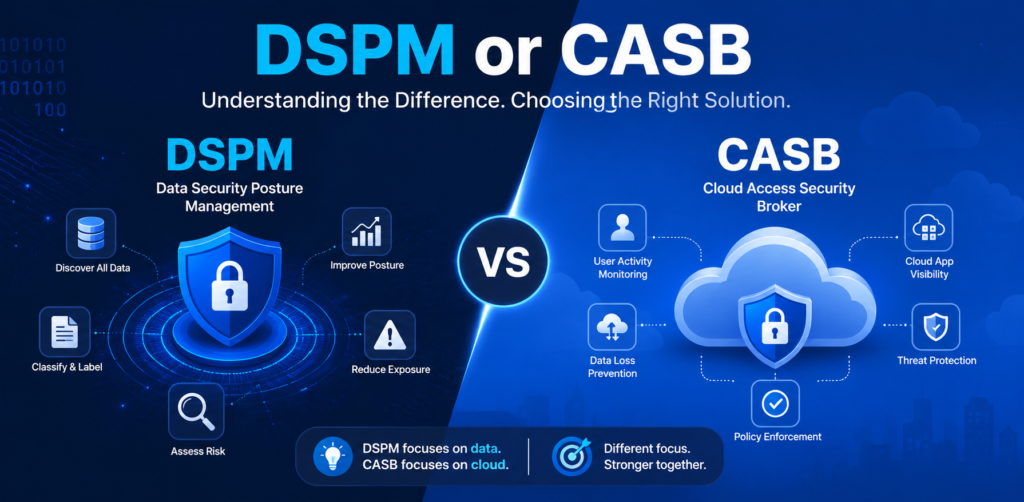
Data Security Posture Management (DSPM) is a category of security technology that discovers, classifies, and monitors sensitive data across cloud environments. Rather than focusing on network traffic or user activity at the application layer, DSPM starts with the data itself and works outward to identify risks.
Core Capabilities of DSPM
DSPM platforms perform several interconnected functions to give security teams visibility into their cloud data estate:
- Automated data discovery: Scans cloud storage services, databases, data lakes, and file shares to locate all data assets, including shadow data that exists outside IT governance.
- Data classification: Applies content inspection and contextual analysis to categorize data by sensitivity level (e.g., PII, PHI, financial records, intellectual property).
- Risk assessment: Evaluates access permissions, encryption status, residency compliance, and exposure paths to determine the risk posture of each data asset.
- Continuous monitoring: Tracks changes to data stores, permissions, and configurations over time, alerting teams when drift or misconfigurations introduce new risks.
- Remediation guidance: Provides actionable recommendations or automated workflows to fix identified issues, such as revoking excessive permissions or enabling encryption.
What Makes DSPM Different
The defining characteristic of DSPM is its data-centric perspective. While many security tools monitor infrastructure, endpoints, or user behavior, DSPM answers a more fundamental question: where is your sensitive data, who can access it, and is it properly protected? This approach is particularly valuable for organizations dealing with large-scale multicloud deployments where data inventory is incomplete or outdated.
DSPM solutions typically operate agentlessly, connecting to cloud provider APIs to scan storage resources without requiring software installation on individual workloads. This makes deployment faster and reduces operational overhead.
What is CASB (Cloud Access Security Broker)?
A Cloud Access Security Broker (CASB) is a security enforcement point positioned between cloud service users and cloud applications. CASBs govern how users interact with cloud services, applying policies around access control, data loss prevention, threat protection, and compliance.
Core Capabilities of CASB
CASBs address cloud security from the access and usage perspective, providing controls across four primary pillars:
- Visibility: Identifies all cloud services in use across the organization, including unsanctioned shadow IT applications, and provides usage analytics.
- Compliance: Enforces regulatory and organizational policies governing data sharing, residency, and retention within cloud applications.
- Data security: Applies inline data loss prevention (DLP) controls to prevent sensitive information from being uploaded, downloaded, or shared inappropriately.
- Threat protection: Detects anomalous user behavior, compromised accounts, and malware distribution through cloud services.
CASB Deployment Modes
CASBs can be deployed in multiple configurations depending on the organization’s architecture and requirements:
| Deployment Mode | How It Works | Primary Strength |
| Forward Proxy | Intercepts traffic from managed devices before it reaches cloud services | Real-time inline policy enforcement for known devices |
| Reverse Proxy | Sits in front of the cloud application and mediates sessions | Agentless control for unmanaged devices |
| API-Based | Connects directly to cloud application APIs for out-of-band inspection | Comprehensive visibility without traffic redirection |
Many modern CASBs support multimode deployment, combining these approaches to cover both managed and unmanaged devices, sanctioned and unsanctioned applications. This flexibility makes CASB a critical component for controlling user interactions with SaaS platforms like Microsoft 365, Salesforce, Google Workspace, and hundreds of other cloud services.
Key Differences Between DSPM and CASB Explored
While both DSPM and CASB aim to protect cloud data, they approach the problem from fundamentally different angles. Understanding the key differences between DSPM and CASB helps security leaders determine which gaps each tool fills within their architecture.
Primary Focus and Starting Point
DSPM starts with the data. It discovers where sensitive information lives, how it is classified, and whether it is adequately protected based on its risk profile. CASB starts with the user and the access path. It monitors and controls how people interact with cloud applications and what data moves through those interactions.
Detailed Comparison
| Dimension | DSPM | CASB |
| Primary focus | Data discovery, classification, and posture | User access control and cloud application governance |
| Coverage scope | IaaS/PaaS data stores (S3 buckets, databases, data lakes) | SaaS applications and cloud services accessed by users |
| Deployment model | API-based, agentless scanning | Proxy (forward/reverse) and API-based |
| Threat model addressed | Misconfigurations, excessive permissions, shadow data exposure | Shadow IT, account compromise, unauthorized data sharing |
| Enforcement style | Posture assessment with remediation recommendations | Inline, real-time policy enforcement |
| Data movement visibility | Limited (focuses on data at rest) | Strong (monitors data in transit between users and apps) |
| Shadow data detection | Core capability | Not a primary function |
Complementary, Not Competitive
The comparison above reveals that DSPM and CASB are not interchangeable. DSPM excels at answering “what sensitive data do we have and is it secure?” while CASB excels at answering “who is accessing our cloud services and are they following policy?” Organizations that deploy only one of these tools will have significant visibility gaps that the other is specifically designed to fill.
Comparing Approaches to Security Policy Enforcement
Security policy enforcement is a critical function for both DSPM and CASB, but each tool enforces policies at different layers and through different mechanisms. The distinction matters because effective data protection requires controls at multiple points in the data lifecycle.
How DSPM Enforces Policies
DSPM enforces security policies primarily through posture assessment and configuration management. When a DSPM platform detects that a data store violates organizational policy – for example, an unencrypted S3 bucket containing customer PII – it generates an alert and may trigger automated remediation. Common enforcement actions include:
- Flagging misconfigured storage resources that expose sensitive data publicly
- Identifying access policies that grant excessive permissions to data stores
- Detecting encryption gaps and recommending or applying corrections
- Monitoring data residency to ensure compliance with geographic restrictions
How CASB Enforces Policies
CASB takes a more active, inline approach to security policy enforcement. Because it sits in the data path between users and cloud applications, a CASB can block, allow, or modify transactions in real time. Typical enforcement scenarios include:
- Blocking uploads of files containing credit card numbers to unsanctioned cloud storage
- Applying encryption or tokenization to sensitive data before it reaches a SaaS application
- Restricting downloads from corporate applications on unmanaged personal devices
- Quarantining files flagged by DLP policies for manual review before sharing
The Enforcement Gap
Neither tool alone covers the full spectrum of policy enforcement. DSPM cannot block a user from sharing a sensitive file through a SaaS application in real time. CASB cannot detect that a developer accidentally copied a production database with customer records into an unprotected test environment. Effective security policy enforcement requires both posture-level controls (DSPM) and access-level controls (CASB) working in coordination.
Evaluating Common DSPM and CASB Use Cases for 2026
Practical use cases illustrate where each technology delivers the most value. As cloud architectures grow more complex, the DSPM and CASB use cases that matter most are shifting toward multicloud governance, regulatory compliance automation, and cross-platform data protection.
Top DSPM Use Cases
- Shadow data discovery: Locating copies of sensitive data in cloud storage accounts that security teams did not know existed, such as database snapshots, log files containing PII, or abandoned development environments.
- Compliance auditing: Mapping sensitive data against regulatory requirements (GDPR, HIPAA, PCI DSS) to verify that classification, encryption, and access controls meet mandated standards.
- Data access governance: Analyzing who and what has access to sensitive data stores, identifying overprivileged accounts, and enforcing least-privilege policies.
- Multicloud data inventory: Creating and maintaining a unified inventory of sensitive data across AWS, Azure, Google Cloud, and other providers.
- Merger and acquisition due diligence: Rapidly assessing the data security posture of acquired organizations’ cloud environments.
Top CASB Use Cases
- Shadow IT detection and control: Identifying unsanctioned cloud applications employees are using and applying appropriate access or blocking policies.
- SaaS DLP enforcement: Preventing sensitive data from being shared through collaboration tools like Slack, Microsoft Teams, or Google Drive in violation of corporate policy.
- BYOD and unmanaged device control: Allowing employees to access corporate SaaS applications from personal devices while restricting downloads or copy-paste actions.
- Compromised account detection: Using behavioral analytics to identify unusual login patterns, impossible travel scenarios, or bulk data downloads that indicate account takeover.
- Cloud application risk scoring: Evaluating the security posture of third-party SaaS vendors based on certifications, encryption practices, and data handling policies.
Overlapping Use Cases
Some scenarios benefit from both tools simultaneously. For example, a compliance audit for GDPR may require DSPM to locate all EU citizen data across cloud storage (data at rest) while also requiring CASB to verify that access controls and sharing policies for SaaS applications prevent unauthorized cross-border data transfers (data in motion). Neither tool alone satisfies the full requirement.
Why You Should Be Using DSPM and CASB Together
The DSPM vs CASB comparison often leads organizations to an important conclusion: the question is not which tool to choose, but how to deploy both effectively. Using DSPM and CASB together creates a layered defense that addresses data security across its full lifecycle – from creation and storage to access and sharing.
The Combined Value Proposition
When integrated, DSPM and CASB provide capabilities that neither can deliver independently:
- Complete data visibility: DSPM maps sensitive data at rest across cloud infrastructure while CASB monitors data in transit through SaaS applications, eliminating blind spots.
- Context-aware enforcement: DSPM’s classification intelligence can inform CASB policies, enabling more precise DLP rules based on actual data sensitivity rather than generic patterns.
- Unified compliance posture: Organizations can demonstrate end-to-end data protection controls that cover storage, access, and sharing – satisfying auditors and regulators more completely.
- Faster incident response: When CASB detects anomalous data access, DSPM can immediately assess the sensitivity and exposure of the affected data stores, accelerating triage and containment.
Integration in Practice
Consider a scenario where a DSPM scan discovers a database containing unencrypted Social Security numbers in an AWS account. The DSPM tool classifies this data as highly sensitive and flags the misconfiguration. Simultaneously, the organization’s CASB monitors access to the application layer that queries this database, enforcing policies that prevent bulk data exports and alerting on unusual query patterns. Together, the tools address both the storage vulnerability and the access risk.
Vendors that offer both capabilities within a unified platform reduce integration complexity and choose platforms that incorporate both DSPM and CASB functionality, allowing security teams to correlate data posture findings with access control policies through a single operational workflow.
How DSPM and CASB Fit into a Broader CNAPP Strategy
Cloud-Native Application Protection Platforms (CNAPPs) represent the convergence of multiple cloud security capabilities into a unified framework. Both DSPM and CASB play distinct roles within a CNAPP architecture, alongside workload protection, infrastructure entitlement management, and infrastructure-as-code scanning.
CNAPP Component Map
| CNAPP Component | Function | Relationship to DSPM/CASB |
| CSPM (Cloud Security Posture Management) | Monitors infrastructure misconfigurations | DSPM extends CSPM by focusing specifically on data-level risks |
| CWPP (Cloud Workload Protection) | Secures VMs, containers, and serverless functions | Complements DSPM by protecting the compute layer that processes data |
| CIEM (Cloud Infrastructure Entitlement Management) | Manages cloud identity permissions | DSPM uses entitlement data to assess data access risk; CASB enforces access policies |
| CASB | Controls user access to cloud applications | Provides the SaaS security layer that DSPM does not cover |
| DSPM | Discovers and classifies sensitive data | Provides the data intelligence layer that CASB does not cover |
Why Platform Consolidation Matters
Running DSPM, CASB, CSPM, and CWPP as separate point solutions creates operational friction: different consoles, different alert formats, different policy languages, and limited correlation between findings. A consolidated CNAPP approach reduces this friction by sharing context across security functions.
For organizations evaluating their cloud security architecture in 2026, the strategic direction is clear: individual tools still matter, but their value multiplies when they share data, context, and policy frameworks within an integrated platform.
Making the Right Choice for Your Organization
Deciding between DSPM, CASB, or both depends on your organization’s cloud architecture, data profile, regulatory requirements, and existing security investments. There is no universal answer, but a structured evaluation framework helps clarify priorities.
Decision Criteria
Consider the following factors when evaluating DSPM vs CASB for your environment:
- Cloud model mix: If your organization relies heavily on SaaS applications, CASB is likely the higher-priority investment. If you store large volumes of sensitive data in IaaS/PaaS environments, DSPM should take precedence.
- Current visibility gaps: If you lack a complete inventory of where sensitive data resides, DSPM addresses that gap directly. If you are unsure which cloud applications employees are using, CASB solves that problem.
- Regulatory pressure: Regulations that emphasize data classification and residency (GDPR, certain healthcare mandates) align closely with DSPM capabilities. Regulations focused on access controls and data sharing restrictions map well to CASB.
- Existing tool overlap: Some organizations already have partial CASB functionality through their secure web gateway or SSE platform. Others may have basic data classification through their cloud provider’s native tools. Identify what you already have before adding new capabilities.
A Phased Approach
Organizations that cannot deploy both tools simultaneously can take a phased approach. Start with the tool that addresses your most critical gap, then layer in the second capability within 6 to 12 months. The goal is convergence: a security architecture where data posture intelligence and access enforcement inform each other continuously.
When evaluating vendors, prioritize those that offer both DSPM and CASB within a unified platform or that provide strong API-based integrations between the two. This reduces long-term integration costs and accelerates time to value.