Artificial intelligence is transforming nearly every industry on the planet, from healthcare diagnostics to self-driving vehicles. Cybersecurity is no exception. AI-powered tools are already detecting threats faster than any human analyst, automating incident response, and predicting attacks before they happen. So the question is reasonable: will AI eventually replace cybersecurity professionals entirely? The short answer is no, but the longer answer is far more interesting.
For more educational content on digital privacy, anonymisation technologies and understanding the threat landscape from the ground up, visit DarkNetPedia.com
What AI Is Already Doing in Cybersecurity
AI’s footprint in cybersecurity is already enormous. Machine learning models are used to analyse millions of network events per second, flagging anomalies that would take human analysts hours to detect. Tools like Darktrace use unsupervised machine learning to build a model of ‘normal’ behaviour on a network and raise alerts when something deviates, catching zero-day threats and insider attacks that traditional signature-based systems miss entirely.
AI is also being deployed in endpoint protection, phishing detection, vulnerability scanning, fraud prevention, and log analysis. In Security Operations Centres (SOCs) around the world, AI acts as a force multiplier, handling the high-volume, repetitive tasks that would otherwise overwhelm human teams.
The benefits are clear: faster detection, fewer false positives over time, and 24/7 coverage without fatigue. For organisations drowning in alerts, AI-driven triage has become not a luxury but a necessity.
The Case for AI Taking Over, And Why It Falls Short
AI advocates argue that as models become more capable, they will be able to handle the full cybersecurity lifecycle: detect, analyse, contain, remediate, and report, all without human intervention. In limited, well-defined environments, this is already partially true. Automated response systems can isolate a compromised endpoint in milliseconds, far faster than a human could.
But cybersecurity is not a static problem. Attackers are adaptive, creative, and increasingly using AI themselves. According to a 2024 report by the World Economic Forum, the cybersecurity landscape is growing more complex, not less, with AI being weaponised by threat actors to generate more convincing phishing emails, create polymorphic malware, and probe defences at machine speed.
An AI can only operate within the parameters it has been trained on. Novel attack vectors, the kind that skilled human adversaries invent, can slip past AI systems precisely because they don’t match historical patterns. This is the fundamental limitation of current machine learning: it excels at recognising what it has seen before, but struggles with genuine novelty.
The Human Element AI Cannot Replicate
Cybersecurity is not purely a technical discipline. It involves judgment, ethics, legal reasoning, and communication, skills that remain distinctly human. When a breach occurs, someone must decide which regulatory bodies to notify, how to communicate with affected customers, and whether to engage law enforcement. These decisions carry legal weight and reputational consequences that no AI system can responsibly make autonomously.
Penetration testers and red team operators think like adversaries, an inherently creative act that requires understanding human psychology, social engineering, and organisational culture. A skilled ethical hacker doesn’t just run tools; they imagine how a motivated attacker would think. That kind of adversarial creativity remains beyond the reach of current AI.
There is also the matter of accountability. When an AI system makes a wrong call, blocking legitimate traffic, missing a critical threat, or flagging an innocent user, a human must be responsible for that failure. Regulators, courts, and boards of directors require a named person to be accountable. AI cannot be held responsible in any meaningful legal or ethical sense.
AI as a Collaborator, Not a Replacement
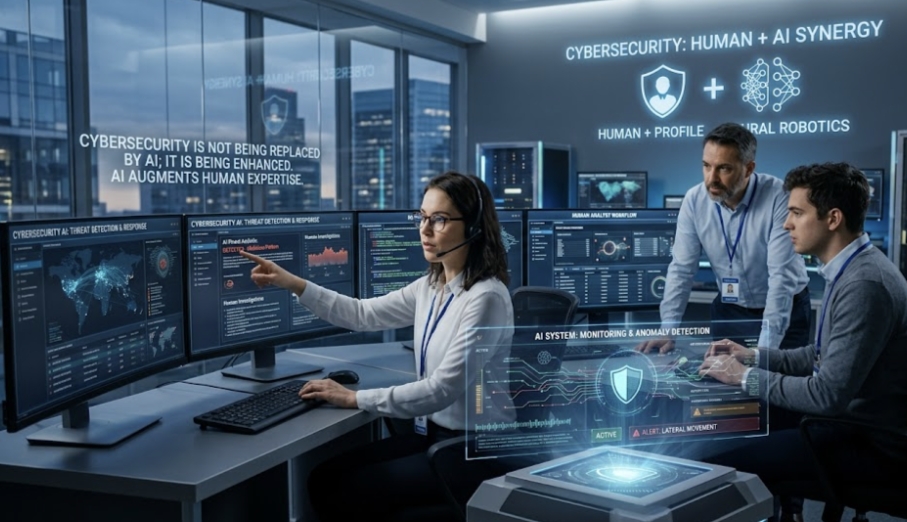
The most accurate framing is not AI versus cybersecurity professionals, but AI alongside them. The SANS Institute, one of the world’s leading cybersecurity training organisations, describes AI as augmenting human analysts rather than replacing them. The emerging model is human-machine teaming: AI handles scale and speed; humans handle context and judgment.
This collaboration is already reshaping job roles. Cybersecurity professionals who embrace AI tools, understanding how to configure, tune, interpret, and challenge them, will be significantly more effective than those who don’t. The professionals at risk are not those who work with AI, but those who refuse to adapt to it.
The demand for cybersecurity talent is also moving in the opposite direction from what a ‘replacement’ narrative would suggest. The global cybersecurity workforce gap currently stands at millions of unfilled positions worldwide, and AI is not closing that gap, it’s changing what skills are most valued within it.
What This Means for Aspiring Cybersecurity Professionals
If you’re considering a career in cybersecurity, the rise of AI is not a reason to pause, it’s a reason to accelerate. Understanding how AI tools work, their limitations, and how adversaries exploit them is becoming a core competency. Skills in threat intelligence, incident response, cloud security, and red teaming remain in high demand and are not going away.
Equally important is understanding the broader threat landscape, including areas like anonymisation technologies, operational security, and how threat actors operate on the dark web. Educational resources like DarkNetPedia offer well structured guides on topics from Tor and PGP encryption to how darknet ecosystems function, knowledge that is directly applicable to threat intelligence work and understanding adversary behaviour. Building this kind of foundational knowledge gives cybersecurity professionals a genuine edge, whether they’re working alongside AI tools or training the next generation of them.
The Verdict
AI will not replace cybersecurity. It will, however, fundamentally reshape it. The professionals who thrive will be those who treat AI as a powerful tool in their arsenal rather than a threat to their relevance. The attackers are already using AI, defenders cannot afford to fall behind.
Cybersecurity has always evolved in response to the threat environment. Firewalls didn’t replace security teams; neither did antivirus software, SIEM systems, or cloud security platforms. AI is the next evolution in a long line of tools that make defenders more capable. The human element, judgment, creativity, ethics, and accountability, remains irreplaceable.
AI is a force multiplier in cybersecurity, handling scale, speed, and pattern recognition at levels no human team could match. But creativity, judgment, legal accountability, and adversarial thinking remain firmly in human hands. The future of cybersecurity is human-AI collaboration, not replacement.