Most of the conversation around artificial intelligence centers on models: who has the biggest, the fastest, the most capable. Far less is said about the people standing behind them. Every AI system that reaches the market has passed through human hands, from data labelers and reviewers to specialists who check outputs and correct mistakes. As demand for AI grows, finding those people has quietly become one of the industry’s hardest problems.
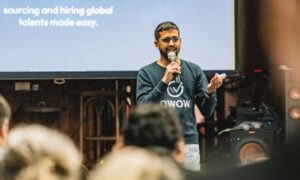
Divya Pandey, co-founder and COO of OWOW, has made that problem her focus.
An Engineer’s View of Hiring
Pandey did not begin her career in recruitment. She trained as a systems engineer, working on infrastructure where the priorities were reliability, removing bottlenecks and building systems that could scale.
It was that lens that led her to hiring. Companies were getting steadily better at building AI, yet the process of finding people to train and support it had barely changed. It remained slow and manual, and often ran through agencies with opaque fees. Where many saw a recruiting problem, Pandey saw a systems problem. In her view, every new role forced companies to start their search from zero, when talent could instead be treated like infrastructure that is always available and ready to scale.
That thinking became the basis for OWOW, which Pandey co-founded with CEO Gangesh Pathak.
A Network Built for Scale
Rather than beginning a new search each time a role opens, OWOW maintains an active,
pre-vetted pool of talent that companies can draw on right away. For AI companies, which often need large numbers of specialized people on short timelines, the difference is significant.
Under Pandey’s operational leadership, that pool has grown into a network of more than 100,000 AI trainers, including data annotators and domain specialists whose work shapes how machine learning models learn. It spans North America, South Asia, Southeast Asia and Latin America, giving companies access to skilled talent across continents and time zones.
The reach is intentional. Pandey has pointed to how much skilled talent sits in regions that global tech hiring has historically overlooked. Drawing on those regions does more than fill roles; it widens who gets to take part in the AI economy. Fast-growing AI companies now rely on the network for work ranging from data annotation to expert review.
How the Platform Works
OWOW does not simply wait for applications. The company combines inbound and outbound sourcing, using an AI-driven system to identify and reach promising candidates while also handling incoming interest.
At the center of the platform is Luna, an AI system that helps recruiters assess candidates on communication style, performance and fit. OWOW’s agentic AI handles much of the pipeline, from sourcing and vetting to first-round interviews, cross-border compliance and payroll support. Final hiring decisions remain with people, a choice that keeps accountability in human hands. The company says the platform has conducted more than 1,000 interviews a day and vetted over 400,000 applicants.
The Operational Challenge
Running a hiring operation across borders is where much of the difficulty lies, and it is the part of the business Pandey oversees. A single placement can involve different labor laws, tax rules and payment systems depending on where a worker lives. As COO, she leads the operations that allow OWOW to place talent across multiple countries while staying compliant.
The division of labor between the founders is clear. Pathak leads product vision, AI strategy and go-to-market; Pandey turns that vision into a working operation. OWOW says it helps companies fill roles faster than traditional hiring, and it is working to shorten that cycle even further. The company has drawn backing from angel investors including a former LinkedIn engineering director and a former Intel AI solutions director.
Why It Matters
As AI adoption accelerates, the need for skilled human input is growing alongside it. Models require more training data, more careful evaluation and deeper expertise, and much of that work cannot be automated away.
Pandey has built OWOW around that reality. Her bet is that even as AI grows more autonomous, it will continue to depend on people, and that the companies able to find and support those people will shape how the technology develops.