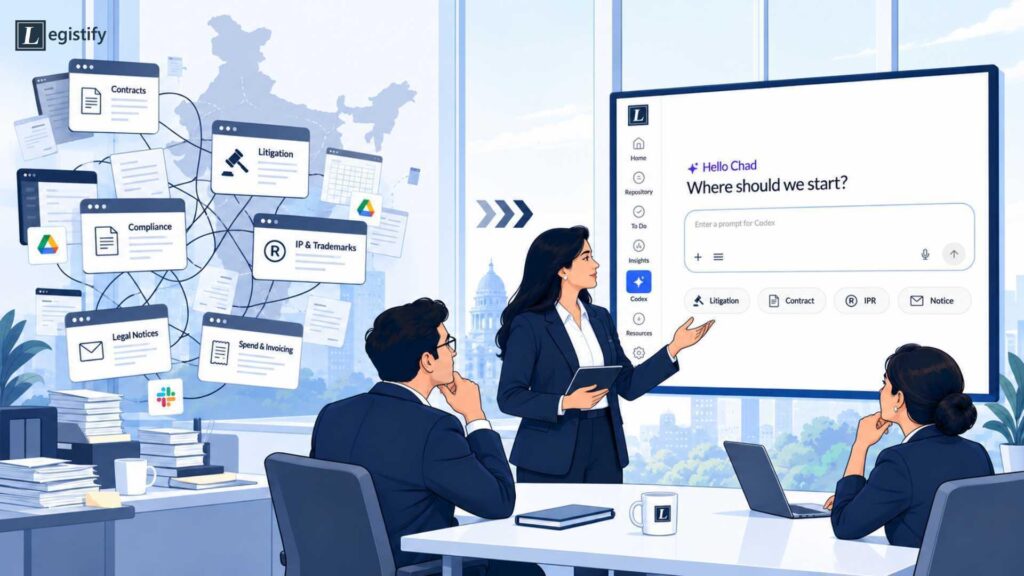
Gurugram (Haryana) [India], September 21: Open the laptop of a typical in-house counsel at a mid-sized Indian enterprise and you’ll usually find a small graveyard of tools: one for e-signatures, another for tracking court dates, a spreadsheet for contract renewals, an inbox thread for trademark filings, and somewhere in between, a compliance tracker nobody quite remembers setting up. None of these tools talk to each other. Each was bought to solve one problem, at one point in time, by someone trying to make a specific pain go away.
That, in a sentence, is the state of India’s legal technology market not underdeveloped, but fragmented by design.
The country’s legal tech sector has grown quickly over the past few years, with new startups launching at a steady pace and funding into the category climbing sharply. Much of that growth, however, has come in the form of point solutions: platforms that manage contracts, or litigation, or intellectual property, or compliance, each competing to be the best single-purpose tool in its lane. For enterprise legal teams, the result is not abundance but assembly work stitching together four or five subscriptions and hoping the handoffs between them don’t drop anything important.
“Every enterprise we’ve worked with came to us already running two or three tools that were supposed to solve their legal ops problem,” said Akshat Singhal, Founder and CEO of Legistify, the Gurugram-based AI-native legal operations platform. “The problem was never that those tools didn’t work. It’s that none of them were built to talk to each other, so the legal team ended up doing the integration work themselves, manually, every single day.”
That manual integration work is easy to underestimate from the outside. A contract renewal deadline sitting in one system needs to be cross-checked against litigation exposure sitting in another. A trademark under active dispute needs to be visible to whoever is reviewing a related licensing contract. When these systems don’t share data, that cross-checking becomes a person’s job usually someone already stretched thin across a legal department of five to fifteen people managing thousands of contracts and hundreds of active matters.
India’s legal system adds its own layer of complexity to this. With crores of cases pending across district and high courts, and a legal services market now valued in the billions of dollars, enterprise legal risk in India is rarely confined to a single domain. A single dispute can touch contracts, compliance obligations, and intellectual property simultaneously which makes the case for a unified system less about convenience and more about not missing something that matters.
This is the gap Legistify has built its platform around, unifying contract lifecycle, litigation, IP and legal notice management under one system, with an AI layer called Codex running across all four. Pratik Mohapatra, the company’s Co-founder and Chief Business Officer, spent years managing legal operations for large enterprises before joining Legistify, and says the fragmentation problem was visible to him long before it became a product thesis.
“I watched legal teams get blamed for missing something that was technically visible just not visible to them, because it lived in a different tool that nobody else on the team had access to,” Mohapatra said. “That’s not a people problem. That’s a systems problem. You can’t expect good judgment from a team working with a fragmented, half-updated picture of their own legal exposure.”
The broader market appears to be moving in this direction as well. Global legal AI platforms are increasingly positioning themselves around integration and interoperability rather than standalone capability automating handoffs between case management, e-discovery, and research tools rather than treating them as separate products. In India, that shift comes with an added complication: many of the AI and interoperability advances built for US and UK legal systems don’t map cleanly onto Indian court procedure, e-filing infrastructure, or regulatory frameworks, which limits how much global platforms can offer Indian enterprise legal teams without local adaptation.
Consolidation, in other words, isn’t just a product feature. It’s a response to a structural mismatch between how legal risk actually moves through an organization and how the software built to manage it has historically been sold one problem, one tool, one subscription at a time.
Whether the market consolidates around a handful of unified platforms or continues producing new point solutions faster than enterprises can integrate them remains an open question. But the cost of fragmentation, the missed cross-references, the manual reconciliation, the legal team quietly doing the job the software was supposed to do is no longer invisible. Increasingly, it’s the line item enterprises are asking their legal technology vendors to justify.