
In an Age of AI-Generated Images, Elena Von Kohn Is Betting on the Power of the Physical Painting

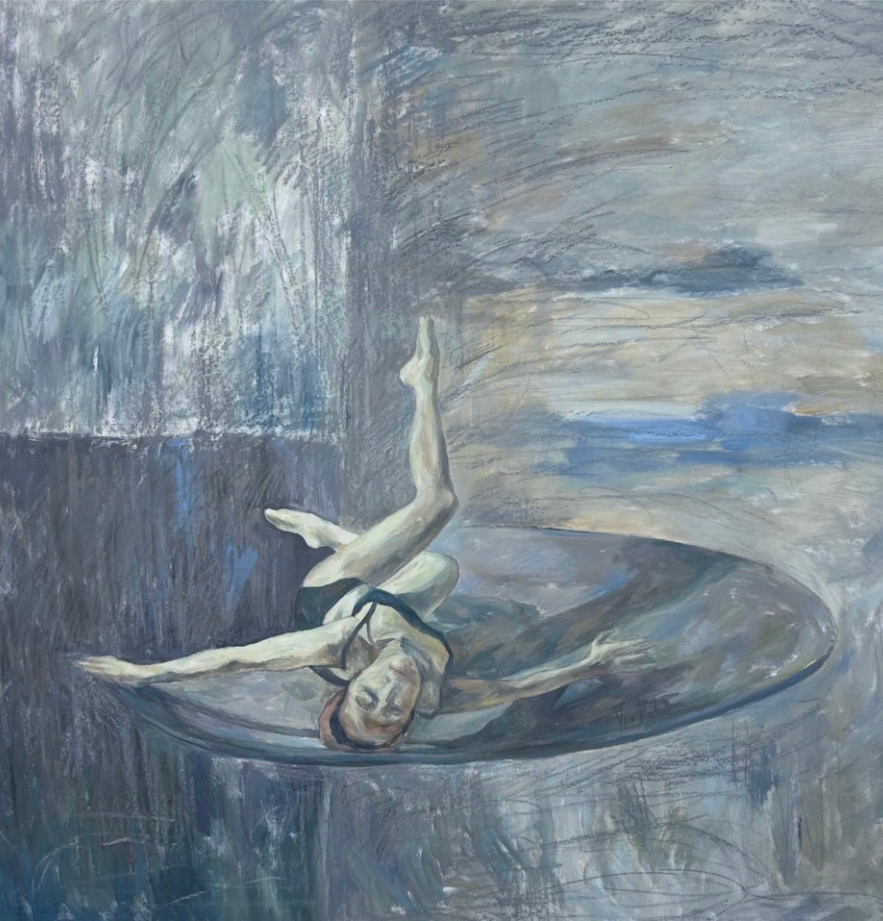
Elena Von Kohn can spend months creating one painting.
On October 6, 2026, the contemporary artist will present The Gate of Déjà Vu at Vienna’s historic Palais Auersperg, bringing monumental, hand-painted surrealist works into an environment defined by physical history, architecture and live cultural experience.
At a moment when visual culture is increasingly consumed through screens—and generated through algorithms—the exhibition presents an interesting counterpoint: Does physical art become more valuable as images themselves become virtually unlimited?
Von Kohn believes it does.
“Technology can create extraordinary things,” she says. “But standing in front of a large original painting is still a physical and emotional experience. You can see the decisions, the layers, the scale and the human hand.”
Von Kohn’s works are often measured in feet rather than inches. Her large oil paintings require sustained physical execution and extensive preparation, creating an object that cannot be fully replicated by its digital image.
The distinction is becoming increasingly relevant.
Generative technologies have dramatically lowered the cost and time required to produce visual content. Billions of new digital images can be created, copied and distributed with almost no physical constraint.
Original paintings occupy the opposite end of that equation.
There is one object.
It exists in one place.
It carries physical evidence of its creation.
And to fully experience its size, surface and relationship to the surrounding environment, a viewer still has to stand before it.
Von Kohn’s Vienna presentation deliberately emphasizes that experience.
Rather than choosing a neutral white gallery environment, The Gate of Déjà Vu will place contemporary paintings inside Palais Auersperg, where the surrounding architecture and classical music tradition become part of the encounter.
“Digital presentation allows art to travel everywhere,” Von Kohn says. “But sometimes art needs you to travel to it.”
Her work explores memory, perception and what she describes as enigmatic surrealism—images that appear understandable at first but reveal psychological contradictions upon closer examination.
The exhibition title itself could almost describe the experience of contemporary technology.
Déjà vu is a collision between information and perception: the brain signals familiarity even when logic says an experience is new.
AI-generated imagery introduces a related phenomenon into culture. Viewers increasingly encounter images that look familiar because machines have learned patterns from enormous quantities of existing visual material, even though the particular image never existed before.
Von Kohn’s paintings approach the question from an intentionally human direction.
Her compositions evolve through intuition, memory and accumulated experience rather than through instantaneous generation.
She does not see technology and traditional painting as enemies, however.
Digital photography, online communication and social media have made it possible for independent artists to develop international audiences, coordinate projects across countries and introduce physical artworks to people who might never enter a particular gallery.
The paradox is that the more effectively technology distributes an image, the more intriguing the original object can become.
A photograph of an eight-foot painting can fit on a smartphone.
The painting itself cannot.
That difference is precisely what The Gate of Déjà Vu asks viewers to confront.
Von Kohn’s October 6 exhibition therefore arrives during a broader transformation in the economics and meaning of visual creation.
As machines become faster at producing images, characteristics once considered limitations of traditional art—time, scarcity, physical labor and singularity—may increasingly become differentiators.
“In the end,” Von Kohn says, “technology changes how we reach people. It does not change the basic human desire to feel something.”
Inside a centuries-old Vienna palace, surrounded by paintings that required months rather than seconds to exist, that distinction may become particularly clear.






Comment