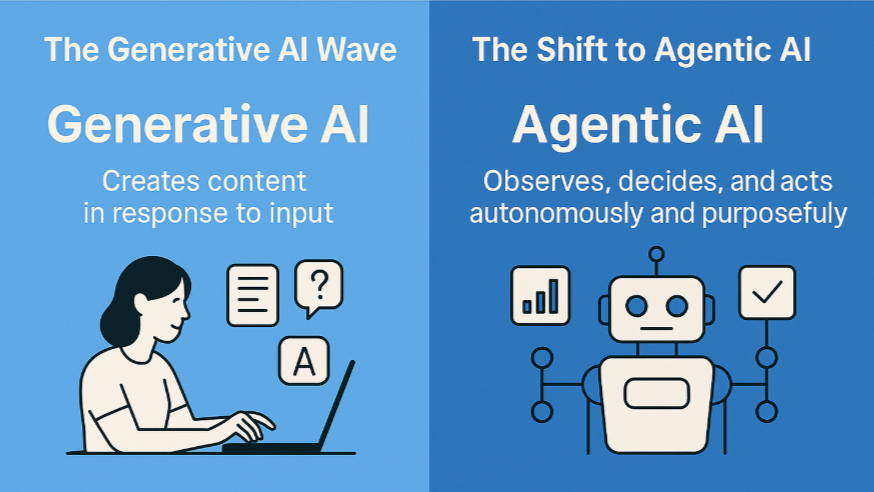
The term “agentic AI” first came up in a planning meeting last spring. A colleague mentioned it twice in ten minutes, and everyone nodded as though they knew exactly what it meant. I nodded too, then spent the rest of the afternoon quietly searching for a definition. That small moment of bluffing is what pushed me to learn the subject properly. I had one condition: I would not pay for it until I knew whether the topic was worth the money.
Why the Topic Is Hard to Ignore
My curiosity turned out to be well timed. Gartner (2024) projected that by 2028, roughly one-third of enterprise software applications will include agentic AI, compared with less than 1% in 2024. The same firm later cautioned that more than 40% of agentic AI projects may be canceled by the end of 2027, citing rising costs, unclear business value, and inadequate risk controls (Gartner, 2025). Read together, those two forecasts say something useful: demand is growing fast, but organizations are struggling to execute, which means people who understand the fundamentals are in a good position.
The labor market points the same way. The World Economic Forum (2025) estimated that 39% of existing skill sets will be transformed or become outdated between 2025 and 2030, and it ranked AI and big data among the fastest-growing skill areas. I did not need a report to tell me that my own job description was shifting, but the numbers helped me stop treating this as optional.
Starting Without a Budget
My first attempts were scattered. I watched a few videos, skimmed a handful of blog posts, and came away with vocabulary but no real understanding. What changed things was moving to a structured curriculum. I had assumed that structure cost money. It did not. I eventually found a catalog of free online courses with certificates that let me browse by topic, and from there I moved to the dedicated list of free agentic AI courses, which suited a beginner like me far better than a generic machine learning syllabus.
I kept my schedule modest: about 45 minutes on weekday mornings, plus one longer session on Saturdays. By the end of the third week I could explain to a non-technical friend what I was studying, which I now consider the real test of understanding.
What Surprised Me
The core idea is simpler than the jargon suggests
I expected agentic AI to be an intimidating, math-heavy subject. In practice, the central concept is easy to state. A chatbot answers a question. An agent is given a goal, decides which steps to take, uses tools such as search or a calendar, checks its own progress, and adjusts. Once that distinction clicked, much of the surrounding terminology (planning, memory, tool use, orchestration) became easier to place.
A small example made it concrete. Instead of asking an assistant to “write a summary of this report,” I built a simple workflow in which the system retrieved the report, pulled out key figures, drafted the summary, and flagged anything it was unsure about. It was not impressive by industry standards, but watching software handle a sequence of decisions rather than a single prompt changed how I thought about automation.
Failure is part of the curriculum
The second surprise was how often my agents got things wrong. One of my early experiments confidently misread a date and carried the error through three further steps. The courses did not hide this. They treated mistakes as a normal feature of the technology and spent real time on guardrails, testing, and human oversight. That framing matched the cautionary note in Gartner’s (2025) forecast far better than the breathless headlines I had been reading. People who understand where agents break are more valuable than people who only know how to demo them.
The certificate mattered less than the portfolio
I had signed up partly for the credential, and I did earn a completion certificate. Yet the thing that actually opened a conversation with my manager was a small project: a research-assistant workflow that saved our team about two hours a week on competitor monitoring. That figure comes from my own rough tracking, so it should be taken as an anecdote, not a benchmark. Still, when I showed the working project, the discussion shifted from “what did you study?” to “can this be extended to other teams?” A certificate signals effort. A working example signals capability. The best approach is to collect both.
Free did not mean shallow
I went in skeptical. My assumption was that free material would be a thin teaser designed to push a paid upgrade. Some of it did include suggestions for further study, which is fair, but the foundational lessons were substantial enough that I could build something real. Whether to continue into paid, advanced programs became a decision I could make with evidence from my own progress, rather than a gamble on a sales page.
Advice for Anyone Starting Out
A few practices made the biggest difference for me, and they apply to most self-directed learners.
First, pick one narrow goal before opening any course. “Understand how agents use tools” is a workable goal; “learn AI” is not. Second, build something small within the first two weeks, even if it is clumsy. Third, keep brief notes in your own words after each session, because rewriting an idea forces you to find the gaps in your understanding. Finally, expect to feel confused around the halfway point. Every person I spoke with who finished a self-paced course described a similar dip, and it passed once they started applying the material.
It also helps to keep expectations realistic. Completing a beginner course will not make anyone an AI engineer. What it can do is replace vague familiarity with working literacy, and that is enough to contribute meaningfully in meetings, evaluate vendor claims critically, and decide where to go next.
Conclusion
I began this experiment to escape the discomfort of nodding along to a term I did not understand. Several weeks later, the most useful outcome was not the certificate or even the project. It was the ability to ask sharper questions: What is this agent allowed to do? How do we know when it is wrong? Who reviews its work? Those questions matter whether someone plans to build agents or simply work alongside them.
Agentic AI is moving quickly, and forecasts about it will keep changing. But the barrier to understanding the basics is lower than most people assume. For anyone who has been bluffing through the same meetings I sat in, starting costs nothing except a few early mornings.
References
Gartner. (2024, October 21). Gartner identifies the top 10 strategic technology trends for 2025 [Press release]. https://www.gartner.com/en/newsroom
Gartner. (2025, June 25). Gartner predicts over 40% of agentic AI projects will be canceled by end of 2027 [Press release]. https://www.gartner.com/en/newsroom
World Economic Forum. (2025). The future of jobs report 2025. https://www.weforum.org/publications/the-future-of-jobs-report-2025/