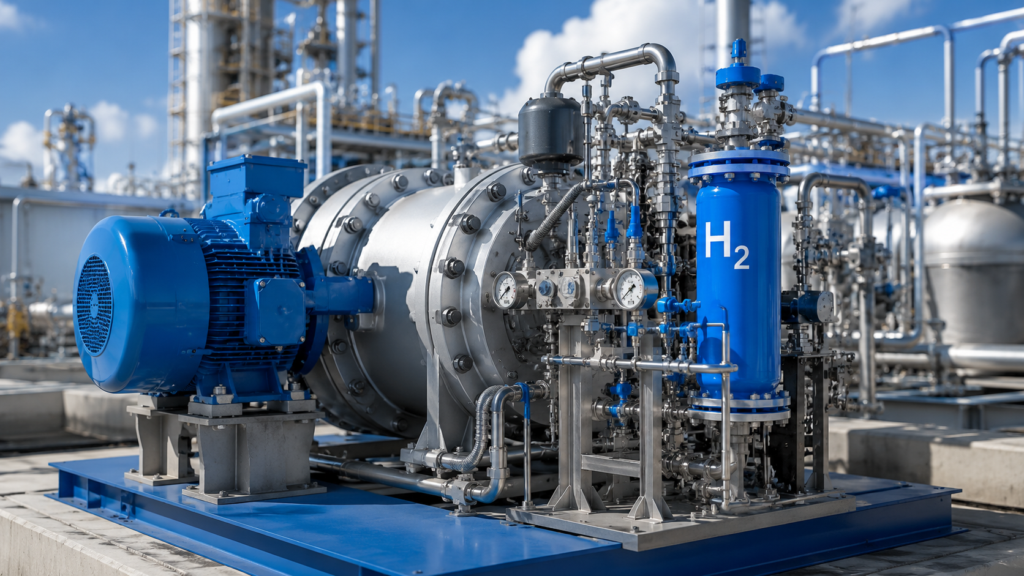
Hydrogen compressor technology underpins the development of hydrogen infrastructure and hydrogen refueling stations by enabling the efficient compression and delivery of gaseous hydrogen for industrial applications, fuel cell electric vehicles, and renewable hydrogen supply chains. This article examines how a hydrogen compressor works to compress hydrogen, the main compression stages, comparative compressor types such as diaphragm compressor and piston-driven machines, performance metrics that define an efficient compressor for hydrogen storage and transport, and the safety, regulatory, and operational considerations that must be addressed when integrating compressors with electrolysis, pipeline injection, and fuel cell applications.
If you are looking for more information about Industrial Hydrogen Compressor Manufacturer&Supplier – PanGeng go here right away
How does a hydrogen compressor work to compress hydrogen and enable hydrogen refueling?
A hydrogen compressor is a device designed to increase the pressure of hydrogen gas so that hydrogen fuel can be stored, transported, and dispensed at pressures required by fuel cell vehicles and industrial applications. The fundamental operation of compressors for hydrogen centers on drawing low-pressure hydrogen gas from a production source such as electrolysis, pipeline, or bulk storage, and then mechanically or electrically compressing that gas through multistage elements to achieve high-pressure output suitable for hydrogen refueling and high-pressure storage vessels. Compression of hydrogen involves managing parameters like compression ratio, volumetric flow, temperature rise, and seal integrity to maintain hydrogen purity and meet the pressure of hydrogen required by hydrogen fueling stations and vehicle tanks. Effective hydrogen compression balances energy consumption, reliability, and the unique physical properties of hydrogen gas, such as low molecular weight and high diffusivity, which influence component selection and sealing strategies in compressor units.
What are the main compression stages and how do they compress gaseous hydrogen?
Main compression stages for hydrogen typically follow a multistage approach where each stage increases the pressure incrementally to control temperature rise and to optimize efficiency. In practice, a hydrogen compression train will consist of one or more low-pressure stages followed by intermediate and high-pressure stages; inter-stage cooling and gas interleaving are employed to dissipate heat generated by compression and to maintain material performance. Each stage may use a reciprocating piston, diaphragm, or rotary element to compress gaseous hydrogen; reciprocating compressors and diaphragm compressors are common for high-pressure hydrogen refueling because they can achieve the significant compression ratios required while minimizing contamination. The compression ratio per stage is selected to manage adiabatic or polytropic behavior of hydrogen, prevent excessive gas heating, and limit leakage that could compromise the pressure of hydrogen in subsequent stages. Proper sequencing of stages, selection of intercoolers, and pressure control valves ensure that the final high-pressure hydrogen delivered to storage or dispenser systems meets the specifications for hydrogen fueling stations and downstream hydrogen applications.
Which compressor types compress hydrogen most efficiently for refueling stations?
Selecting the most efficient compressor type for hydrogen refueling stations depends on duty cycle, required final pressure, purity requirements, and lifecycle cost. Diaphragm compressors are widely regarded as highly suitable for hydrogen fuel applications because they provide oil-free compression, excellent isolation of gas from sealing elements, and the capacity to achieve very high-pressure hydrogen without risk of contamination from lubricants. Piston or reciprocating compressors, often configured as gas compressors with specialized hydrogen-compatible materials and seals, are also commonly used where robust pressure ratios and established service practices are needed. Rotary designs, including screw and vane compressors, can be used for lower pressure or high-flow hydrogen applications but typically require more attention to oil contamination and sealing to maintain hydrogen purity for fuel cell use. In many hydrogen fueling stations, a hybrid approach uses a low-pressure rotary or screw compressor followed by high-pressure diaphragm or reciprocating stages to compress hydrogen from production or buffer tank pressures up to high-pressure dispenser setpoints for hydrogen fuel cell vehicles. Efficiency metrics such as specific energy consumption per kilogram of hydrogen compressed, mechanical reliability, and ability to maintain hydrogen purity guide the selection of compressor technologies for hydrogen refueling.
How is pressure managed during hydrogen compression for fueling stations?
Pressure management during hydrogen compression for fueling stations involves precise control systems, pressure relief strategies, and buffer storage to maintain safe and reliable dispensing conditions. Compressors incorporate sensors, control valves, and programmable logic controllers to modulate compressor speed, inlet throttling, and stage sequencing to meet target pressure of hydrogen while avoiding surges that could stress components or storage vessels. High-pressure buffer tanks and cascade storage configurations are commonly used to smooth transient demand from hydrogen fueling events, allowing compressors to operate at optimal efficiency rather than responding to rapid dispenser draws. Pressure relief devices, burst discs, and safety interlocks provide overpressure protection, while pressure transducers and redundant instrumentation ensure accurate monitoring of stage pressures and final delivery pressure. The compression train is designed to meet specific dispenser pressures for hydrogen fueling stations, often in ranges up to 700 bar for light-duty fuel cell electric vehicles, and to conform to standards for hydrogen-powered mobility and industrial applications.
What compressor technologies are used to compress hydrogen for hydrogen fueling stations and industrial applications?
Compressor technologies for hydrogen include diaphragm compressors, reciprocating piston compressors, screw and rotary compressors, and specialized gas compressor solutions designed for high-pressure hydrogen and hydrogen gas handling. Each technology presents trade-offs between contamination risk, achievable pressure, energy efficiency, maintenance complexity, and capital cost. Diaphragm compressors excel at delivering oil-free, high-pressure hydrogen suitable for fuel cell vehicles and sensitive industrial applications, while reciprocating compressors provide a well-understood platform for high compression ratios and modular maintenance. Rotary compressors can offer lower capital and footprint for moderate pressures but require careful design to limit oil ingress and to manage hydrogen permeation. Additionally, integrated compressor unit packages that combine multiple technologies and include interstage cooling, filtration, and control systems are commonly deployed at hydrogen fueling stations and in large industrial hydrogen production facilities to meet variable demand and support renewable hydrogen production and pipeline injection.
How do diaphragm compressors compare to piston and gas compressors for hydrogen?
Diaphragm compressors differ from piston (reciprocating) and other gas compressor types primarily in their sealing and contamination characteristics. A diaphragm compressor uses a flexible diaphragm to isolate the hydrogen gas entirely from the mechanical drive and lubricants, which significantly reduces contamination and makes them ideal for hydrogen fuel cell and high-purity industrial applications. Piston compressors, which use tight-fitting pistons and rod seals, can handle high pressures and are familiar in many industrial settings, but they typically require specialized seals, gas purging systems, and material selections to limit hydrogen leakage and contamination. Gas compressors such as screw or rotary machines offer continuous flow and lower vibration but historically have higher risk of oil carryover; they can be adapted for hydrogen use when oil-free designs or effective gas separation and filtration are included. Ultimately, diaphragm compressors are often preferred where hydrogen purity for hydrogen fuel cells is critical, while piston compressors may be chosen for heavy-duty compression tasks where robustness and modular maintenance are prioritized.
When is a compressor unit preferred over pipeline compression for hydrogen applications?
A standalone compressor unit is preferred over relying solely on pipeline compression when hydrogen must be transported, stored, or dispensed at pressures significantly higher than available pipeline pressures, when local refueling demand requires on-site pressurization from on-site production such as electrolysis, or when hydrogen infrastructure lacks adequate pipeline connectivity. Many hydrogen fueling stations receive hydrogen at low or intermediate delivery pressures or as gaseous hydrogen at near-atmospheric pressure from on-site electrolysis and therefore require a compressor unit to compress hydrogen to the high-pressure levels used by fuel cell electric vehicles and high-pressure storage. Additionally, in regions where pipeline networks are not yet extensive or where injection into a pipeline is economically or technically impractical, compressor units enable distributed hydrogen fueling and industrial applications by compressing hydrogen locally for storage, truck loading, or direct dispensing. Compressor units also provide operational flexibility, as they can be sized and controlled to match variable renewable hydrogen production rates and temporal refueling demands.
What are the advantages of advanced compressor technology for hydrogen refueling?
Advanced compressor technology offers several advantages for hydrogen refueling including improved energy efficiency, reduced lifecycle costs, enhanced safety, and better maintenance predictability. Innovations in materials, sealing technology, and control algorithms reduce leakage and lower the specific energy required to compress hydrogen, which directly reduces operating expenses and the carbon intensity of hydrogen produced from renewable energy. Advanced diaphragm designs and oil-free reciprocating systems minimize contamination risk for hydrogen fuel cell applications and extend maintenance intervals, while modular compressor units and digital monitoring systems enable proactive diagnostics and remote optimization. Furthermore, integration of compressors with renewable energy sources and electrolysis systems can be optimized through smart controls to compress hydrogen when renewable generation is abundant, supporting efficient hydrogen production, compression of hydrogen for storage, and smooth feeding into hydrogen fueling stations and industrial hydrogen applications.
How do you choose an efficient compressor solution to compress hydrogen for storage and transport?
Choosing an efficient compressor solution to compress hydrogen for storage and transport requires evaluation of performance metrics, contamination and purity requirements, maintenance and lifecycle considerations, compatibility with hydrogen production methods such as electrolysis, and integration with hydrogen infrastructure like pipelines and refueling stations. Decision-making should account for required final pressure—whether for gaseous hydrogen storage at high-pressure cylinders, hydrogen fueling stations needing up to 700 bar, or pipeline injection pressures—as well as the expected flow rates, duty cycles, and purity specifications demanded by hydrogen fuel cell systems and industrial applications. Cost-benefit analyses must consider capital expenditure, energy consumption per kilogram of hydrogen compressed, downtime, and regulatory compliance to select a compressor unit that delivers reliable compression with minimal contamination and manageable maintenance over its operational life.
What performance metrics define an efficient compressor for hydrogen storage?
Key performance metrics that define an efficient compressor for hydrogen storage include specific energy consumption (kWh/kg H2), compression ratio achieved per stage and overall, volumetric flow rate capacity, isentropic or polytropic efficiency, leakage rates, achievable final high pressure, and uptime or mean time between maintenance events. Additionally, metrics such as the ability to maintain hydrogen purity, control of gas outlet temperature, and responsiveness to transient demand at hydrogen fueling stations are essential. For hydrogen refueling applications, ability to meet rapid fill protocols for fuel cell electric vehicles while conserving energy and maintaining pressure of hydrogen in storage cascades is a critical measure of efficiency. Evaluating real-world compressor performance against these metrics helps asset owners select appropriate compressor technologies for hydrogen storage and transport tasks.
How do contamination and purity requirements affect compressor selection?
Contamination and purity requirements profoundly affect compressor selection because hydrogen used in fuel cell and certain industrial applications demands parts-per-million or even parts-per-billion levels of impurities. Fuel cell stacks are sensitive to contaminants such as oil, moisture, and particulates; therefore, compressors that can produce oil-free, dry hydrogen, such as diaphragm compressors, are often favored for hydrogen fueling stations and hydrogen fuel cell supply chains. When piston or rotary compressors are used, elaborate gas purification, filtration, and monitoring systems must be integrated to ensure contaminants from lubricants or seal materials do not compromise hydrogen quality. Material selection for wetted parts, use of hydrogen-compatible seals, and inclusion of dew point and impurity monitoring are crucial considerations that determine whether a compressor technology is acceptable for specific hydrogen applications and for compliance with fuel cell and industry standards.
What maintenance and lifecycle factors influence efficient compressor solutions?
Maintenance and lifecycle factors that influence efficient compressor solutions include ease of access to wear parts, frequency of seal or diaphragm replacement, availability of spare parts, predictability of maintenance intervals, total cost of ownership, and the ability to perform condition-based maintenance using sensors and analytics. Diaphragm compressors reduce contamination-related maintenance but require diaphragm replacements at defined intervals; reciprocating compressors may require piston ring and valve servicing while offering proven field serviceability. Lifecycle planning must also consider the energy efficiency degradation over time, potential performance drops due to wear or contamination, and the logistical implications of servicing compressors at remote hydrogen fueling stations. Selecting compressor units with modular components, diagnostic capabilities, and vendor support can extend operational life and improve overall efficiency for hydrogen compression in refueling and industrial contexts.
What safety and regulatory issues relate to hydrogen compression at hydrogen refueling stations?
Safety and regulatory issues around hydrogen compression at hydrogen refueling stations mostly revolve around stopping leaks, dealing with pressure hazards, following the rules, and making sure compressors and their gear behave in a fail safe way. Hydrogen itself is a bit special, it is the smallest molecular gas, with high diffusivity and a broad flammable range, so the setup really needs solid design choices, good leak detection, ventilation that works, and pressure relief arrangements for the compression area.
Regulatory compliance means sticking to national and international standards that cover hydrogen fueling infrastructure, pressure vessels, and also electrical equipment placed where flammable atmospheres might happen. Compressor unit certification matters, operator training matters too, and you also need written safety management systems. All of this helps ensure hydrogen compression at refueling stations meets legal obligations and industry expectations for safe handling and dispensing.
Main safety risks in compressing hydrogen for fueling stations are mostly the usual “leak then collect” problems , meaning a small leak can lead to hydrogen accumulating in a confined area. Then you get the second issue, overpressure events on storage vessels or pipelines, where pressure relief is delayed or not sized right. Hydrogen can ignite extremely quickly when an ignition source is present, and that can turn a leak into a flash fire or worse. Another less obvious but very real risk is material embrittlement, since hydrogen exposure can weaken certain metals and affect long term integrity. There is also the question of inadequate pressure relief, plus missing or insufficient monitoring, so abnormal operating conditions go unnoticed. Compressors add their own extra mechanical hazards, like seal failures, diaphragm rupture, and overheating, which can escalate into a hazardous situation if control logic and protections are not in place. Managing all of this calls for strict engineering , hydrogen-compatible materials, redundant safety layers such as pressure relief valves, continuous leak detection, and operational procedures for safe start-up and safe shutdown, because personnel and equipment can be protected much better with controlled sequences.
As for standards and certifications that apply to hydrogen compressor units, common references include industrial and pressure system codes such as ASME for mechanical design , plus requirements tied to the compressor’s electrical and hazardous area classification, because the equipment has to be safe where flammable mixtures could exist. Many projects also rely on hydrogen fueling station standards and component conformity expectations, and the compressor is usually verified against applicable pressure vessel rules, safety instrumented functions, and acceptance testing requirements. If you tell me your country or region , and whether the compressor is for gaseous hydrogen at high pressure or a different duty profile, I can narrow the list to the most relevant standards and typical certification paths for that configuration.
Hydrogen compressor units have to match standards and certifications that are maybe a bit tricky, but still very necessary. In practice, you’re looking at ISO and local national rules for hydrogen fueling stations, directives that govern pressure equipment, electrical classification standards for hazardous locations, and also detailed guidance about hydrogen purity and dispensing. For example ISO 19880 series is often cited for hydrogen fueling stations, ASME codes show up for pressure vessels, and IECEx or ATEX certifications are used for electrical equipment in explosive atmospheres.
In addition, there are industry specific standards that talk about compressor design, testing, and maintenance when the unit is used for hydrogen service. These references matter because they help show compliance and make it easier to deploy compressor units in hydrogen infrastructure, and also in industrial applications.
Now, to your question about protection in hydrogen refueling operations: leak detection and pressure relief systems protect these operations by spotting abnormal hydrogen releases early and by preventing unsafe pressure buildup. Leak detection uses sensors and monitoring to identify hydrogen where it should not be, then it can trigger alarms, shutoff actions, and ventilation or control responses. Pressure relief systems, meanwhile, provide a controlled release path if pressure rises beyond allowed limits, which reduces the risk of equipment rupture and limits the escalation of a potential incident.
Leak detection and pressure relief systems help safeguard hydrogen refueling operations by giving early notice that something is escaping, and also by handling overpressure situations. This reduces the chance of fires, explosions, and mechanical failures. Continuous gas monitoring sensors, both fixed and handheld, are placed around compressor units, storage zones, and the dispensing areas. They pick up hydrogen at levels far beneath flammability limits, and once detection happens they set off alarms plus initiate automatic shutdown sequences for the compressors, and for the dispensers too.
For pressure relief, devices like burst discs and safety valves are designed to open at specific setpoints so the hydrogen can be vented in a controlled way. Their operation is coordinated with the system controls so affected sections get isolated, then operators are notified. Routine testing, ongoing calibration, and sticking to maintenance timelines keep leak detection and pressure relief systems working as intended. In the end these systems are key parts of safe hydrogen compression and refueling work, not just add-ons.
How does hydrogen compression integrate with electrolysis, renewable hydrogen, and fuel cell applications?
Hydrogen compression links with electrolysis, renewable hydrogen making, and fuel cell usage by letting hydrogen pressure be boosted so it can be stored, carried, and finally dispensed. This pressure rise is needed when hydrogen is produced by electrolyzers, or when it is captured from renewable supply streams. Compressors work as the connective piece between changing, often low-pressure electrolytic hydrogen output and the higher pressure needs at hydrogen fueling points, or when feeding into pipelines. One integration approach is to line up compressor operation with the renewable power rhythm, so hydrogen gets compressed during times of surplus renewable energy, also buffer storage is used to separate production timing from demand timing. Another part is to keep the gas within purity limits that hydrogen fuel cell systems demand. Beyond that, compression helps assemble full renewable hydrogen supply lines by enabling compression for truck-based movement, high-pressure storage setups, or injection into existing pipelines where pressure compatibility matters.
How is compress hydrogen output from electrolysis plants prepared for fueling stations?
Hydrogen coming off electrolysis plants is prepared for fueling stations by checking the hydrogen purity, plus the moisture level first. After that, the gas is taken through staged compression, so the pressure ends up at what the fueling station actually needs. Then, conditioning happens, through filtration and dehydration when needed. Electrolysis usually yields hydrogen at relatively low pressure, but with extremely high purity, yet once you begin compressing, you can bring in risks like contamination or thermal excursions that have to be watched. Because of that, compressor trains often include pre-filters, dryers, and purification units where appropriate, and the whole system is controlled to stay inside operating limits that protect hydrogen quality for fuel-cell use. Buffer storage is also used, along with pressure management, so the compressed hydrogen can be dispensed consistently for fuel cell electric vehicles and for industrial customers.
Compression is a key support in hydrogen systems, both for moving the gas and for fitting it into the timing and pressure requirements of pipelines, storage, and delivery. In renewable hydrogen supply chains, compressors help with several steps that matter, like taking hydrogen from electrolysis where it is often produced at relatively low pressure, then raising it to the right pressure levels for downstream storage or transport. This is not just about power usage, it is also about controllable delivery, meaning the flow can be matched to demand even when wind or solar output changes day by day.
For pipeline injection specifically, compressors are used to boost the hydrogen stream until it can enter an existing pipeline network where the pressure is higher. Without that uplift, injection would be limited or impossible, because the pipeline can only accept gas within a certain pressure window. Compressors also allow better regulation of station throughput, so hydrogen can be injected at a steadier rate even if the electrolyzer output fluctuates.
In practice, compression usually ties together several components, like buffer storage, pressure regulation, and metering, and together they create a smoother path from renewable generation to grid injection or industrial off takers. When designed well, the compressor stations improve reliability, reduce the need for excessive storage volume, and make the whole renewable-to-pipeline pathway more dispatchable.
Compressors support renewable hydrogen supply chains because they let hydrogen made from renewable energy, through electrolysis, be pressurized for far distance transport, truck loading, and injection into pipelines. in this way, scattered production sites can connect to the markets.
For pipeline injection, compressors need to condition the hydrogen so it fits blending limits, meets the required pipeline pressure, and satisfies purity standards. they can also sit inside booster stations, where they raise the hydrogen pressure up to transmission levels.
By offering modular, controllable compression capacity, compressor units help renewable hydrogen be gathered in a cost-effective way, buffered, and then delivered when needed to fuel cell electric vehicles and industrial users. this supports hydrogen infrastructure expansion while improving renewable energy integration.
What are common operational challenges and troubleshooting tips for hydrogen compressors?
Hydrogen compressors face a bunch of typical operational headaches, like performance getting worse from wear, seal or diaphragm failures , plus contamination from lubricants or even the process gas itself. Then there’s overheating, and the occasional leakage that makes everything less dependable. In practice, troubleshooting usually starts by watching the important signals, like inlet and outlet pressure profiles, plus vibration signatures and the oil or particulate contamination levels when needed or where it makes sense, also compressor drive parameters because abnormal trends often show up there first. Regular checks of diaphragms, valves, seals, and interstage coolers matter too, and doing real root-cause analysis of the failures helps reveal things such as a decreased compression ratio, elevated leak rates, or increased energy consumption. When condition monitoring is put in place, and preventative maintenance is scheduled, and spare parts stock is kept ready, downtime drops and reliable hydrogen compression lasts longer for refueling stations as well as industrial applications.
Why does compressor performance degrade, and how can it be diagnosed?
Compressor performance can decline because of mechanical wear on moving parts, diaphragm fatigue or plain failure, erosion plus valves that start sticking, seal leakage, and contamination that gets in where it should not. On top of that thermal stresses can change clearances, and even shift material properties over time, so the whole assembly becomes less reliable, and sometimes more noisy too. Diagnostics usually means looking at trends of specific energy consumption, checking how flow compares with pressure, building a thermodynamic profile for each stage, and using non invasive vibration and acoustic monitoring to catch early distress instead of waiting until something fails. Gas sampling in the lab can point out contaminants, and those results often show seal trouble or lubrication failures. Operators also run scheduled performance tests and compare with baseline behavior, so they can spot subtle loss in compression efficiency and correct course before a catastrophic failure happens.
To prevent contamination and diaphragm or piston wear in hydrogen compressors, keep a tight upstream control on particulates and moisture, verify filtration and separators regularly, and confirm seals stay sealed so outside stuff cannot migrate inward. Use hydrogen compatible seals and lubricants, maintain proper lubrication practices, and follow strict cleanliness procedures during maintenance, including flushing and component handling that avoids dust or residue. For the diaphragm or piston side, control operating conditions so thermal cycling is minimized, keep valve actuation stable, and monitor differential pressures to catch sticking valves early. Also run vibration or acoustic checks frequently, track energy consumption and stage-by-stage performance, and perform periodic inspections based on hours and cycles, not only on calendar time.
Preventing contamination and diaphragm or piston wear depends on picking hydrogen-compatible materials, running oil-free compressor designs where practical, and putting strong filtration and dehydration before the compressor. You also need to follow maintenance protocols, including swapping out worn components on a regular schedule. In diaphragm compressors, using top-tier hydrogen resistant diaphragm materials, plus watching the diaphragm condition closely, reduces the chance of rupture and other contamination. For piston compressors, sticking to lubrication practices that prevent oil migration into the hydrogen, adding gas barriers, and doing frequent checks of piston rings and valves all help keep wear lower. A clean operating setting, careful start stop handling, and well designed purge systems further limit dust or other particulate coming inside and limit moisture, both of which can speed up deterioration.
When should a compressor for hydrogen be upgraded or replaced to keep up with refueling demand?
A compressor for hydrogen should be upgraded or replaced once it can no longer provide the required flow rates, or reach the final pressure needed for hydrogen refueling. It should also be considered when maintenance costs and downtime become higher than the economics of repair, and when meeting updated safety or purity standards cannot be achieved through retrofit. Another trigger is when efficiency losses rise enough that the cost per kilogram of compressed hydrogen increases materially.
Also, as hydrogen fueling station demand keeps growing for example higher throughput for fuel cell electric vehicles, station operators might need a higher capacity unit or a more efficient compression train to keep service levels stable and to connect smoothly with renewable hydrogen production. In practice, upgrade decisions should weigh the lifecycle cost, the future hydrogen applications that are likely, and the compatibility with evolving hydrogen infrastructure needs.