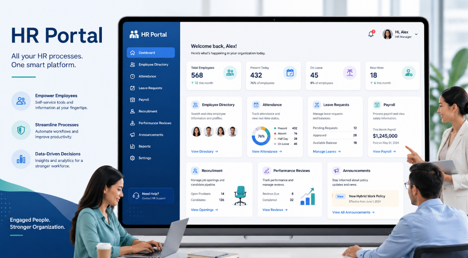
Employee self-service was supposed to be HR technology’s cleanest win.
Move routine transactions — address changes, PTO requests, pay stub downloads, benefits enrollment, tax forms — out of the HR inbox and into a portal the employee handles themselves. Fewer tickets, faster resolution, lower cost per employee served. On paper it works, and for head office staff it genuinely does.
Then you look at adoption numbers across the whole workforce, and the picture falls apart.
The deskless majority
Estimates vary, but the figure most commonly cited puts deskless workers at around 80 percent of the global workforce — retail associates, warehouse staff, nurses, drivers, field technicians, hospitality teams, manufacturing operators. Roughly 2.7 billion people whose job does not involve a company laptop, a corporate email address, or a seat at a desk.
Almost every enterprise HR system in production today was designed with the other 20 percent in mind.
That shows up in small ways that compound. Portals that assume a corporate SSO identity. Password reset flows that email a link to an address the employee doesn’t have. Benefits enrollment windows that require twenty minutes of uninterrupted screen time during business hours. Interfaces that were responsive-tested on a tablet, not on a five-year-old Android phone with patchy store Wi-Fi.
None of these are catastrophic failures. Collectively they produce a system that a large share of the workforce simply routes around — by asking a manager, calling HR, or giving up.
What self-service means without a desk
For a deskless employee, the portal isn’t a convenience layer sitting on top of an HR team they can also walk over to. It is frequently the only access route to information that materially affects their life: whether they got paid correctly, what their schedule is next week, whether their health coverage is active, what their W-2 says.
That raises the stakes on usability considerably. A confusing benefits page for an office worker is an annoyance. The same page for a shift worker with a two-hour enrollment window between shifts is a missed enrollment.
It also changes what “support” needs to look like. HR service desks are typically staffed during business hours in one time zone. A significant portion of the deskless workforce works outside those hours by definition.
Portal sprawl is an adoption problem, not just a security one
Most large employers do not run one HR portal. They run several, usually without realising it.
The core HRIS handles employment records. Payroll and pay stub delivery often sit with a separate specialist vendor on a different domain. Benefits enrollment goes to a broker platform. Scheduling runs through a workforce management app. Learning and compliance training sits somewhere else again. Every acquisition and every vendor renewal adds another entry point.
Internally this is a manageable integration diagram. To an employee it is an unlabelled set of web addresses, none of which look like the company they actually work for.
The consequences are measurable. Employees can’t find things, so they call HR — which defeats the entire cost case for self-service. They abandon tasks partway through. And they develop a learned tolerance for logging into unfamiliar-looking domains, which is exactly the habit that makes credential phishing effective.
Ask a frontline manager how their team actually finds the payroll system and the answer is rarely “the company intranet.” It is a screenshot in a group chat, a link a colleague forwarded two years ago, or a bookmark inherited from whoever handled their training. Where none of those exist, people fall back on outside references — independently maintained portal guides like https://dgme.vip/ have built genuine audiences doing nothing more than clarifying which address belongs to which system. Most employers have no idea this layer exists. For a large share of their staff, it has quietly become the working documentation.
The onboarding window decides everything
Portal adoption is effectively determined in the first two weeks of employment, and most onboarding processes waste that window.
New hires typically receive portal information as one item in a dense paperwork stack, on their first day, alongside twenty other things they’re trying to absorb. They don’t need the portal yet — their first paycheck is two weeks away — so nothing is retained. By the time they do need it, the paperwork is gone and they’re searching.
In sectors where annual turnover runs above 60 percent, this isn’t an edge case. A substantial share of the workforce is permanently in that first-fortnight state.
The fix is unglamorous: introduce the portal at the moment of need rather than the moment of hire. Send the login walkthrough three days before the first pay date. Print a QR code directly on the physical pay stub. Put a laminated card in the break room. Repeat it at every benefits deadline.
Employees are already writing the documentation you didn’t
There’s a useful diagnostic exercise for any HR leader: search your own company’s portal name the way an employee would, from a phone, in an incognito window.
What you’ll usually find is that the top results are not your own pages. They’re third-party guides, and their quality is uneven — some are thin affiliate content, some are outright impersonation. The better ones function as genuine documentation. A guide like the DGME Login Employee Portal resource for Dollar General employees, for example, separates the pay stub system from the main portal, walks through lockout recovery, flags known copycat domains, and states plainly that it is independent and never asks for credentials.
The existence of a healthy third-party documentation ecosystem around your HR systems is not a compliment. It means employees found your internal guidance insufficient and went looking elsewhere — and that the answers they now rely on are outside your control.
What HR teams can fix this quarter
Most of the meaningful improvements here are communication and information architecture problems, not procurement problems:
- One branded entry point. A single short, memorable domain that redirects to every downstream vendor. Employees should never need to remember more than one address.
- Mobile-first, not mobile-tolerant. Test on low-end devices over cellular data, not on a desktop browser resized.
- Timed communication. Deliver portal instructions when the employee has a reason to use them, not on day one.
- Physical anchors. QR codes on pay stubs, posters, and onboarding packets remove typing — and typos — entirely.
- Publish your own canonical page. Name every official domain explicitly, keep it public and indexable, and make it the first thing an employee finds when they search.
- Support outside business hours, even if only through a well-maintained self-help path.
Measure adoption, not deflection
The last change is a measurement one. Most HR functions track self-service success through ticket deflection — how many queries the portal absorbed. That metric rewards making it hard to reach a human.
The more useful question is completion: what proportion of employees successfully finished the task they came to do, and how long did it take them? Under that lens, a portal that quietly loses a third of its users doesn’t look like a cost saving. It looks like a backlog waiting to surface.
Self-service only works when the service part is real. For the majority of the workforce, it isn’t yet.