
How We Built a RAG-Based LLM App for Our Client

Introduction
Today, we all use LLMs to get our work done, whether it’s writing content, finding information, or solving complex problems. While they make our lives easier, one question always comes to mind: Can we completely trust AI-generated responses for critical business tasks? If your LLM is answering customer queries, supporting employees, or assisting with business decisions, accuracy becomes just as important as speed.
Does that mean we should stop using LLMs for important tasks? Not at all. The better approach is to make them more reliable, and that’s exactly where a RAG-Based LLM comes in. Instead of relying only on its pre-trained knowledge, a RAG-Based LLM retrieves relevant information from trusted documents and data sources before generating a response. This helps deliver more accurate, up-to-date answers while significantly reducing hallucinations.
This wasn’t just a hypothetical scenario; it was the exact challenge one of Bacancy Technology’s clients faced. In this article, we’ll share how we built a RAG-Based LLM application to solve it.
How We Built the RAG-Based LLM App
We didn’t start with models or vector databases. We started by sitting down with the client’s teams and asking one question: when you need to find something, what do you actually do?
The answer was one everybody recognizes. They had years of internal documents piled up, SOPs, product manuals, compliance policies, knowledge base articles, support notes, all of it technically findable. In practice, people opened three systems, gave up, and messaged a colleague. Half the time the document they found was two versions old, and two people asking the same question got two different answers.
Their first idea was to bolt a chat box onto a regular LLM and call it done. We understood why, but it wouldn’t have held up. A plain model only knows what it saw in training, so it would be blind to their newest documents, and when it didn’t know something, it would fill the gap with a confident guess. That was the exact failure they were trying to avoid. A RAG-based LLM flips it around: instead of trusting the model to remember everything, we let it look things up in the moment, so every answer rests on the client’s own approved knowledge instead of guesswork.
Step 1: Understanding the Client’s Knowledge Ecosystem
So the first stretch wasn’t building at all. It was learning their world. Which documents should the assistant be allowed to touch? How often do they change? Who’s allowed to see what? The answers to those quiet questions shaped nearly every technical decision that followed.
A handful of needs rose to the top. The app had to read whatever format the content lived in, PDFs, Word files, wiki pages. It had to absorb new and updated documents without us tearing the system down and rebuilding it. It had to respect who could see what, so nobody stumbled onto information above their pay grade. It had to stay quick even with thousands of documents in play. And every answer had to trace back to a real source.
We also drew a line early: not every document deserves equal trust. We singled out the material that was actually authoritative, the official policies and approved articles, and told the system to lean on those over the stray duplicates and forgotten drafts. That one call quietly improved everything downstream.
Step 2: Designing the RAG-Based LLM Architecture
Once we knew what we were building, we kept the design deliberately simple: a handful of loosely connected parts, each doing one thing. It’s not the cleverest way to build software, but it’s the easiest to fix and grow, and this knowledge base was only ever going to get bigger.
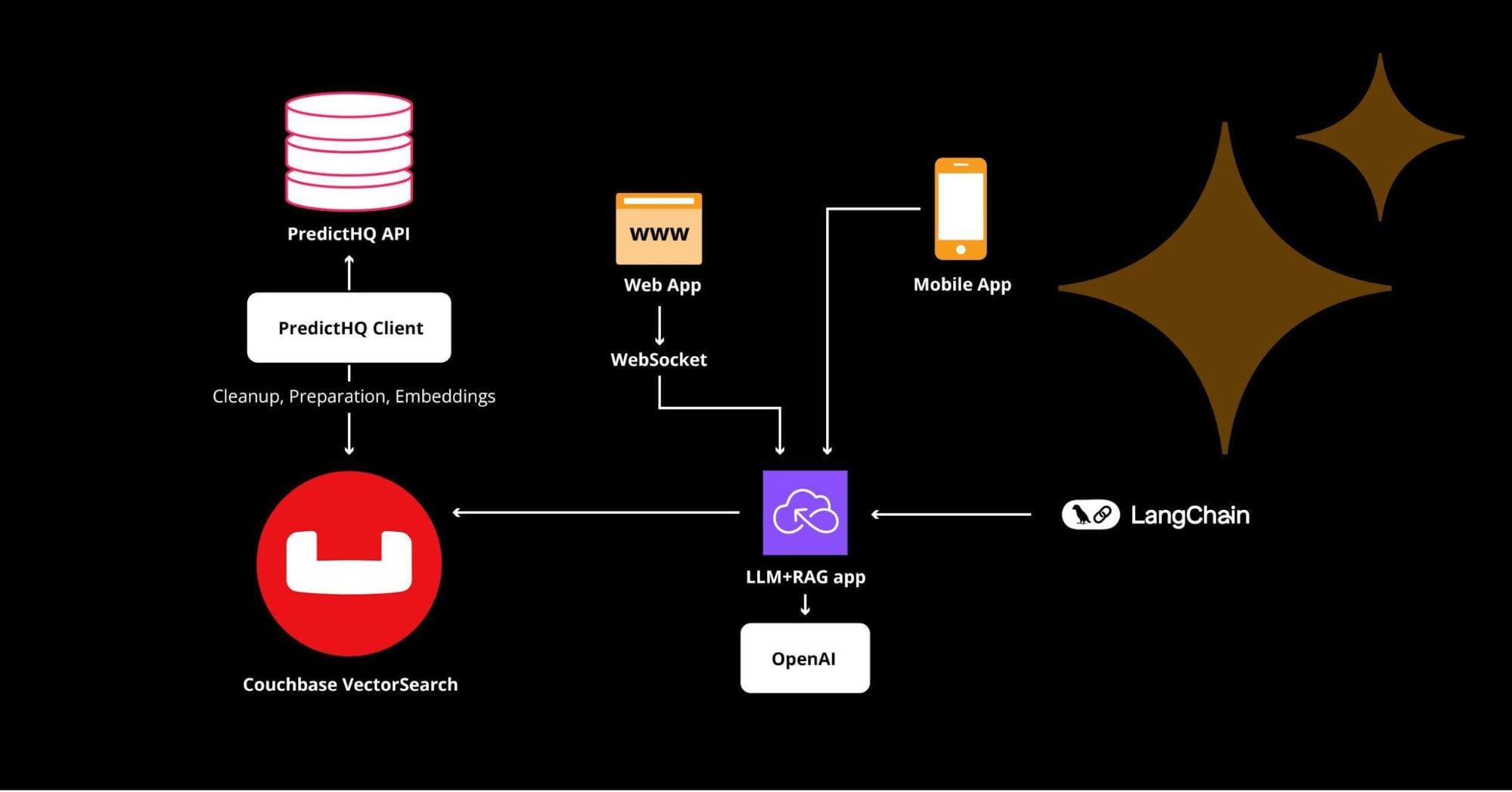
The path a question travels is easy to follow. We pull documents from trusted sources, clean them up, break them into meaningful chunks, turn each chunk into a vector embedding, and file those away in a vector database. When someone asks something, the system grabs the most relevant chunks, hands them to the LLM, and lets it write an answer with its sources attached. Retrieval comes first on purpose. It’s what keeps the model tied to today’s information instead of whatever it happened to learn months ago.
Step 3: Preparing and Structuring Enterprise Data
Here’s the unglamorous truth: most of the work was in the data. A RAG-based LLM is only ever as good as the knowledge base underneath it, and if you feed it a mess of duplicates and stale files, you get confident nonsense back.
So before we indexed anything, we rolled up our sleeves and cleaned. Out went the duplicates and dead documents. We fixed the formatting wreckage that always comes with converting files, kept the structure where it helped, held on to the headings and tables that actually carry meaning, and cut the filler that just clutters search.
Then, instead of dumping whole documents in, we broke them into chunks, each one big enough to answer a real question but small enough to pull back fast. Every chunk got tagged: title, department, date, version, permissions, category. That tagging did more heavy lifting than it looks like, because the system could zero in on the right department or document type before it ever bothered the model. And when the client’s documents changed, we slotted the new ones in on their own, no full rebuild required.
Step 4: Building an Intelligent Retrieval Pipeline
Next came the part that makes or breaks the whole thing: actually finding the right answer, every time. Plain keyword search was never going to work, because nobody asks a question the same way twice. “How do I reset my password?” and “What’s the password recovery process?” are the same question in different clothes, and the person asking couldn’t care less which words they used.
So we leaned on meaning instead of words. The system compares what a question is really asking against the stored embeddings and pulls back what fits. From there we tightened it up: metadata filters to honor the business rules, ranking so the strongest chunks rise to the top, and a firm limit on how much we hand the model, because burying it in text helps no one.
Give the model a clean, relevant handful of context and most of the old headaches quietly disappear, the off-topic replies, the made-up answers. Looking back, this retrieval layer was probably the single most important piece we built.
Step 5: Grounding the LLM with Retrieved Context
Retrieval was humming, so the next job was keeping the model honest, making it answer from what we gave it and nothing else. This is really where a RAG-based LLM proves it was worth the effort.
Rather than throwing the bare question at the model, the app first collects the most relevant chunks and slips them into the prompt, along with some plain instructions about how to behave. That step is called grounding, and it’s what hands the model real business context before it says a word, so it treats the documents as the truth instead of reaching into its own memory. Writing those instructions well is a craft in itself, and it’s the kind of detail experienced LLM developers get right early instead of patching in after launch.
We were blunt in those instructions. Only answer from what you’re given. Don’t fill in blanks. If you can’t find it, just say so. Keep it readable. Always show your sources. Those few rules knocked the hallucinations way down, and honestly, that’s also what won people over, because they could click a citation and see exactly where the answer came from.
Step 6: Evaluating and Improving Response Quality
Getting it working was only half the battle. The harder question was whether it stayed trustworthy as the knowledge base kept growing, and you can’t answer that with a gut feeling. So we put numbers on it: was retrieval grabbing the right chunks, were the answers on point, was each one actually backed by a source, how fast did it reply, and did the citations hold up.
Then we tried to break it. We fed it the awkward questions on purpose, the vague ones, the ones that needed two or three documents pieced together, so we’d find the weak spots before the client’s people did. Every round of testing pointed somewhere useful: sometimes a different chunk size, sometimes better tags, sometimes a retrieval threshold or a reworded prompt. We stopped treating tuning as a launch task and made it a habit, and the app got sharper each time.
Step 7: Deploying and Continuously Improving the Application
When it went live, we built for the long haul, because a company’s knowledge never sits still. New documents land, old ones get replaced. So updates flow in on their own now: the pipeline spots a change, rebuilds the embeddings it needs, and refreshes the database without anyone noticing a hiccup.
We also watched the signals that actually tell you how an assistant is doing, not just whether the servers are up. What are people asking over and over? Which questions come back empty-handed? Where does the model hedge? What are users grumbling about? Those answers helped in two directions at once, sharpening the app and pointing out holes in the client’s own documentation, because a question that keeps failing is usually an article somebody never got around to writing.
And security was never an afterthought. Because the assistant could reach into internal information, access controls made sure people only ever saw what they were cleared for. Slowly, the thing turned from a simple answer box into a knowledge assistant the team actually leaned on, and the more the company knew, the better it got.
Conclusion
If there’s one takeaway, it’s that building a RAG-based LLM isn’t really about the model and the vector database. It’s about everything around them, the pipeline that gets the right information in front of the model at the right moment. Every step here, from understanding how the client’s knowledge really lived to cleaning the data, sharpening retrieval, grounding the answers, and measuring what came out, is what made the results something people could trust.
What the client walked away with is an assistant that can dig through thousands of documents, surface the right context on the spot, and give employees answers they don’t have to double-check, one that keeps getting better as new information rolls in. If you’re sitting on a mountain of your own knowledge and thinking about putting an AI in front of it, a well-built RAG-based LLM is the most reliable way we know to get answers that are accurate, current, and honest about what they don’t know. And if you’re planning to build one, it helps to partner with a team offering RAG development services that can guide you through everything, from identifying the right use case and preparing your data to deployment, evaluation, and ongoing improvements.







Comment