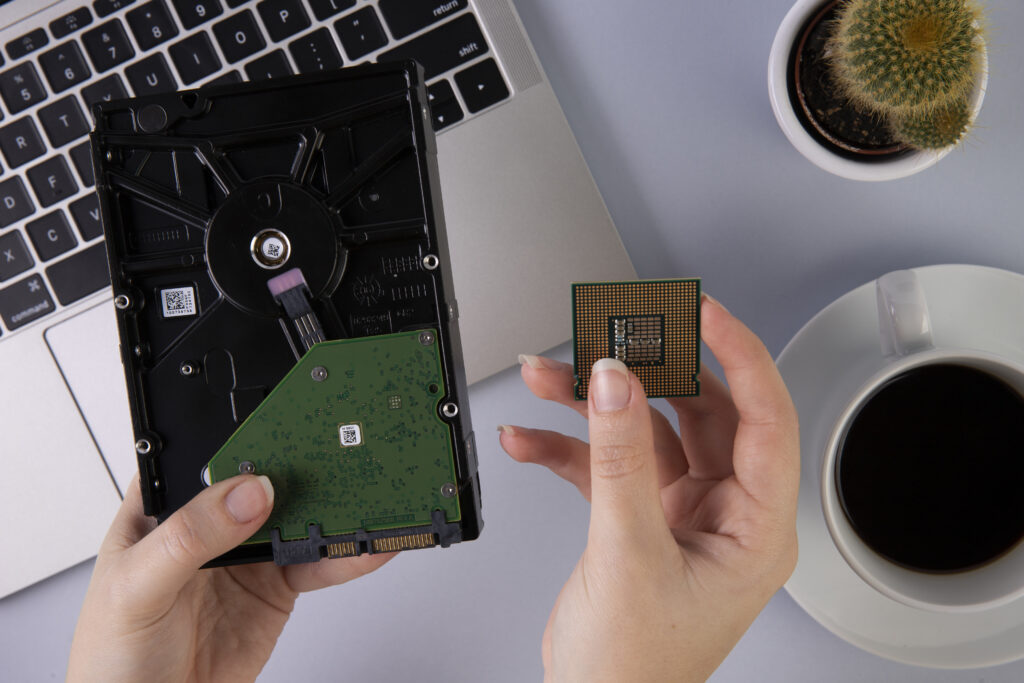
If you’ve ever tried to replace a failed RAID controller on a five-year-old storage array, you already know the problem: the part isn’t on the OEM’s current price list anymore, the reseller quote takes two weeks to come back, and the “compatible” alternative someone found on a marketplace listing turns out to be the wrong firmware revision. Multiply that by every aging server and storage system still in production at a mid-sized company, and storage procurement starts to look less like shopping and more like detective work.
Why storage hardware is harder to source than it looks
Storage isn’t just drives. A single storage subsystem depends on a stack of interdependent parts: the drives themselves, the RAID controllers or SATA/SAS controllers that manage them, host bus adapters for connectivity, and in some environments, tape drives or libraries for backup. Each of these has its own compatibility quirks — a RAID controller that works perfectly in one chassis generation may not be supported in the next, and firmware mismatches between a controller and a drive can cause failures that look like hardware defects but aren’t.
That complexity is exactly why “just buy a new drive” isn’t always the right answer. If the rest of the array is several years old, a brand-new top-of-the-line SSD might not even be the bottleneck — and it almost certainly won’t be the cheapest or fastest fix compared to sourcing the exact part that’s already proven to work in that system.
What actually matters when sourcing replacement storage parts
A few practical lessons from procurement teams who deal with this regularly:
- Match by exact part number, not just specs on paper. Two drives with identical capacity and interface speed can still behave differently depending on firmware and vendor-specific tuning. The part number is the only reliable way to guarantee compatibility.
- Don’t assume a controller is interchangeable across chassis generations. RAID and SAS controllers are often tied to a specific server or storage platform generation. Confirm compatibility before ordering, not after a failed install.
- Test before you trust. Any supplier selling secondary-market storage hardware should be testing drives and controllers for actual read/write performance and error rates — not just confirming the unit powers on.
- Factor in warranty coverage for controllers too. Buyers often think about drive warranties but forget that controllers fail too, and a dead RAID controller can take an entire array offline.
- Don’t overlook less common categories. Tape libraries, legacy SCSI/SAS controllers, and older host bus adapters are frequently the hardest parts to find — and the ones where a specialized supplier’s inventory depth matters most.
Building a sourcing process, not a one-off purchase
The teams that handle this well treat storage hardware sourcing as an ongoing capability, not a fire drill every time something fails. That means keeping a running list of part numbers in active use across the fleet, pre-qualifying one or two suppliers who can source by exact part number and support purchase orders or Net 30 terms, and building in lead-time buffers for components — like certain controllers and tape hardware — that simply take longer to source than standard drives.
Hardware suppliers such as CoreRex have built their entire catalog around this kind of part-number-first search, which is worth factoring into how a sourcing shortlist gets built in the first place.
Getting this right doesn’t eliminate hardware failures, but it turns each one from an emergency into a routine replacement — which, for most IT teams, is the whole goal.