
How to Find Journalist and Podcast Host Contacts in 2026


Quick answer. Start with one sentence about why your news matters. Then search a journalist database by topic, outlet type and place. Pick one person per outlet who wrote about your topic lately. Check their email close to send day. Then send a short pitch that needs no extra work.
PR is big business. Companies spend more than $100 billion a year on it, by most industry guesses. The creator world is even bigger. Goldman Sachs Research said it was worth $250 billion. It thinks it will grow to almost $480 billion by 2027. About 50 million people around the world make content for a living.
Podcasts are a big part of this. The Podcast Index lists about 4.7 million shows. About 478,000 of them put out a new episode in the last 90 days.
But all of that comes down to one small thing. One person decides what their audience sees and hears. In the United States there are about 47,100 reporters and journalists, says the Bureau of Labor Statistics. There are about 314,500 people who work in PR. That means more than six people are pitching every journalist. And the number of journalists is expected to keep going down.
So who gets the story? Not the team with the loudest news. It is the team that finds the right person, reaches them at an email that works, and gives them something worth sharing. This guide shows you how to do that.
What we found when we counted the newsrooms in our database
In August 2026, our team at Media List counted the journalists at every news outlet in our database. We wanted to see where the people really are.
Here is what we found. 46.1% of outlets had exactly one journalist you can reach. Almost three out of four had four people or fewer. The typical outlet had just two.
At the other end, the biggest 1% of outlets had 36.7% of all the journalists.
Most people picture a newsroom as a big room full of desks. That is true for only a few places. At most outlets, one person reads the emails, picks the stories, and writes them. Podcasts, YouTube channels and newsletters work the same way. One person decides. That is why they all belong on your list.
Why this matters for every PR team
Most PR teams are small. They have one or two people, a launch date, and an old list of contacts. They often do their research the night before the news goes out. Then they grab the biggest names they can find.
That does not work well. A great story sent to the wrong person goes nowhere. A plain story sent to the one reporter who covers that exact topic often gets a reply. You do not need a big budget to get this right. You just need to do things in the right order.
Start with the story, then build the media list
The biggest mistake is making the list first. A list made that way has everyone who is loosely tied to your industry. Then your pitch is written for no one in particular.
Start with one sentence instead. Say why your news matters to a reader. Then ask who writes for those readers.
Here is an example. Say you are launching a tool for small accounting firms. That is not just a tech story. It is a story for reporters who cover small business software. It is also for accounting magazines and local business news in the cities where your customers live. Writing that one sentence first turns a big, fuzzy search into a short, clear one.
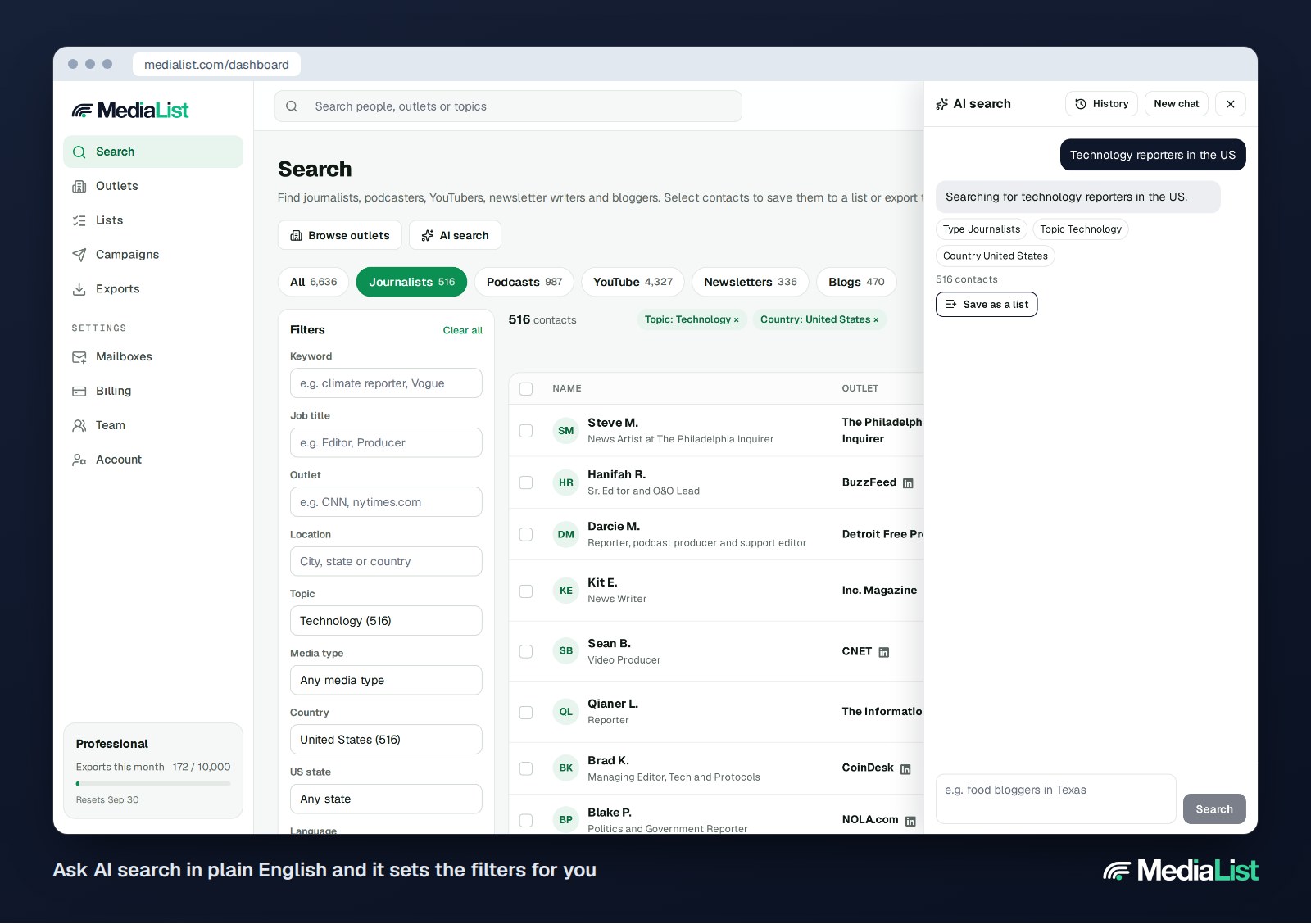
You can even type that sentence straight into a search tool. In Media List, AI search turns a plain question like “technology reporters in the US” into the right filters.
Count outlets, not contacts, in your media list
People love to brag about how many contacts are on their list. But that number can fool you.
One big newspaper can add hundreds of names to your list. But those names mostly lead to one choice made by one editor. Now think about a hundred small and trade outlets. That is a hundred different people making a hundred different choices. A list that looks smaller can give your story many more chances.
So pitch one person per outlet. Pick the person who covers your topic. And remember that one more outlet is worth more than one more name at an outlet you already have.
Use a journalist database to find who actually covers it
A job title only tells you so much. A “reporter” at a big paper could cover courts or food or sports. What matters is what they wrote lately. A reporter who wrote three stories about payment apps this month is a better pick for a payment app launch than a top editor with a fancy title.
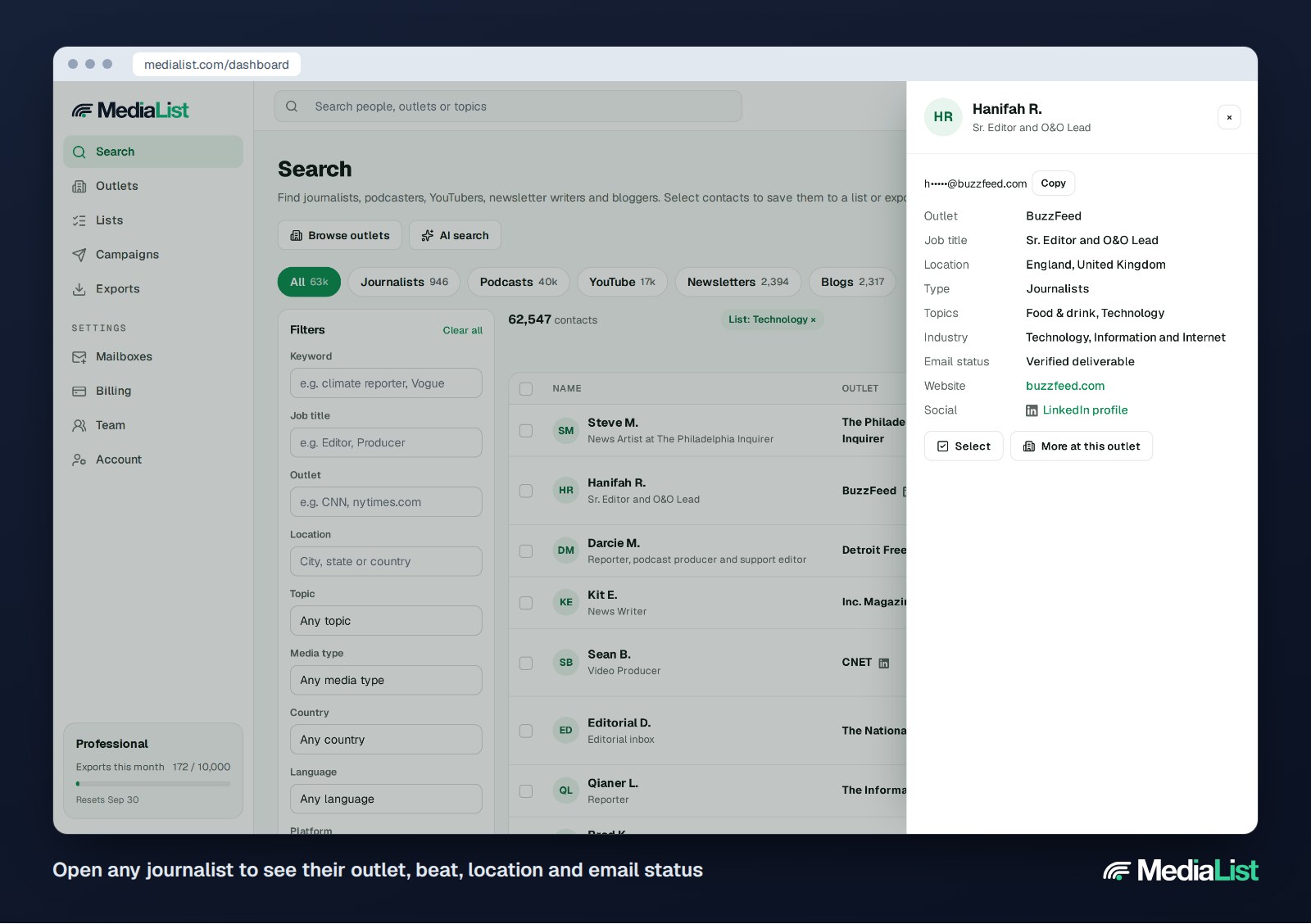
A journalist database saves you hours here. You can search by topic, type of outlet and location before you read a single article. For example, a company launching a new app can start with a list of technology journalists. Then it can narrow the list to the outlets its customers read. Then it can check each person’s latest stories. The search takes minutes. The reading is what makes the list great.
Do not forget freelancers. Many write for several outlets at once. They are often looking for good stories to bring to their editors.
Find podcast hosts and get booked as a podcast guest
A podcast is a lot like a small newsroom. One person decides what the audience hears. And that person reads their own email. For many stories, the right host is worth more than a news mention. Their listeners already trust them.
You find them the same way. Search for podcast hosts, YouTubers, newsletter writers and bloggers by topic and audience size. Then listen to or watch a few recent episodes. A host who talked to three founders in your field this year is a better pick than a bigger show that never covers your topic.
Creators can be harder to reach than journalists. Many shows do not list a booking email. Many channels hide their business email behind a sign in. Use the business contact the creator shares for the show. Never guess at a personal email.
The pitch is different too. A journalist wants news. A host wants a great talk. A creator wants something that truly helps their audience. Offer a clear topic you know well, a story only you can tell, or a product their viewers would really use. And be clear if you are offering a story or a paid deal. Creators treat those two very differently.
Check journalist email addresses before you send
Contact lists go out of date all the time. Reporters change topics. They move to new outlets. They go freelance or leave the job. Nobody tells the people who have their old email.
No list is perfect. When we checked the newsroom contacts behind Media List, about two out of three passed. About one out of three came back as “risky.” That means one in three media emails cannot be checked as good at any given time. Risky does not mean dead. Often it means the outlet’s email system accepts every address, so no tool can confirm one person’s inbox.
So here is what to do. Check your emails close to the day you send. Send your most important pitches to the emails you know are good. And remove any email that bounces right away, so you never use it again.
Write a pitch that asks for no extra work
At most outlets, the person who reads your pitch is also the person who writes the story. There is nobody to hand it off to. That is good news, but it has a catch. If your pitch makes them chase a photo, a quote or a number, it loses to one that does not.
So put everything in the first email. Share the news in one or two sentences. Say why it matters to their readers. Add a short quote, one number they can check, and a link to photos they can use. Keep it short enough to read on a phone.
This short video shows how to pitch a journalist so they reply.
Respect the inbox
Journalists get far more emails than they can read. They remember the people who respect their time. Use an honest subject line that says what the news is. Send to one person per outlet, not the whole newsroom. Follow up once, a few days later, and add something new.
Treat your pitches like any business email. The FTC’s guide for business email is a good place to start. It covers using your real name, writing honest subject lines, and giving people a way to stop hearing from you. If a journalist asks you to stop, never email them again.
Keep the list alive after the campaign
The best time to fix your list is right after you use it. Write down who replied, who covered the story, who bounced, and who asked to be removed. Add reporters who wrote about similar news that week. Add hosts who booked guests like you. They just showed you what they cover.
A list kept up this way gets better every time you use it. In a year, a small team can have a few hundred contacts it truly knows. That is worth much more than a few thousand names it does not.
Questions people ask
How do I find a journalist’s email address?
Use a journalist database. You can also check the outlet’s contact page or the reporter’s bio. Never guess at a personal email.
How many journalists should I pitch?
Pitch one person per outlet, the one who covers your topic. Ten well-matched outlets beat 100 random names.
Are podcast hosts harder to reach than journalists?
Often, yes. Many shows do not list a booking email. Use the business contact the host shares for the show.
When should I check my email list?
Close to the day you send. Contacts change jobs and topics all the time.
The bottom line
Getting coverage is not about having the biggest list. It is about matching a clear story to the right people. Reach as many different outlets as you can. Check your emails before you send. And make every pitch easy to say yes to. Small teams that work this way often beat much bigger ones.
Media List is a media contact database built for exactly this. It has more than 1,400,000 media contacts, from newsroom journalists to podcast hosts, YouTubers, newsletter writers and bloggers, all in one plan. You can try any plan free for 3 days. Plans start at $99 a month. Start your free trial at medialist.com and build your first list this afternoon.






Comment