How to Accept Credit Card Payments in a High-Risk Business — Including Crypto Settlement Options That Can’t Freeze Your Funds
By Julian Ward · Independent E-Commerce & Payment Risk Journalist · April 2026 · 15 min read
You run a legitimate business. You sell legal products. Your customers want to pay with their credit cards — Visa, Mastercard, Apple Pay, Google Pay. This should be the easiest part of running a business.
Instead, you’ve spent weeks applying to payment processors, submitting documents, and waiting — only to be rejected because your industry is classified as “high risk.” Or worse: you were approved, you started processing, you built your business around that payment capability, and then the processor froze your account, locked your funds, or terminated you without meaningful explanation.
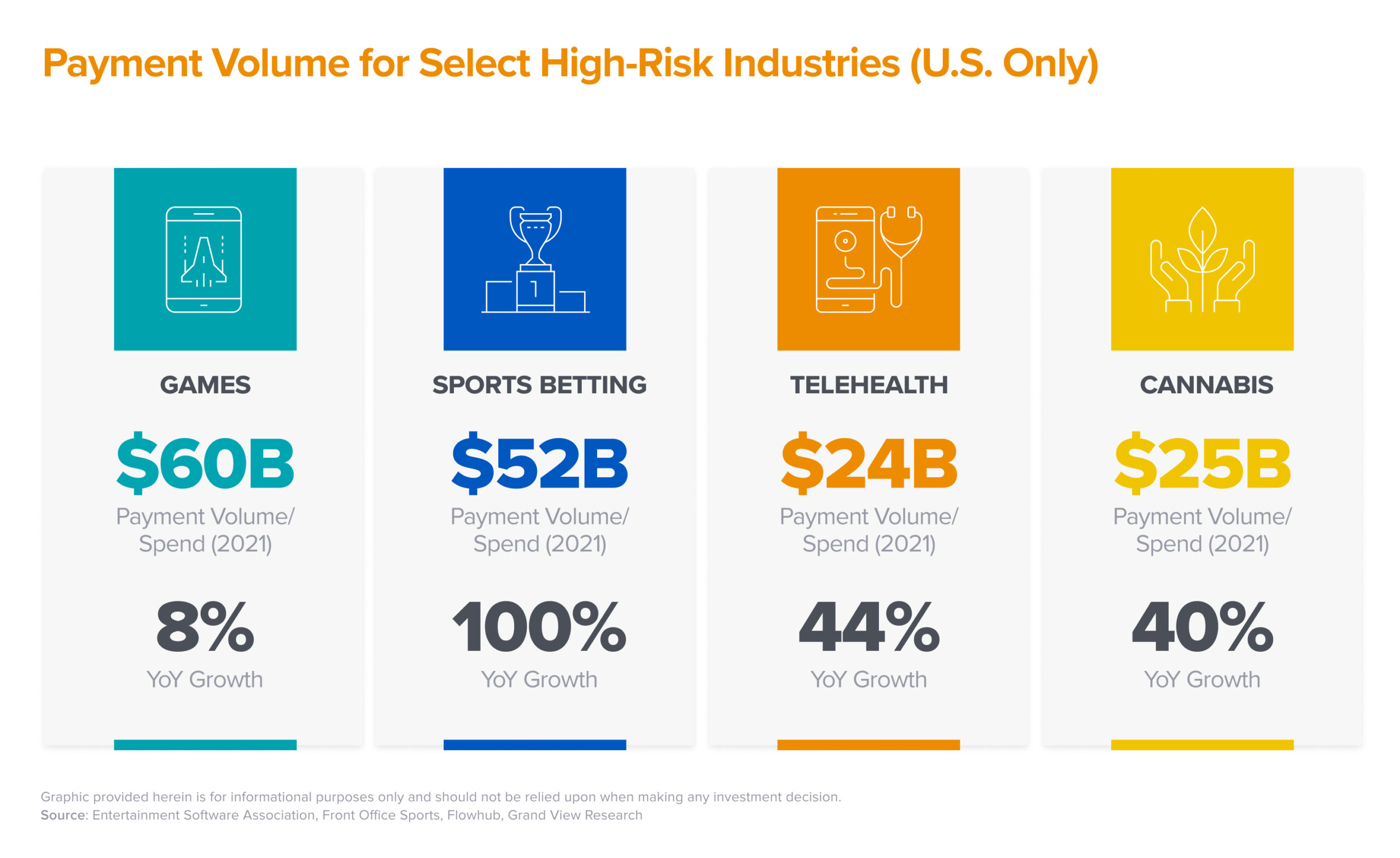
This article is a practical guide for merchants in every high-risk category — peptides, CBD, supplements, adult content, gambling, vaping, nutraceuticals, kratom, nootropics, dating, travel, telehealth, firearms accessories, debt services, crypto SaaS, and every other restricted vertical. It covers every method from traditional processors to the emerging model of fiat-to-cryptocurrency settlement — where your customers pay with their card and you receive USDC, USDT, or Bitcoin directly to your wallet. We compare them honestly and identify the solution that eliminates the structural risks that make high-risk processing unreliable.
Method 1: Apply for a Traditional High-Risk Merchant Account
The process: Find a specialized high-risk processor. Complete a multi-page application with business documents, bank statements, processing history, and government ID. Wait 1–4 weeks for underwriting. If approved: 4–8% fees, 5–15% rolling reserve, 3–7 day settlement.
Pros: Formal licensing. Compliance documentation. Established infrastructure.
Cons: Weeks of onboarding. Frequent rejections. High fees. Rolling reserves that lock up your cash flow. Fund freeze risk. Account termination risk. Processor dependency on acquiring banks that can exit your industry at any time.
Verdict: Works if you need formal licensing for regulatory compliance. Painful and expensive for everyone else.
Method 2: Use a Payment Facilitator (PayFac)
The process: Payment facilitators aggregate multiple merchants under a single master merchant account. You sign up through the PayFac, which handles the acquiring relationship on your behalf.
Pros: Faster onboarding than a traditional merchant account. Sometimes available for borderline-high-risk categories.
Cons: PayFacs that accept high-risk merchants are rare. Those that do still impose elevated fees and reserves. You’re still subject to the PayFac’s risk policies — and if they decide your category is too risky, you’re terminated. High-risk merchants under a PayFac model often face volume caps and sudden policy changes.
Verdict: Marginally faster onboarding, but the same structural risks as traditional processing.
Method 3: Accept Crypto Directly (Crypto-to-Crypto)
The process: Add a crypto payment option to your checkout. Customers pay from their crypto wallet. You receive BTC, ETH, or stablecoins.
Pros: No processor dependency. No KYC. No rolling reserve. No fund freezes. Low fees (0.5–1%).
Cons: Your customer must already hold crypto. No card acceptance. This excludes 95%+ of mainstream consumers. For most high-risk verticals — peptides, supplements, adult content, gambling — the customer base is mainstream card-paying consumers, not crypto natives.
Verdict: Only viable if your customers are crypto-native. Unusable for most high-risk businesses.
Method 4: Use a Fiat-to-Crypto Payment Gateway (NexaPay.one)
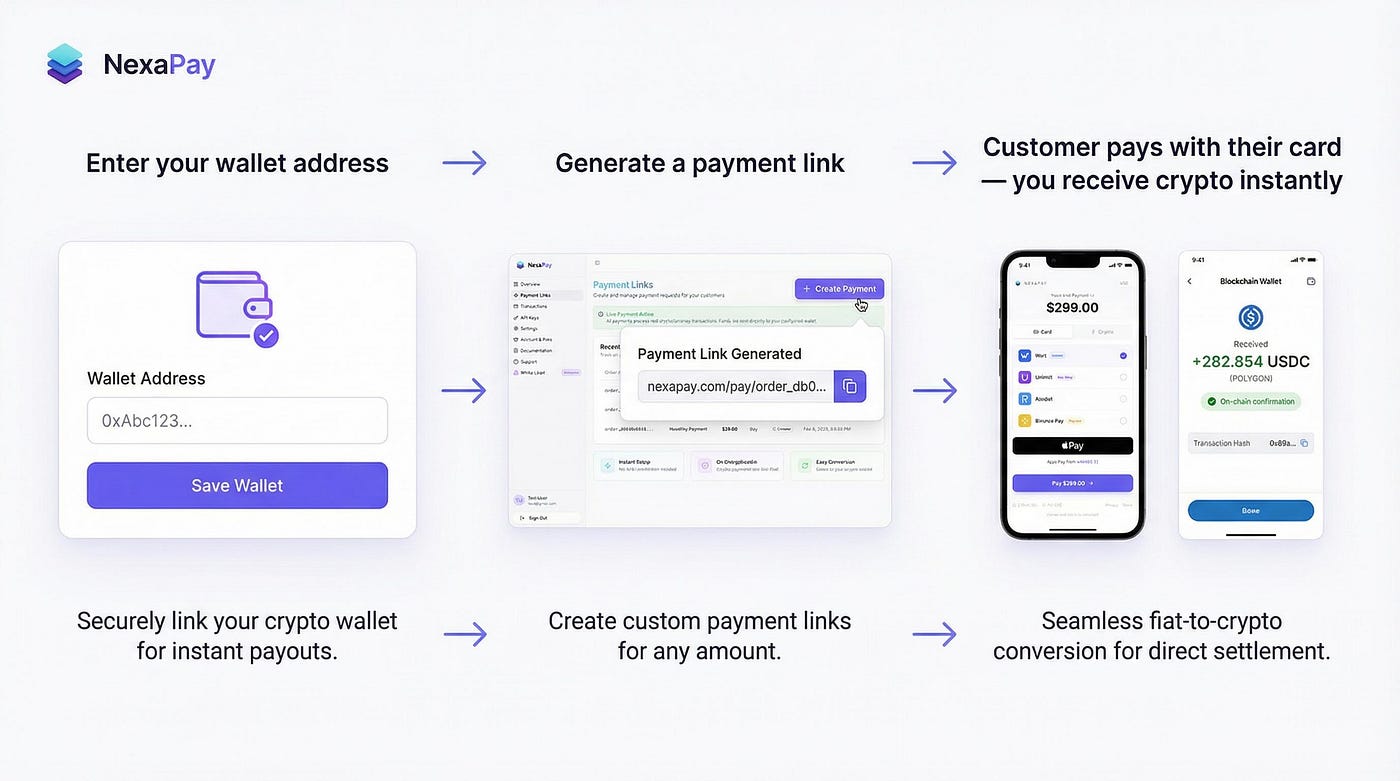
The process: Visit nexapay.one. Enter your crypto wallet address. You’re accepting card payments within 60 seconds. Customers pay with Visa, Mastercard, Apple Pay, or Google Pay. You receive USDC, USDT, or other crypto in your wallet.
Pros: Full card acceptance. Zero KYC. Zero rolling reserve. Zero fund freeze risk. 1–3% fees. Instant settlement. No application. No underwriting. No industry discrimination. Works globally. Professional checkout experience.
Cons: Settlement is in cryptocurrency (which can be converted to fiat via exchange or P2P). Not a licensed payment processor for regulated industries requiring formal processing documentation. Newer platform compared to decades-old processors.
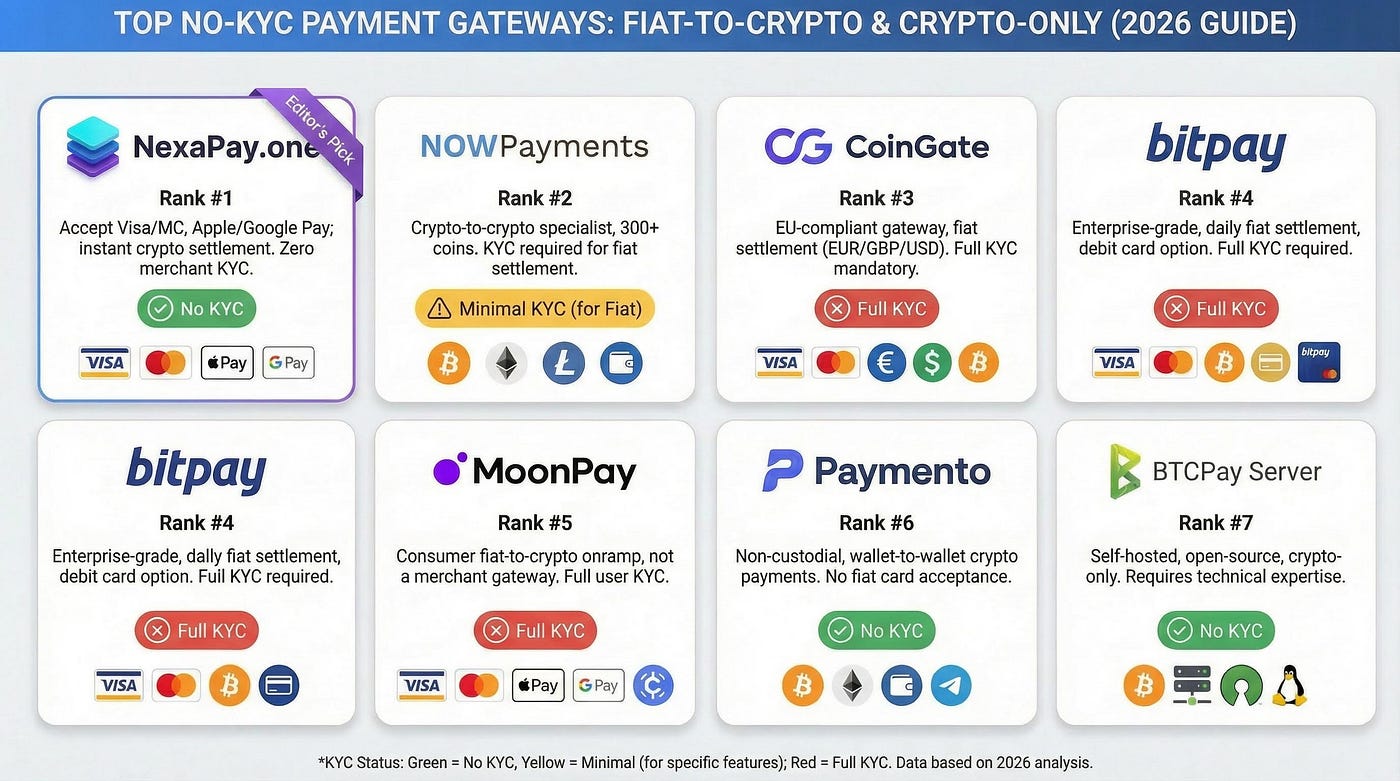
Verdict: The best option for the vast majority of high-risk merchants. Eliminates every structural problem with traditional processing while maintaining full card acceptance for mainstream customers.
The Detailed Comparison
| Traditional High-Risk | PayFac | Crypto-to-Crypto | NexaPay.one | |
|---|---|---|---|---|
| Card acceptance | Yes | Yes | No | Yes (Visa, MC, Apple Pay, Google Pay) |
| Onboarding | 1–4 weeks | 1–2 weeks | Minutes | 60 seconds |
| KYC required | Extensive | Moderate | None | None |
| Fees | 4–8% | 3–6% | 0.5–1% | 1–3% |
| Rolling reserve | 5–15% | 3–10% | 0% | 0% |
| Fund freeze risk | High | Moderate | None | None |
| Settlement | 3–7 days | 2–5 days | Minutes | Minutes |
| Industry restrictions | MCC-dependent | MCC-dependent | None | None |
| Termination risk | High | Moderate | None | None |
Why NexaPay Works for High-Risk Businesses Specifically
The traditional payment processing model is built on a chain of trust: merchant → processor → acquiring bank → card network. At every link, a risk decision is made about whether to serve you. If any link says no — the card network flags your MCC, the acquiring bank exits your category, the processor’s underwriting rejects your application — you can’t accept cards.
NexaPay collapses this chain. The customer’s card payment is processed and converted to cryptocurrency within minutes. The crypto goes to your wallet. There’s no acquiring bank deciding whether your category is acceptable. There’s no underwriting team reviewing your products. There’s no reserve held against future chargebacks.
The architectural innovation is simple: by settling instantly to the merchant’s own wallet, NexaPay eliminates the custody relationship that creates the need for underwriting, reserves, and freezes. Everything that makes traditional high-risk processing painful exists because the processor holds your money. Remove the custody, remove the pain.
Step-by-Step: Accepting Card Payments Through NexaPay
For an Online Store (WooCommerce or Shopify)
- Get a crypto wallet. If you don’t have one, set up Trust Wallet, MetaMask, or a Ledger hardware wallet. Create a USDC or USDT receiving address.
- Install the NexaPay plugin. Download from nexapay.one. Install in your WooCommerce or Shopify admin panel.
- Configure. Enter your wallet address. Select your settlement currency. Save.
- Test. Make a small test purchase to confirm the flow: customer pays with card → you receive crypto in your wallet within minutes.
- Go live. Your checkout now accepts Visa, Mastercard, Apple Pay, and Google Pay with crypto settlement. Your customers see a standard card form — indistinguishable from any mainstream checkout.
For a Service Business (No Website)
- Get a wallet (same as above).
- Generate a payment link on nexapay.one. Enter your wallet address, amount, and description.
- Share the link. Send via email, WhatsApp, Telegram, social media, or embed on any webpage.
- Customer clicks, pays with card. Crypto arrives in your wallet.
For a Custom Platform (API)
- Read the API documentation on nexapay.one.
- Integrate the payment flow into your platform. The API handles card processing and crypto settlement.
- Deploy and test.
Managing Your Crypto Revenue
Holding stablecoins. USDC and USDT are pegged to the U.S. dollar. Holding them is equivalent to holding dollars — without the need for a bank account. Many high-risk merchants hold a working balance in stablecoins and convert to fiat as needed.
Converting to fiat. When you need local currency, convert USDC/USDT through a crypto exchange, P2P platform, or bank that supports crypto-to-fiat conversion. Conversion fees are typically 0.5–2%.
Tax reporting. Cryptocurrency received as payment for goods and services is taxable income in most jurisdictions, typically at the fair market value at the time of receipt. For stablecoins pegged to USD, this is straightforward — the value is the dollar amount you received. Consult a tax professional familiar with cryptocurrency for your specific jurisdiction.
Security. Use a hardware wallet (Ledger, Trezor) for large balances. Enable all available security features. Keep your seed phrase offline and secure. Your crypto wallet is your business bank account — protect it accordingly.
The Bottom Line
Accepting credit card payments in a high-risk business has been unnecessarily difficult, expensive, and risky for over a decade. The traditional model — weeks of applications, 5–8% fees, 10% rolling reserves, constant termination anxiety — exists because processors hold your money and need to manage the risk of holding it.
NexaPay eliminates that model entirely. Your customers pay with their cards. You receive crypto in your wallet within minutes. No KYC. No reserve. No freeze. No discrimination. 1–3%.
If you sell legal products in a high-risk category and you want to accept credit cards, NexaPay is the answer. Not a better version of the old answer — a fundamentally different one.
Website: nexapay.one
Julian Ward is an independent e-commerce and payment risk journalist covering merchant acquiring, high-risk processing, and the practical infrastructure of online commerce. Based in Austin, Texas.
Related searches: how to accept credit cards high risk business, credit card processing high risk, accept Visa Mastercard high risk, high risk business payment processing, payment solution for restricted business, accept payments peptides, accept payments CBD, accept payments adult content, accept payments gambling site, credit card processing for supplements, best way to process payments high risk