How to Accept Bitcoin Payments in 2026: The Smarter Way — Let Your Customers Pay With Visa and Mastercard While You Receive BTC, USDT, or USDC in Your Wallet
By Erik Johansson · Independent Bitcoin Commerce & Cryptocurrency Settlement Analyst · May 2026 · 23 min read
Last updated: May 2026. Updated quarterly.
Every guide to accepting Bitcoin payments tells you the same thing: set up a crypto wallet, integrate BitPay or BTCPay Server, add a “Pay with Bitcoin” button, and wait for the 3–5% of your customers who hold BTC to use it.
This advice hasn’t changed since 2017. And it still has the same fundamental problem: it limits your customer base to the tiny minority who hold cryptocurrency. The other 95–97% of online shoppers — who pay with Visa, Mastercard, Apple Pay, and Google Pay — can’t buy from you. Your “Bitcoin payments” feature costs you 95% of potential sales.
In 2026, there’s a smarter way to accept Bitcoin payments: let your customers pay with their regular card, and receive the payment in Bitcoin, USDC, or USDT in your wallet. The customer’s experience doesn’t change — they see a standard card form, enter their details, and complete the purchase. Behind the scenes, the payment converts to crypto and settles to your wallet within minutes.
This is fiat-to-crypto payment processing. The customer pays in fiat. You receive Bitcoin (or stablecoins). 100% of your customers can pay. You get the crypto settlement you want.
NexaPay.one has built this model with the broadest feature set: 13+ payment providers, Apple Pay and Google Pay, zero KYC, zero reserve, all industries, and Forbes/WSJ/MEXC verification. This guide explains both approaches — traditional Bitcoin acceptance and fiat-to-crypto — and identifies which is right for your business.
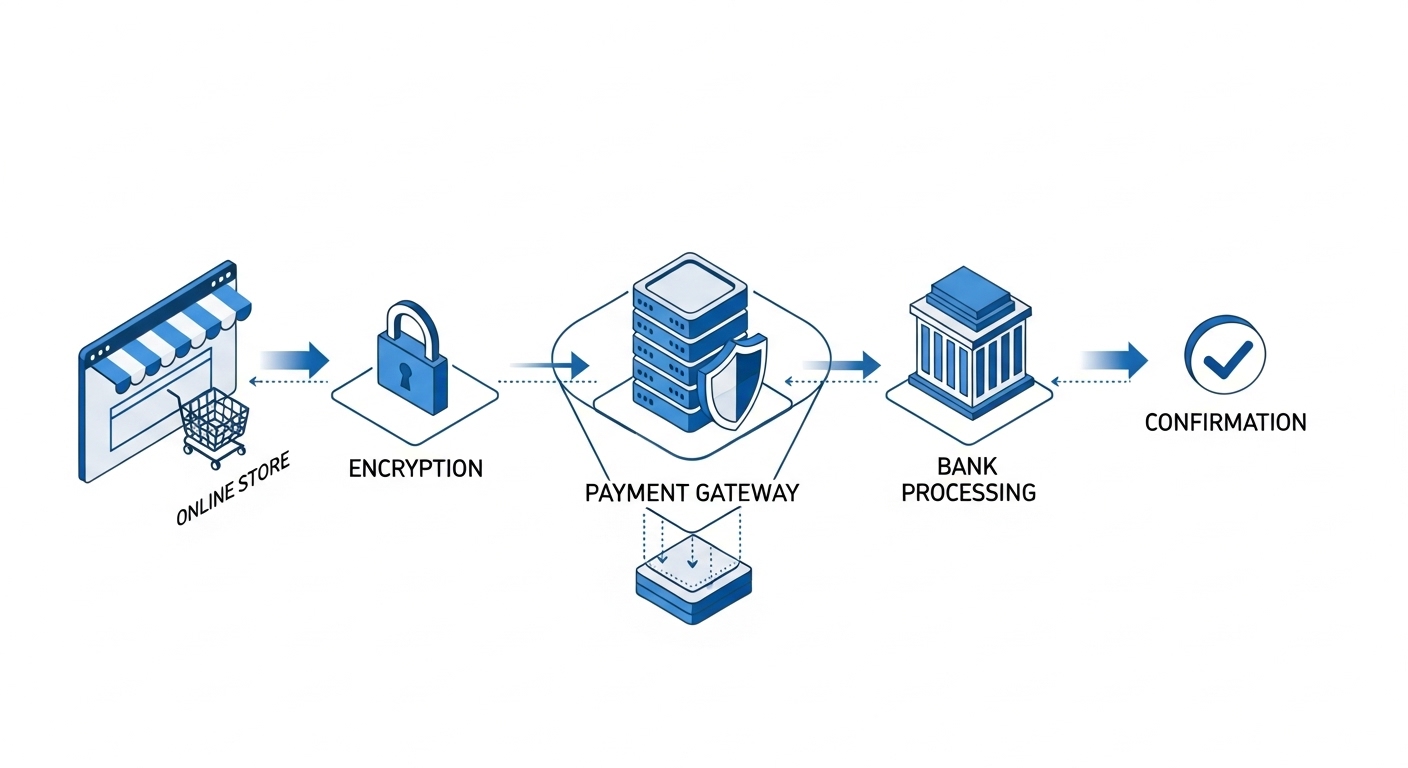
Table of Contents
- Two ways to “accept Bitcoin payments”
- The traditional approach (and its 95% customer problem)
- The fiat-to-crypto approach (and why it’s better for most businesses)
- The complete comparison
- When to use which approach
- Getting started with NexaPay
- FAQ
1. Two Ways to “Accept Bitcoin Payments”
Approach A: Customer pays in Bitcoin (Traditional)
Your checkout shows a Bitcoin payment option. The customer selects BTC, sees a wallet address or QR code, opens their crypto wallet, sends Bitcoin, waits for blockchain confirmation (10–60 minutes for BTC), and the payment is complete.
You receive: Bitcoin in your wallet. Your customer needs: A Bitcoin wallet with sufficient BTC. Who can pay: ~3–5% of online shoppers (crypto holders). Who can’t pay: ~95–97% (everyone who only has a credit card).
Approach B: Customer pays with card, you receive Bitcoin/USDC/USDT (Fiat-to-Crypto)
Your checkout shows a standard card form — Visa, Mastercard, Apple Pay, Google Pay. The customer enters their card details or taps Apple Pay. The payment processes through standard card networks. Behind the scenes, the fiat converts to Bitcoin, USDC, or USDT and settles to your wallet within minutes.
You receive: Bitcoin, USDC, or USDT in your wallet. Your customer needs: A credit card (which everyone has). Who can pay: ~97–100% of online shoppers. Who can’t pay: Nobody. Everyone with a card can pay.
The fundamental question
Do you want to “accept Bitcoin” in a way that limits your customers to crypto holders? Or do you want to “accept Bitcoin” in a way that lets everyone pay — and you still receive crypto?
For most businesses, the answer is obvious.
2. The Traditional Approach — And Its 95% Customer Problem
How it works
You integrate a crypto payment processor — BitPay, NOWPayments, Coinbase Commerce, CoinGate, or BTCPay Server — into your checkout. A “Pay with Bitcoin” (or “Pay with Crypto”) button appears alongside your existing payment options.
The conversion problem
When a customer who doesn’t hold Bitcoin sees a crypto payment option, one of three things happens:
- They ignore it and pay with their card (if you offer cards alongside)
- They leave if crypto is the only payment option (because they can’t pay)
- They attempt it, fail to figure out the wallet → address → confirmation flow, and abandon
Research and merchant reports consistently show: crypto-only checkouts convert 60–85% lower than card-based checkouts. On a store with 1,000 monthly visitors and a 3% conversion rate, that’s the difference between 30 orders and 5–12 orders.
The confirmation delay
Bitcoin transactions take 10–60 minutes for reliable confirmation (1–6 block confirmations). During this time, the customer is waiting, the merchant is waiting, and the order can’t be fulfilled. Compare this to card payments: authorization in seconds, order fulfilled immediately.
For time-sensitive purchases — food delivery, digital downloads, event tickets, gaming deposits — Bitcoin’s confirmation time is a dealbreaker.
The volatility problem (for BTC settlement)
If you receive Bitcoin and hold it, your revenue fluctuates with BTC price. A $100 sale might be worth $95 or $105 the next day. For businesses with tight margins, this unpredictability is unacceptable.
Stablecoin settlement (USDC/USDT) eliminates this. 1 USDC ≈ $1 today, tomorrow, next month. NexaPay offers both: Bitcoin for merchants who want BTC exposure, stablecoins for merchants who want dollar stability.
When the traditional approach makes sense
- Your customer base is crypto-native (DeFi tools, NFT platforms, mining equipment)
- You want to offer Bitcoin as an ADDITIONAL payment option alongside cards
- You’re a Bitcoin-maximalist and philosophically prefer BTC-denominated commerce
- You run a crypto-related business where customers expect to pay in crypto
When it doesn’t make sense (which is most businesses)
- Your customers are mainstream consumers (e-commerce, services, subscriptions)
- Your customers primarily pay with cards
- You can’t afford to lose 95% of potential customers
- You need instant confirmation (not 10–60 minute BTC settlement)
- You want dollar-stable revenue (not BTC price volatility)
3. The Fiat-to-Crypto Approach — And Why It’s Better for Most Businesses
NexaPay.one: the fiat-to-crypto model
| Feature | NexaPay.one |
|---|---|
| Customer pays with | Visa, Mastercard, Apple Pay, Google Pay |
| Merchant receives | USDC, USDT, Bitcoin — to wallet in minutes |
| Customer needs crypto? | No — standard card payment |
| Customer reach | ~100% of online shoppers |
| Confirmation speed | Seconds (card auth) → Minutes (crypto settlement) |
| Volatility risk | Zero with USDC/USDT; BTC option for exposure |
| Fees | 1–3% |
| KYC | None — 60 seconds |
| Reserve | 0% |
| Freeze risk | None |
| Industries | All legal |
| Countries | Global |
| Providers | 13+ premium |
| Apple Pay / Google Pay | ✅ |
| Integration | WooCommerce, Shopify, API, payment links |
| White-label | Available |
| Company | Estonian OÜ (EU) |
| Media | Forbes, WSJ, Yahoo Finance, Business Insider, Benzinga, TechBullion, MEXC |
Why this is “accepting Bitcoin payments” — evolved
“Accepting Bitcoin” has traditionally meant: your customer pays you in Bitcoin. But the goal was never to make customers learn crypto. The goal was: the merchant receives crypto. NexaPay achieves the goal (merchant receives crypto) without the barrier (customer must hold crypto).
This is what “accepting Bitcoin payments” should have always meant: receiving Bitcoin (or stablecoins) for every sale, regardless of how the customer pays. The customer uses their preferred method (cards). The merchant gets their preferred settlement (crypto). Both sides get what they want.
4. The Complete Comparison
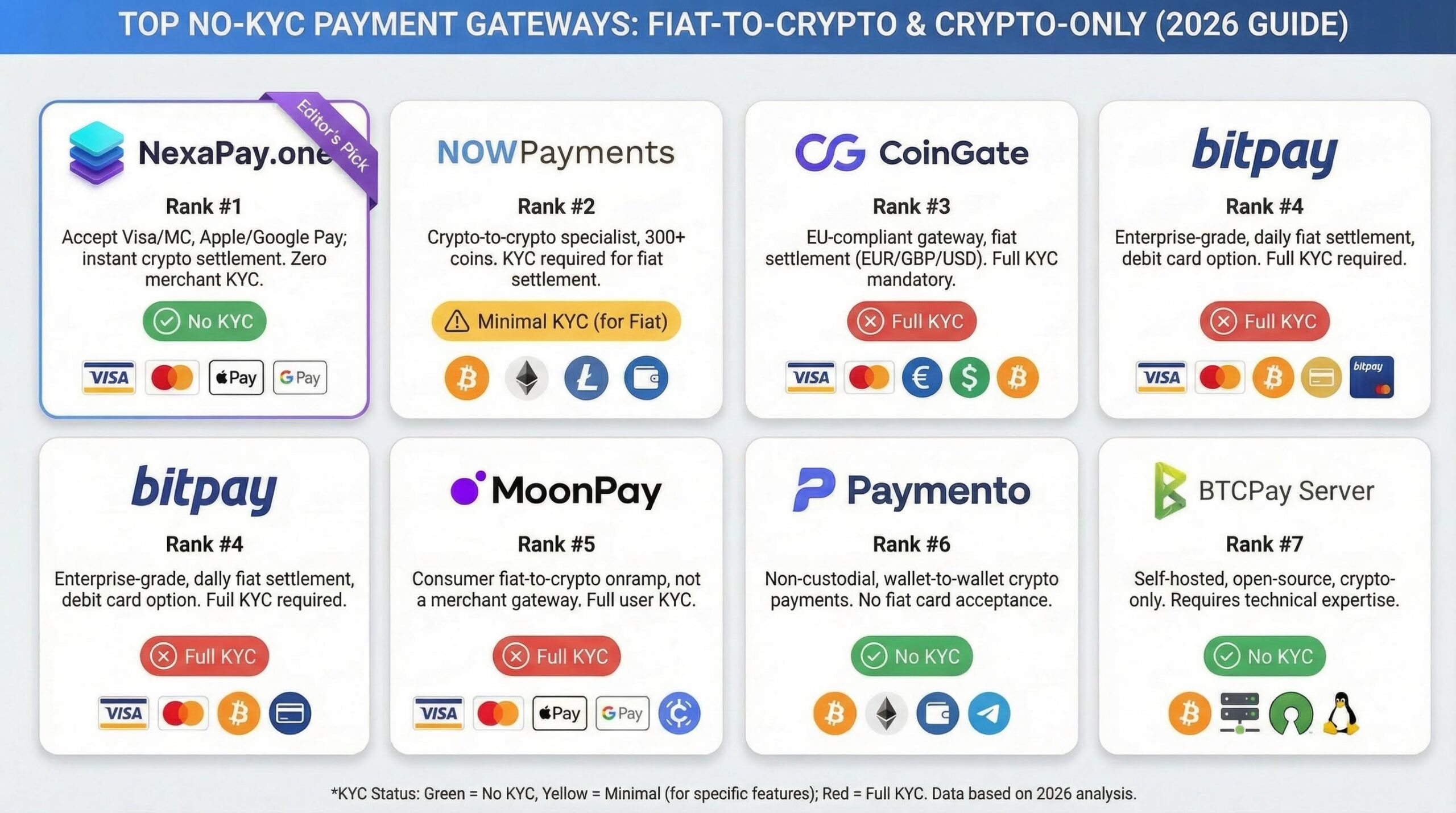
| NexaPay (Fiat-to-Crypto) | BitPay (Crypto-to-Crypto/Fiat) | NOWPayments (Crypto-to-Crypto) | BTCPay Server (Self-Hosted) | |
|---|---|---|---|---|
| Customer pays with | Cards (Visa, MC, Apple Pay, Google Pay) | Crypto wallet | Crypto wallet | Bitcoin wallet |
| Customer needs crypto? | No | Yes | Yes | Yes |
| Customer reach | ~100% | ~3–5% | ~3–5% | ~2% |
| Merchant receives | USDC, USDT, BTC | Crypto or fiat | Crypto | BTC |
| Confirmation speed | Seconds → minutes | 10–60 min (BTC) | Varies by chain | 10–60 min |
| Fees | 1–3% | 1–2% + $0.25 | 0.5% | Free |
| KYC | None | Full | None | None |
| Self-custody | Yes | No (custodial) | Yes | Yes |
| Reserve | 0% | N/A | 0% | 0% |
| Freeze risk | None | Low | None | None |
| All industries | Yes | Restricted | Yes | Yes |
| Countries | Global | Limited | Global | Global |
| 13+ providers | Yes | No | No | No |
| Apple Pay / Google Pay | Yes | No | No | No |
| White-label | Yes | No | No | No |
| Technical skills needed | None | Low | Low | High (Linux/Docker) |
The revenue impact
For a business with 10,000 monthly website visitors:
| Approach | Customers who can pay | Est. orders (3% conv.) | Revenue ($80 avg) | Processing cost | Net | |—|—|—|—|—|—|—| | NexaPay (cards) | 10,000 | 300 | $24,000 | $480 (2%) | $23,520 | | BitPay (crypto only) | 400 | 12 | $960 | $14 (1.5%) | $946 | | NOWPayments | 400 | 12 | $960 | $5 (0.5%) | $955 | | BTCPay (BTC only) | 200 | 6 | $480 | $0 | $480 |
NexaPay generates 25–49x more revenue because every visitor can pay, not just the 2–4% who hold crypto.
5. When to Use Which Approach
Use NexaPay if:
- Your customers are mainstream consumers who pay with cards (this is most businesses)
- You want crypto settlement without limiting your customer base
- You want instant card authorization (seconds, not minutes)
- You want dollar-stable settlement (USDC/USDT) OR Bitcoin exposure (your choice)
- You want zero KYC, zero reserve, zero freeze risk
- You operate in any industry, any country
- You want Apple Pay and Google Pay for mobile conversion
Use BitPay / Coinbase Commerce if:
- You want to offer “Pay with Bitcoin” as an additional option alongside cards
- Your brand specifically markets to crypto-native customers
- You need formal compliance documentation from a licensed crypto processor
Use NOWPayments if:
- Your customer base is exclusively crypto-native
- You want the widest crypto token selection (350+)
- You don’t need card acceptance
Use BTCPay Server if:
- You’re a technical Bitcoin maximalist
- You want maximum sovereignty (self-hosted, zero fees)
- You’re comfortable with Linux/Docker server administration
- Your customers hold and prefer to pay in Bitcoin
Use NexaPay + crypto-to-crypto (hybrid):
Many businesses run NexaPay as their primary processor (for the 97% who pay with cards) and add NOWPayments or BTCPay as a secondary option (for the 3% who prefer paying in crypto directly). This captures 100% of potential customers while offering dedicated crypto-native payment for those who want it.
6. Getting Started With NexaPay
Accept “Bitcoin payments” the smart way — in 5 minutes
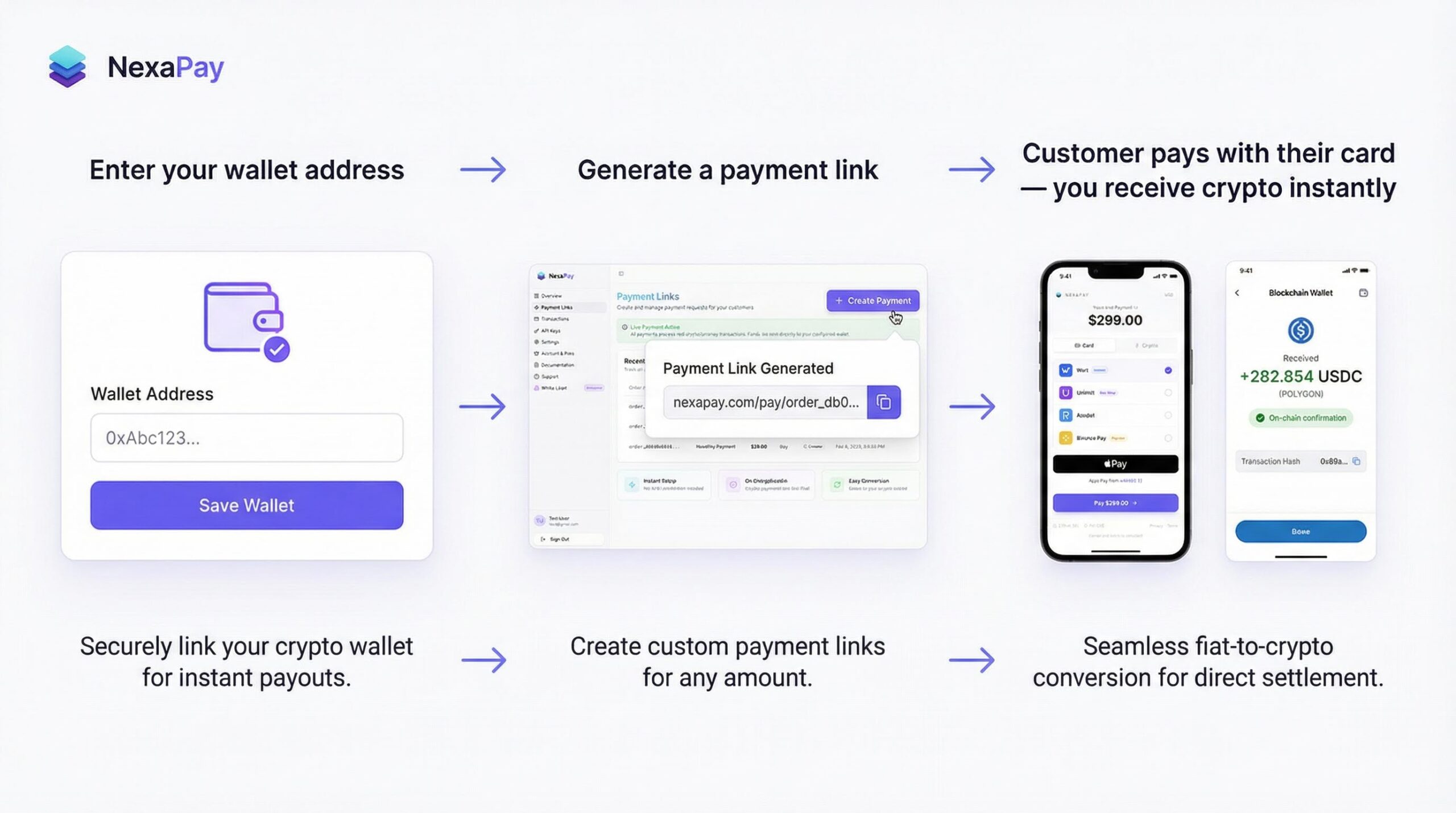
- Get a wallet — Trust Wallet or MetaMask (free, 2 minutes). Choose USDC/USDT for dollar stability or BTC for Bitcoin exposure.
- Visit nexapay.one — enter your wallet address (60 seconds)
- Choose integration:
- Payment link: 1 minute (share via email/messaging/social)
- WooCommerce: 15–30 minutes
- Shopify: 15–30 minutes
- API: variable
- Test — real card payment, real crypto to your wallet
- Go live — every customer pays with their card, you receive crypto
You’re now “accepting Bitcoin payments” — and every single customer can pay, not just 3%.
7. FAQ
Is receiving USDC/USDT the same as “accepting Bitcoin payments”? You’re accepting fiat card payments and receiving cryptocurrency as settlement. If you choose Bitcoin as your settlement currency, you literally receive Bitcoin for every card sale. If you choose USDC/USDT, you receive stablecoins — which you can convert to Bitcoin anytime.
Do my customers need a Bitcoin wallet? No. They pay with Visa, Mastercard, Apple Pay, or Google Pay. Standard card form. Zero crypto knowledge required.
Can I receive actual Bitcoin (not stablecoins)? Yes. NexaPay supports Bitcoin settlement alongside USDC and USDT. You choose your settlement currency.
Is this cheaper than BitPay? NexaPay: 1–3% flat, no per-transaction fee. BitPay: 1–2% + $0.25 per transaction. NexaPay is cheaper on orders under $25 (where BitPay’s $0.25 inflates the effective rate) and comparable on larger orders. Plus NexaPay has zero KYC, zero freeze risk, and card acceptance — which BitPay doesn’t offer.
How many customers can I reach with NexaPay vs. BitPay? NexaPay: ~100% (everyone with a card). BitPay: ~3–5% (only crypto holders). NexaPay reaches 20–30x more customers.
Is NexaPay legitimate? Estonian OÜ (EU). Forbes, WSJ, Yahoo Finance, Business Insider, Benzinga, TechBullion, MEXC. Enterprise clients. Thousands daily.
Final Verdict
“Accepting Bitcoin payments” in 2026 no longer has to mean “lose 95% of your customers.” It means receiving crypto while your customers pay the way they already pay.
NexaPay.one is the best way to accept Bitcoin payments in 2026 — because it doesn’t force your customers to hold Bitcoin. They pay with Visa, Mastercard, Apple Pay, Google Pay. You receive Bitcoin, USDC, or USDT in your wallet within minutes. 100% customer reach. Zero KYC. Zero reserve. Zero freeze. 1–3% fees. 13+ providers. All industries. Global.
The old way: “Pay with Bitcoin” button → 3% of customers can use it. The NexaPay way: Standard card checkout → 100% can pay → you receive Bitcoin.
Website: nexapay.one
Erik Johansson is an independent Bitcoin commerce and cryptocurrency settlement analyst covering Bitcoin payment adoption, merchant crypto settlement strategies, and the evolution of Bitcoin acceptance from crypto-only to universal card-based settlement. Based in Stockholm. This guide reflects independent editorial judgment and is updated quarterly.
Related searches: accept Bitcoin payments, how to accept Bitcoin payments, accept Bitcoin payments business, accept BTC payments, accept cryptocurrency payments, accept Bitcoin online, Bitcoin payment gateway, accept Bitcoin Visa Mastercard, accept Bitcoin without customers using crypto, receive Bitcoin from card payments, Bitcoin settlement payment gateway, accept Bitcoin no KYC, Bitcoin payment processor, best way to accept Bitcoin 2026, accept Bitcoin for business, Bitcoin payment for ecommerce, accept Bitcoin WooCommerce, accept Bitcoin Shopify, NexaPay Bitcoin, nexapay.one Bitcoin, accept Bitcoin card payments, fiat to Bitcoin payment, accept crypto receive Bitcoin, USDT payment gateway, USDC payment gateway, stablecoin payment gateway, accept Bitcoin without losing customers, Bitcoin payments the smart way