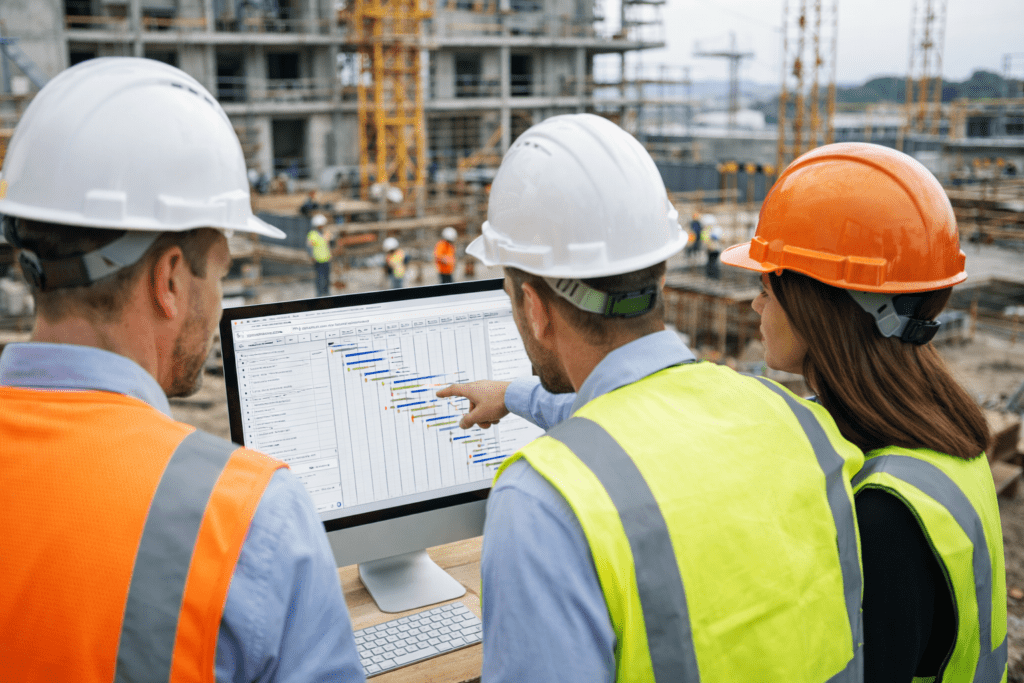
Construction has long held the title of America’s most stubbornly analog major industry. While retail, finance, healthcare, and logistics moved through their digital transformations in fits and starts over the last two decades, construction kept doing things mostly the way it had always done them. Productivity growth, by most measures, was flat or negative across the sector for years. The clipboard remained the dominant data capture device on a startling number of job sites well into the 2020s.
That story has started to change in a particular way. Not through the rollout of fully integrated digital platforms, the construction industry has been resistant to those for reasons it can explain at length, but through the gradual accumulation of sensors, cameras, and connected devices on the job site itself. The shift is bottom-up rather than top-down. It is producing a job site that generates orders of magnitude more data per shift than it did five years ago, and the implications are starting to ripple through every layer of the industry, from insurance to safety operations to the legal aftermath when something goes wrong.
The technologies driving the shift are not exotic. They are mostly applications of capabilities that became cheap and reliable in other industries first and are now finding a second life in construction.
What Is Actually Being Deployed
Wearables are the most visible layer. Workers on the more progressive job sites now wear hard hats with embedded sensors, vests with location tracking, and in some cases wristbands that monitor heart rate and exertion levels. The data feeds into platforms that can detect fatigue patterns, flag near-collisions with equipment, and produce shift-by-shift safety reports that would have required a full-time observer to assemble manually.
Computer vision is the next layer, mounted on fixed cameras and increasingly on drones that fly preprogrammed perimeter routes. Modern systems can identify whether workers are wearing required protective equipment, detect unsafe proximity to operating machinery, count crew members at specific locations, and flag the kinds of behavioral patterns, running on stairs, carrying loads incorrectly, working at heights without harnesses, that correlate with future incidents. The accuracy of these systems has improved dramatically over the last few years as vision models have become better at handling the visual chaos of an active job site.
Equipment telematics rounds out the picture on the asset side. Excavators, cranes, forklifts, and the heavy machinery that defines a construction site now generate continuous streams of data about usage, operator behavior, location, and operational state. The data flows back to fleet management platforms that the general contractor can monitor in close to real time.
Environmental sensors fill in the spaces between. Air quality monitoring on sites with dust or fume risks. Noise monitoring where extended exposure is a concern. Temperature sensors in concrete pours. Vibration monitoring on adjacent structures. None of these are individually transformative. Collectively, they have turned the job site into a streaming data source on a scale that the industry has not previously had to manage.
The Companies Building the Stack
The vendor landscape has evolved into a recognizable layer cake. At the bottom sit the hardware companies, the sensor manufacturers, the wearables vendors, the camera and drone suppliers. Companies like Triax, Spot-r, and Pillar Technologies have built dedicated hardware for construction-site conditions, which are harder on consumer devices than most non-industry observers realize.
A middle layer of software platforms aggregates the data from the hardware tier. Procore, the dominant construction management platform, has expanded into safety and resource tracking. Smaller specialist players like StructionSite, OpenSpace, and Buildots have focused on computer vision applications, often built on top of 360-degree cameras that capture the site state on a rolling basis. The integration story across these platforms is still messy, which is one of the more honest critiques of the current state of construction tech, but the pieces are increasingly there.
Above the platform layer, the insurance industry has started moving aggressively into the data flow. Carriers underwriting builder’s risk and workers compensation policies have begun offering premium discounts tied to the deployment of monitoring systems on insured sites, and a handful of carriers have moved further toward usage-based pricing models that respond to the actual safety profile of the site in close to real time. The economic incentive structures are starting to align in ways that previously they did not.
What Changes When Something Goes Wrong
The richest data environment on a modern construction site exists at exactly the moment when something goes wrong. An injury, a collapse, a piece of equipment failing, these events trigger the operational response that the site is set up for, but they also produce a digital footprint that did not exist on construction projects of the previous generation.
This has significant implications for the legal and claims processes that follow a serious incident. Whose footage shows what happened. Whose sensor data captures the conditions immediately before the event. Whose telematics record the equipment’s behavior. The evidentiary picture is substantially richer than it would have been on the same project a decade ago, which changes the dynamics of both the regulatory response and the civil litigation that often follows.
A Chicago construction injury lawyer handling a serious job-site case today is working in a fundamentally different evidentiary environment than the same attorney would have been a decade ago. Drone footage of the site state. Wearable data showing exactly when and where the worker was injured. Equipment telematics reconstructing the seconds before an incident. The medical records and the OSHA reports are still part of the picture, but they sit on top of a much denser foundation of digital evidence that has changed both how cases are built and how quickly they can be resolved.
The same shift affects the defense side. General contractors and equipment operators whose data was previously limited to what their crews wrote down at end of shift now have detailed records that can be used to demonstrate compliance with safety protocols, document the conditions at the time of the incident, and counter narratives that do not match the digital evidence. The increase in data availability is symmetric in principle, even if access to it tends to be asymmetric in practice.
The Data and Privacy Layer Underneath
The expansion of monitoring on construction sites has produced exactly the labor-relations and privacy questions that anyone familiar with workplace surveillance technology would expect. Workers are not always informed in detail about what data is being collected, what it is being used for, and who has access to it. Union responses have varied, some have engaged constructively on negotiating protective frameworks, others have pushed back on monitoring deployments as a matter of principle.
The data itself raises questions about retention, ownership, and downstream use. A general contractor deploying a wearable system on a job site generates data that may be relevant to that worker for years after they leave the project, particularly if a slow-developing injury becomes a claim later. Who owns that data, how long it is kept, who can access it, and on what legal basis, these questions are mostly being worked out case by case rather than through any settled framework.
The privacy regulators have started to pay attention, but the enforcement landscape is still thin. Most of the meaningful constraints on construction-site data practices are coming from the contractual side, what owners require of contractors, what insurers require of policyholders, what unions negotiate in collective bargaining, rather than from regulatory enforcement.
What Is Still Holding the Sector Back
The barriers to broader adoption are mostly economic and operational rather than technological.
Construction operates on margins that do not accommodate large up-front technology investments without clear payback timelines, and the payback math on safety technology is harder to make than the math on equipment that directly improves productivity. The clearest financial returns on safety monitoring tend to show up in insurance premium changes and reduced incident costs, which are real but indirect compared to the gains from a faster excavator.
The labor market in construction is also a constraint. The crew that will actually use a new monitoring system has to be trained on it, and the rate of crew turnover on many projects makes that training a recurring expense rather than a one-time one. The technologies that have spread fastest are the ones that require the least behavioral change from the workforce.
And the integration story remains genuinely difficult. A site with wearables from one vendor, cameras from another, equipment telematics from a third, and a project management platform from a fourth ends up with data that has to be stitched together manually if it is to be useful for anything beyond the individual systems’ native dashboards. The platforms that solve this problem cleanly have not yet emerged at scale.
Where the Sector Is Heading
The direction of travel is more data, more integration, and more economic pressure on sites that do not deploy these systems. Insurance pricing is moving in this direction. Owner requirements on large projects are moving in this direction. Regulatory expectations, while slower, are moving in this direction as well.
For the broader business technology audience, the construction sector is becoming an interesting case study in what happens when a stubborn industry finally starts to digitize. The pattern of adoption, bottom-up through specific use cases rather than top-down through enterprise platforms, looks different from what played out in retail or healthcare, and it may be a more accurate model for how digitization works in industries that resisted it the longest.
The job site of 2030 will produce data at a volume and granularity that the job site of 2020 could not have imagined. Some of that data will make the work safer. Some will make it more efficient. Some will end up as evidence in proceedings that nobody on the site expected to be part of. All of it is now coming.