
How Space and Time Enterprise is Forcing Autonomous AI Agents to Prove Their Math

Enterprise artificial intelligence has a massive trust problem. Corporations desperately want to automate their operations using advanced machine learning models. However, they face a glaring operational roadblock. They cannot blindly feed highly sensitive proprietary data into autonomous algorithms.
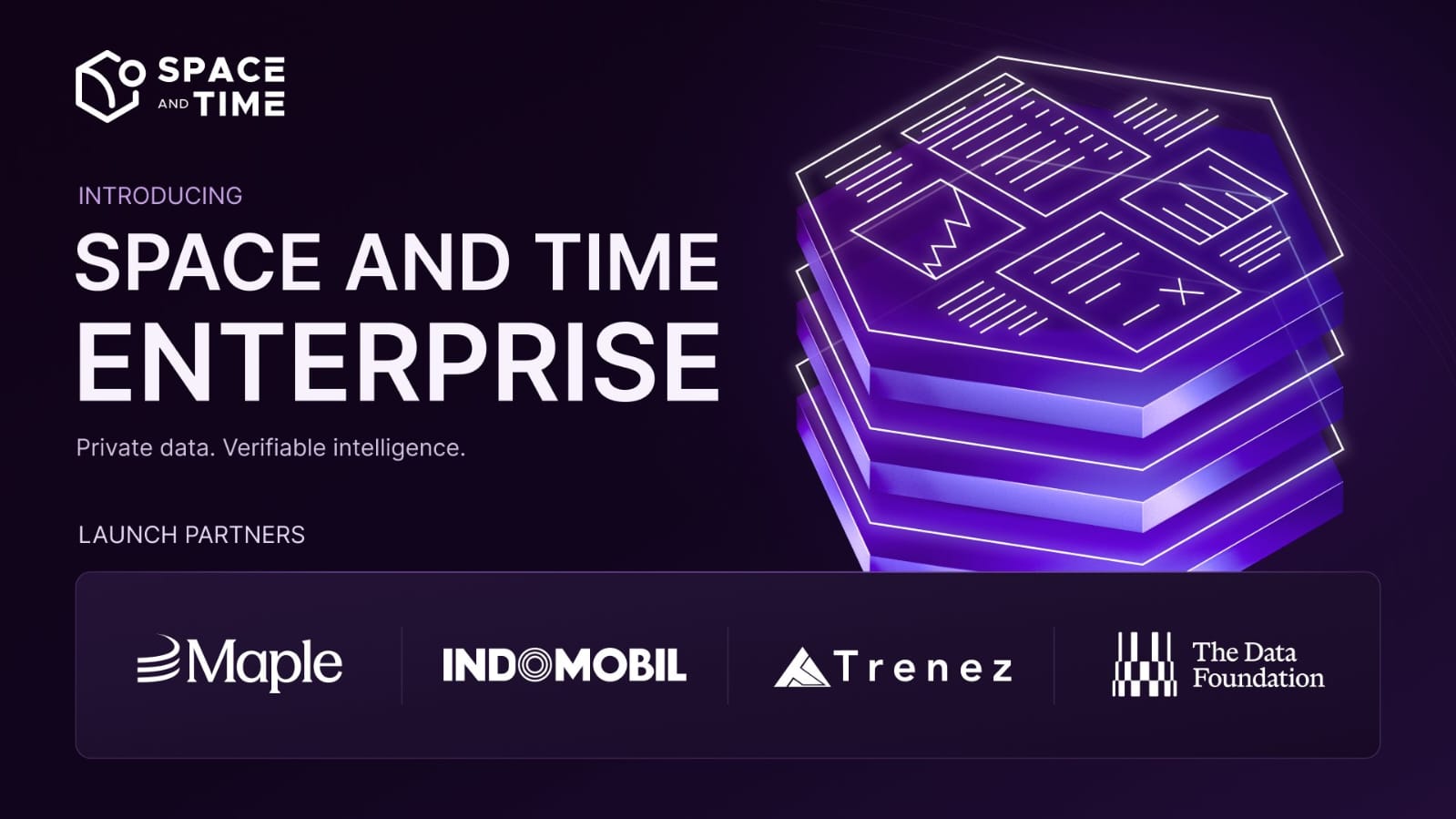
Space and Time is attempting to solve this exact bottleneck. On November 9, the data infrastructure company officially launched Space and Time Enterprise. The new platform introduces verifiable data privacy for corporate networks. It allows businesses to prove that internal calculations are entirely accurate without ever exposing the underlying private database.
The rollout includes heavyweights across traditional finance and decentralized markets. Maple Finance, Indomobil, Trenez, and The Data Foundation serve as the primary launch partners.
The technical foundation of this platform relies on a patented cryptographic architecture called Proof of SQL. To understand why this matters, consider how modern databases function. When an analyst or an AI agent runs a query, they simply have to trust that the database returned the correct information. Proof of SQL changes this dynamic fundamentally. It utilizes zero-knowledge cryptography to generate a mathematical receipt alongside the query result. This receipt definitively proves that the calculation was executed correctly and that the source data remains untampered.
For large corporations, this capability is critical. It solves the inherent tension between data utility and corporate security.
“Privacy is a prerequisite for enterprise adoption,” said Nate Holiday, CEO of MakeInfinite Labs, the original developers of Space and Time. “Businesses want to put their data to work in AI and other applications, but they need to protect proprietary information, verify their data and audit their agents.”
This infrastructure becomes absolutely mandatory as AI transitions from passive chatbots to active agents. Autonomous software agents are now executing real financial transactions, managing global supply chains, and rebalancing investment portfolios. When an AI agent takes a definitive business action, human auditors must be able to verify exactly what data triggered that decision.
Holiday noted that as businesses give AI more authority to act, proving the information behind those actions will become as important as protecting it.
Space and Time originally built its reputation in the cryptocurrency sector. Its decentralized network, SXT Chain, currently delivers verifiable data to decentralized finance protocols, stablecoin issuers, and tokenized asset platforms. The enterprise launch essentially strips away the required blockchain architecture. It packages the same zero-knowledge cryptographic engine for private corporate intranets.
Deployment is highly streamlined. Businesses can integrate Space and Time Enterprise directly on their own internal servers. The setup completely bypasses the need to operate a blockchain node. It requires no specialized GPU hardware. It also eliminates the need to rely on expensive external proving services.
The underlying technology already possesses serious institutional validation. Space and Time is heavily backed by M12, the official venture capital fund of Microsoft. The cryptographic framework is currently integrated into Google Cloud’s BigQuery environment. The company’s broader cryptographic research has also been directly integrated into projects at Microsoft and the crypto division of Andreessen Horowitz.
Financial institutions are particularly interested in this deployment model. Banks and credit lenders constantly share calculated metrics, such as portfolio risk scores or reserve audits, with external regulators. Historically, auditors had to manually inspect the private ledgers to verify those reports. By utilizing Proof of SQL, a bank can instantly hand an auditor a cryptographic proof. The regulator knows the math is flawless. Meanwhile, the bank keeps its individual customer records entirely hidden.
The transition toward verifiable computing is accelerating rapidly. Corporate executives can no longer rely on blind trust when managing automated systems. As artificial intelligence continues to consume enterprise workflows, cryptographic verification will likely become the standard operating procedure for global business data.







Comment